
Introduction
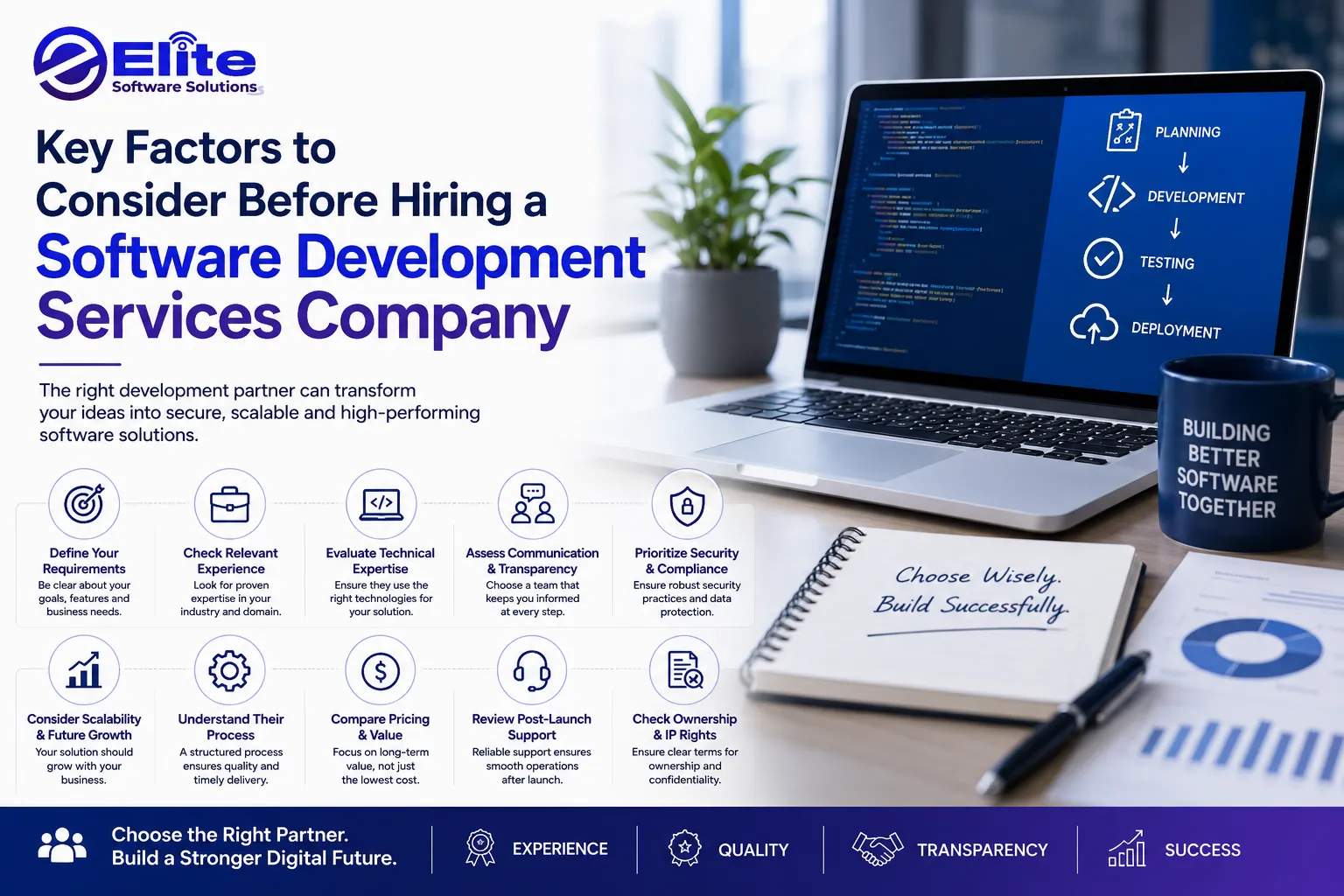
Choosing the right technology partner can have a lasting impact on the success of a digital project. Whether a business is planning a new web application, mobile platform, enterprise system, customer portal, or business automation solution, the development partner behind the project can influence its quality, cost, security, scalability, and long-term maintainability.
The decision should involve much more than comparing quotations. A low initial price may look attractive, but it does not necessarily indicate strong technical expertise, effective project management, or reliable long-term support. Similarly, an impressive portfolio does not automatically mean a provider understands the specific challenges of your business.
Businesses need to evaluate potential partners from both technical and business perspectives. The right team should understand the organization's objectives, communicate clearly, recommend appropriate technologies, and build a solution capable of evolving as requirements change. Businesses can also explore experienced providers offering software development services to understand how professional development capabilities can support their digital goals.
Start With a Clear Understanding of Your Requirements
Before approaching potential development partners, businesses should establish a clear understanding of what they want to achieve.
This does not mean having every technical detail finalized. Instead, decision-makers should identify the primary business problem, intended users, important workflows, expected outcomes, and major functionality.
For example, a company might want to automate manual processes, improve customer communication, create a mobile application, integrate multiple systems, or replace an outdated platform.
Clearly defining these objectives makes discussions with potential providers more productive. It also prevents unnecessary features from being included simply because they sound technologically impressive.
Evaluate Relevant Industry and Technical Experience
Experience is an important consideration when selecting a development partner, but businesses should look beyond the number of years a company has been operating.
Relevant experience can be more valuable than general experience. A provider that has previously worked with similar business processes, technologies, integrations, or project requirements may be better prepared to anticipate common challenges.
Reviewing previous projects can provide useful insight into a provider's capabilities. Businesses should look at how effectively the team has solved real problems rather than focusing solely on visual design.
Case studies can be particularly helpful because they may explain the original challenge, development approach, technology used, and resulting business improvements.
Examine Technology Expertise
Different applications require different technology strategies.
A development team may need expertise in web development, mobile applications, cloud platforms, databases, APIs, artificial intelligence, cybersecurity, or third-party integrations depending on the project.
The objective is not to find a company that uses every available technology. Instead, businesses should look for a provider capable of selecting technologies based on practical requirements.
Ask how the team approaches architecture, performance, security, testing, deployment, and scalability. These decisions can influence the application's performance and maintenance requirements for years after launch.
Understand the Development Methodology
A transparent development process can make a project considerably easier to manage.
Before hiring a provider, businesses should understand how requirements are collected, how designs are reviewed, how development progresses, and how testing is handled.
Many modern development teams work in iterative stages, allowing clients to review progress throughout the project. This can reduce the risk of discovering major misunderstandings near the end of development.
Regular demonstrations and progress updates also give stakeholders opportunities to provide feedback while changes are still manageable.
A methodology is valuable when it creates visibility, accountability, and consistent progress rather than simply being presented as a technical term.
Consider Communication and Collaboration
Technical expertise is important, but communication can be equally significant.
Software projects involve continuous decisions. Requirements may change, technical limitations can emerge, and business priorities may shift during development.
If communication is inconsistent, relatively small misunderstandings can result in delays and additional costs.
Before signing an agreement, clarify who will manage communication, how frequently updates will be provided, how meetings will be conducted, and how issues will be escalated.
A strong development partner should also be capable of explaining technical concepts in straightforward business language. Decision-makers should not have to become software engineers simply to understand the progress of their own project.
Think About Scalability From the Beginning
A successful digital product may eventually need to support more users, transactions, locations, integrations, and functionality.
For this reason, scalability should be discussed during the planning stage.
This does not mean building an unnecessarily complicated system. Overengineering can increase initial costs and create unnecessary maintenance challenges.
Instead, the development architecture should provide a sensible path for future expansion.
Discuss expected business growth with potential providers and ask how their proposed solution can accommodate increasing demand. A system designed around realistic future requirements can reduce the likelihood of expensive redevelopment later.
Make Security a Core Consideration
Security should never be treated as something that can simply be added at the end of development.
Depending on the nature of the application, security considerations may include authentication, authorization, encryption, secure APIs, data protection, access controls, vulnerability testing, and monitoring.
Businesses should ask prospective partners how security is incorporated throughout the development lifecycle.
This becomes especially important when applications process customer information, financial records, employee data, healthcare information, or other sensitive business information.
A capable technology partner should be able to explain the security practices used to protect both the application and its underlying data.
Compare Total Project Costs
Cost naturally plays a major role in the selection process, but businesses should avoid making their decision solely on the lowest quotation.
Two providers can offer different estimates because they may have different assumptions regarding functionality, testing, infrastructure, project management, technology, and post-launch support.
Before comparing prices, understand exactly what each proposal includes.
Consider development, quality assurance, deployment, infrastructure, integrations, documentation, maintenance, and future changes.
A provider with a slightly higher initial estimate may ultimately offer better value if the solution is more reliable, maintainable, secure, and scalable.
Ask About Post-Launch Support
The launch of an application is not necessarily the end of the development relationship.
Software may require updates, bug fixes, security improvements, performance optimization, compatibility changes, and new functionality as the business evolves.
Ask potential providers about their post-launch support process. Find out how technical issues are reported, how urgent problems are handled, and whether maintenance agreements are available.
Having access to a team that understands the application can make future improvements much easier than starting from scratch with a completely new provider.
Check Ownership and Documentation
Businesses should clearly understand who owns the source code, designs, documentation, and other project assets.
Ownership and licensing terms should be established in writing before development begins.
Documentation is also important. Technical documentation, API information, deployment instructions, database structures, and architecture details can make future maintenance considerably easier.
These considerations may not seem important during the early stages of development, but they can become extremely valuable when the application needs significant changes several years later.
Assess Cultural and Strategic Fit
A development partnership is more effective when both sides have compatible expectations.
Businesses should consider whether a provider understands their industry, respects their working style, responds promptly, and demonstrates genuine interest in the business problem rather than simply focusing on delivering code.
The strongest relationships are usually collaborative. Business stakeholders understand the objectives and priorities, while the development team contributes technical expertise and practical recommendations.
This type of relationship can lead to better decisions throughout the project.
Conclusion
Selecting a software development partner is a strategic business decision rather than simply a purchasing exercise. Technical capabilities, relevant experience, communication, security practices, scalability, development methodology, pricing transparency, and long-term support should all be considered before making a commitment.
Businesses should also remember that the cheapest proposal is not always the least expensive option over the lifetime of a product. Poor architecture, inadequate testing, unclear requirements, and weak support can create costs that extend far beyond the initial development budget.
Taking the time to evaluate potential providers carefully can reduce these risks and create a stronger foundation for long-term success. The right development partner should not simply deliver software; it should understand the business objectives behind that software and help create a solution capable of supporting future growth.
When technology is treated as a long-term investment rather than a one-time project, businesses are better positioned to build digital products that remain useful, secure, scalable, and adaptable as their needs continue to evolve.
Hashtags
#SoftwareDevelopment #SoftwareDevelopmentServices #BusinessTechnology #DigitalTransformation #SoftwareSolutions #CustomSoftware #SoftwareEngineering #TechnologyStrategy #BusinessGrowth #ApplicationDevelopment #SoftwareProjectManagement #DigitalInnovation #EnterpriseSoftware #BusinessEfficiency #TechnologyPartner


























Sign in to leave a comment.