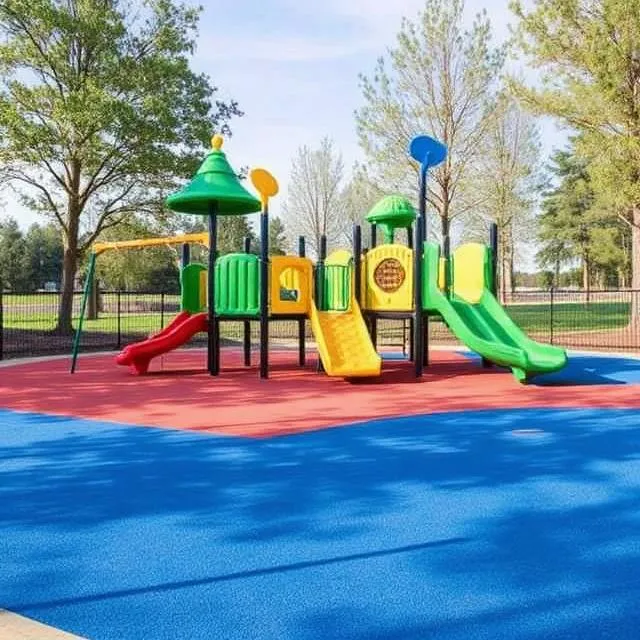

There's no single "best" playground surfacing material — the right choice depends on how high your equipment stands, how much of your budget covers materials versus long-term maintenance, how the site drains, and how accessible the play area needs to be. Get this decision wrong and you either overspend on a surface your site can't support, or install something that fails to meet basic fall-protection requirements.
This guide walks through the factors that should actually drive a surfacing decision for a school, HOA, apartment community, daycare, church, or park project — not just a list of material types, but how to weigh them against your specific site and budget.
What Playground Surfacing Actually Does
Playground surfacing exists primarily to absorb the impact of falls. Every commercial play structure has a critical fall height (CFH) — the highest point from which a child could reasonably fall — and the surfacing underneath needs to be capable of cushioning a fall from that height. This is a safety requirement, not an aesthetic one, which is why surfacing selection has to start with the equipment itself rather than personal preference for how a material looks.
Beyond fall protection, surfacing also affects accessibility, drainage, ongoing maintenance workload, and how the playground performs across different seasons and weather conditions.
The Two Categories of Playground Surfacing
Commercial playground surfacing generally falls into two broad categories, and understanding the tradeoff between them is the starting point for any decision.
Loose-Fill Surfacing
Loose-fill materials — engineered wood fiber (wood chips), rubber mulch, and pea gravel — are installed by spreading a layer of material to a specified depth across the play area. They tend to have lower upfront material costs but require ongoing maintenance: raking, replenishing depth after settling and displacement, and periodic inspection for debris.
Because loose-fill materials compress and shift with use and weather, keeping them at a consistent, code-compliant depth takes recurring attention. This also makes full ADA accessibility more difficult to maintain over time, since displaced or compacted material can create uneven or hard-packed areas.
Unitary (Poured or Bonded) Surfacing
Unitary surfacing — poured-in-place (PIP) rubber, bonded rubber, rubber tiles, and artificial turf — creates a continuous, fixed surface installed on-site or in manufactured sections. These systems typically cost more upfront but require significantly less ongoing maintenance, hold their depth and impact performance more consistently, and generally offer more reliable accessibility for wheelchairs and mobility devices since there's no loose material to navigate.
The tradeoff is straightforward: loose-fill costs less to install but more to maintain over time; unitary surfacing costs more to install but less to maintain.
Comparison at a Glance
| Surface Type | Category | Relative Upfront Cost | Maintenance Level | Accessibility |
|---|---|---|---|---|
| Pea Gravel | Loose-fill | Low | High | Poor |
| Wood Chips / Engineered Wood Fiber | Loose-fill | Low–Moderate | High | Fair |
| Rubber Mulch | Loose-fill | Moderate | Moderate | Fair–Good |
| Grass Mats | Unitary | Moderate | Moderate–High | Good |
| Pour-in-Place Rubber | Unitary | High | Low | Excellent |
| Artificial Turf | Unitary | Moderate–High | Low | Good |
These are general tendencies, not guarantees — actual cost and performance depend on project size, regional supply, site prep needs, and the specific product used.
Key Factors That Should Drive Your Surfacing Decision
Critical Fall Height and Equipment Height
Direct answer: the taller your equipment, the more impact-absorbing depth or performance your surfacing needs — this should be confirmed before any material is chosen, not after.
Surfacing needs to be matched to the fall height of the tallest component in the play area, which is why surfacing and equipment selection are connected decisions rather than separate ones. Reviewing your planned commercial playground structures and equipment alongside your surfacing options early in the planning process avoids having to retrofit a surface after equipment is already installed.
Accessibility (ADA Considerations)
Direct answer: unitary surfaces like poured-in-place rubber generally offer the most consistent accessibility, while loose-fill materials require more active management to stay navigable.
Accessible routes to and through the play area matter for caregivers using mobility devices as well as children with physical disabilities. A firm, stable, and slip-resistant surface supports independent access to play components at ground level. Loose-fill materials can meet accessibility goals, but only with consistent maintenance to prevent ruts, compaction, or excessive depth in high-traffic paths. These are general accessibility considerations, not a guarantee of legal ADA compliance for any specific installation — that depends on the full site design.
Budget: Upfront Cost vs. Lifecycle Cost
Direct answer: the cheapest surface to install is not always the cheapest surface over a 10-year period once maintenance labor and material replenishment are factored in.
A lower sticker price on loose-fill material can be offset by years of raking, topping off depth, and replacing displaced material — costs that are easy to underestimate at the planning stage. Organizations with dedicated grounds staff may be better positioned to manage loose-fill maintenance than those without. This is one of several reasons MVP Playgrounds' planning process establishes a budget early, alongside site conditions and equipment goals, before finalizing a surfacing plan.
Climate and Drainage
Direct answer: sites with poor drainage or heavy seasonal rain generally perform better with surfacing systems designed for water flow-through, since standing water undermines both safety and material lifespan.
Wood-based loose-fill materials can hold moisture and are more prone to mold or decomposition in consistently wet climates. Pour-in-place rubber and rubber mulch are more resistant to water damage but still depend on proper site grading and a well-prepared sub-base to drain effectively. In hot, high-UV climates, darker unitary surfaces can retain more heat than lighter-colored loose-fill materials, which is worth factoring in for sites with significant direct sun exposure.
Maintenance Capacity and Staffing
Direct answer: match the surfacing to who will actually be responsible for maintaining it — not to an idealized maintenance schedule.
A school or municipal park with regular grounds crews may be well equipped to manage loose-fill surfacing. An HOA or small daycare without dedicated maintenance staff may find a low-maintenance unitary surface more practical over time, even at a higher initial cost.
Intended Use and Traffic Volume
Direct answer: higher-traffic public playgrounds generally benefit from more durable unitary surfacing, while lower-traffic or budget-constrained sites can perform well with properly maintained loose-fill.
A neighborhood HOA playground used primarily by residents has different wear patterns than a public city park or a school playground used daily by hundreds of students. Traffic volume affects how quickly loose-fill material displaces and how often unitary surfacing needs cleaning or minor repair.
Safety Standards and Certifications to Understand
Playground surfacing in the U.S. is generally evaluated against ASTM International standards, particularly those addressing impact attenuation (how effectively a surface cushions a fall) and accessibility. Products may also carry IPEMA certification, which indicates third-party verification against relevant ASTM standards. The Consumer Product Safety Commission (CPSC) publishes public playground safety guidelines that inform how equipment and surfacing are evaluated together, and organizations planning a new playground may benefit from consulting a Certified Playground Safety Inspector (CPSI) during the design phase.
Not every individual product on the market carries every certification, so it's worth confirming certification status for the specific product being considered rather than assuming it applies industry-wide. For more detail on the standards relevant to commercial playgrounds, see MVP Playgrounds'overview.
Surfacing Considerations by Facility Type
Different organizations tend to weigh these factors differently based on their staffing, budget cycles, and user base:
- Schools and parks & recreation departments often have access to grounds maintenance staff, which can make loose-fill options like engineered wood fiber or rubber mulch more manageable, though many public sites still choose unitary surfacing for high-traffic accessibility needs.
- HOAs and apartment communities typically have limited or no dedicated maintenance staff, which often shifts the calculation toward lower-maintenance unitary options despite a higher upfront cost.
- Daycares and childcare facilities frequently prioritize accessibility and consistent surface performance for a wide age and mobility range, since younger children are more likely to be on the ground or transitioning between play components at lower heights.
- Churches and community centers vary widely depending on how often the play area is used and whether volunteer or contracted maintenance is available.
Planning Surfacing Alongside Your Overall Playground Project
Surfacing shouldn't be selected in isolation from the rest of the playground plan. It's most effective when considered alongside your equipment layout, budget, and site conditions from the start — which is why surfacing typically comes up early in a structured planning process rather than as an afterthought once equipment has already been chosen. MVP Playgrounds' planning process establishes objectives, site conditions, and budget before finalizing equipment and surfacing together, which helps avoid the cost and disruption of retrofitting a surface later.
For a more detailed breakdown of individual surfacing materials and their basic characteristics, see MVP Playgrounds' overview of the varieties of playground surfacing.
Frequently Asked Questions
What is critical fall height, and why does it matter for surfacing? Critical fall height is the maximum height from which a piece of equipment is designed for a child to fall without exceeding safe impact levels, based on the surfacing beneath it. Surfacing depth and type need to be matched to this height — taller equipment generally requires deeper loose-fill material or a unitary surface engineered for a higher fall rating.
Is pour-in-place rubber worth the higher upfront cost? For sites with limited maintenance staff, heavy traffic, or a strong accessibility priority, the lower long-term maintenance and consistent performance of pour-in-place rubber often offsets the higher initial investment. For lower-traffic sites with maintenance capacity, loose-fill options can be a reasonable and more budget-friendly choice.
How deep does loose-fill surfacing need to be? Depth requirements depend on the specific material and the critical fall height of the equipment above it — generally, taller equipment requires greater depth. Because loose-fill materials compact and displace over time, many facilities install extra depth upfront to account for settling and maintain code-compliant coverage between top-offs.
Can artificial turf be used as playground safety surfacing? Artificial turf can be used for playground surfacing, but typically requires an underlying shock-absorbing pad to meet fall-height safety requirements — turf alone, without a pad, does not provide adequate impact attenuation for most play equipment.
How often does loose-fill surfacing need to be replenished? This varies by material, traffic volume, and climate, but loose-fill surfacing should be inspected regularly and topped off whenever depth falls below the level required for the equipment's fall height. High-traffic areas under swings and slide exits typically need more frequent attention than the rest of the play area.
Does surfacing choice affect ADA accessibility on its own? Surfacing is one part of accessibility, but not the only one — accessible routes, ramps, and ground-level play components also factor in. A firm, stable, slip-resistant surface supports accessibility goals, but a fully accessible playground design considers the layout as a whole, not surfacing alone.
Which surfacing option is easiest to maintain in a rainy climate? Unitary surfaces like pour-in-place rubber generally handle wet climates better than wood-based loose-fill, which can retain moisture and be more prone to mold or decomposition. Proper site drainage and sub-base preparation matter for any surface type in a high-rainfall area.
Should surfacing be chosen before or after selecting playground equipment? Ideally, they're planned together. Equipment height determines fall-height requirements that surfacing must meet, so finalizing equipment without accounting for surfacing — or vice versa — often leads to costly changes later in the project.
Choosing the right surfacing depends on the specifics of your site, budget, and equipment plan. The team at MVP Playgrounds works with schools, HOAs, apartment communities, daycares, churches, and parks & recreation departments to plan surfacing alongside the rest of a commercial playground project






















Sign in to leave a comment.