

Picking a web design agency is one of those decisions that looks simple until you start comparing quotes and portfolios and realise every agency claims to be the best fit for you. The truth is, the right agency for a boutique retailer is rarely the right agency for a B2B software company, and the cheapest quote is almost never the cheapest option once you factor in rebuilds, lost leads, and slow page speed.
This guide walks through what actually matters when hiring a web design agency: how to assess their real capability, what questions expose weak proposals, how pricing models work, and which red flags should end a conversation before it starts. It's written for business owners and marketing managers who need a website that performs, not just one that looks nice in a screenshot.
Why This Decision Matters More Than It Seems
Your website is usually the first proper interaction a prospective customer has with your business. A slow, confusing, or outdated site pushes people back to the search results within seconds. Google's own research on page experience has repeatedly linked load speed and usability to both conversion rates and rankings, so this isn't just a design preference — it affects revenue directly.
A poor agency choice tends to show up in three ways: the site looks fine but doesn't convert, the site works well initially but becomes unmanageable to update, or the relationship breaks down mid-project and you're left rebuilding from scratch. All three are avoidable if you know what to check before signing a contract.
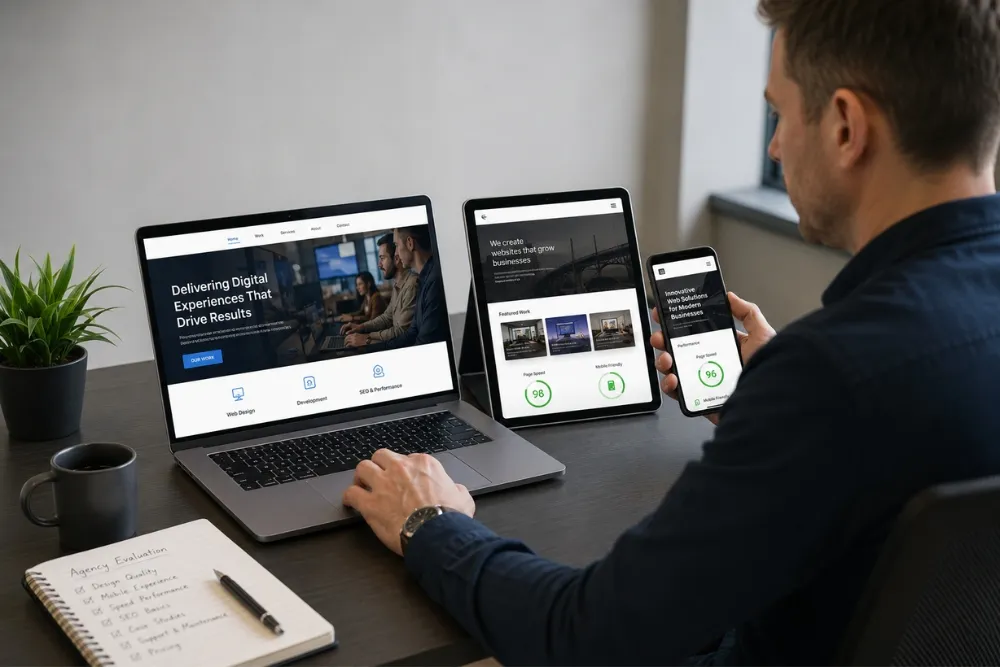
Step 1: Define What "Right" Actually Means for Your Business
Before you look at a single agency, get clear on what the website needs to do. This sounds obvious, but most disappointing projects trace back to a vague brief.
Ask yourself:
- Is the primary goal lead generation, e-commerce sales, brand credibility, or booking appointments?
- Do you need ongoing content updates, or will the site stay largely static after launch?
- Are there existing systems the site must connect to — a CRM, booking software, payment gateway, inventory tool?
- What's your realistic budget range, including the first year of hosting and maintenance?
- Do you need multilingual support, accessibility compliance, or specific industry regulations (healthcare, finance, legal)?
Write these down. A specific brief filters out agencies that aren't a good match far faster than any interview question will.
Step 2: Know the Different Types of Web Design Agencies
Not every agency does the same kind of work, and mismatched expectations cause a lot of friction later.
| Agency Type | Best For | Typical Cost Range | Watch Out For |
|---|---|---|---|
| Freelancer / solo designer | Small budgets, simple brochure sites | Low | Limited capacity, single point of failure if unavailable |
| Boutique design studio | Brand-led sites, strong visual identity | Mid to high | May lack deep technical or SEO expertise |
| Full-service digital agency | Businesses needing design, SEO, and marketing under one roof | Mid to high | Can be more expensive; check if design is a core strength or an add-on |
| Specialist e-commerce agency | Online stores, Shopify/WooCommerce builds | Mid to high | Confirm experience with your specific platform |
| Enterprise web agency | Large, complex sites with multiple stakeholders | High | Longer timelines, more process overhead |
If you run a small local business, a full enterprise agency is likely overkill. If you're launching a complex online store with thousands of products, a generalist freelancer may struggle with the technical depth required.
Step 3: Evaluate Their Portfolio Properly
Most people glance at an agency's portfolio and judge it on visual appeal alone. That's a mistake. Look deeper:
- Check the live sites, not just screenshots: Open the actual websites the agency built. Click around. Does navigation feel intuitive? Does it load quickly on mobile? A polished screenshot can hide a slow, clunky live experience.
- Look for relevant industry experience: An agency that's built ten e-commerce stores understands checkout friction, product filtering, and cart abandonment in ways a portfolio full of restaurant websites won't.
- Ask about the agency's role on each project: Some portfolios include work where the agency handled only the visual design while another team built the site. Ask directly who did what.
- Test the sites on your own phone: Since the majority of web traffic is mobile, this single check tells you a lot about how seriously the agency treats responsive design.
Step 4: Ask Questions That Reveal Real Capability
A good discovery call or pitch meeting should give you honest, specific answers — not marketing language. Useful questions include:

- What platform or technology will you build this on, and why is that the right choice for us? A confident agency explains the reasoning (WordPress for content flexibility, Shopify for retail, a custom build for specific functionality) rather than defaulting to whatever they always use.
- How do you approach page speed and Core Web Vitals? This tells you whether performance is planned from the start or treated as an afterthought.
- Who owns the website and its content once the project ends? Some agencies retain admin access or lock you into proprietary systems. Make sure you have full ownership of the domain, hosting, and codebase.
- What does the process look like from kickoff to launch? Look for a structured process with defined milestones, not a vague "we'll figure it out as we go."
- How do you handle SEO fundamentals during the build? URL structure, metadata, image optimisation, and site architecture should be considered during design, not bolted on afterwards.
- What happens after launch? Ask about maintenance packages, security updates, and how quickly they respond to issues.
- Can I speak to a recent client? A confident agency will connect you with a reference. Hesitation here is worth noting.
Step 5: Understand Pricing Models and What They Actually Include
Web design pricing varies widely, and low quotes often exclude things you'll need later. Common pricing structures:
- Fixed project fee — clear upfront cost, best when the scope is well defined. Ask what counts as a "revision" and how many rounds are included.
- Hourly or day-rate billing — flexible but harder to budget for; get an estimated total before starting.
- Monthly retainer — common with agencies offering ongoing design, content, and marketing support alongside the build.
- Platform subscription plus build fee — typical for Shopify or Squarespace projects, where you pay the agency for the build and the platform separately for hosting.
Whatever the model, get a written breakdown covering: design, development, content migration, testing, training on how to use the site, and what happens if the project runs over the agreed timeline. A contract without these specifics tends to lead to scope creep and unexpected invoices.
Step 6: Watch for Warning Signs
A few patterns consistently predict a difficult project:
- Vague answers about ownership of the finished site, domain, or hosting account.
- No clear process or timeline, just reassurances that "it'll be done soon."
- Reluctance to show live client sites, only static portfolio images.
- Pressure to sign quickly with discounts tied to an artificial deadline.
- Little to no mention of mobile performance, accessibility, or SEO during the pitch.
- Communication that feels one-directional — you're told what will happen rather than asked about your goals.
None of these are automatic dealbreakers on their own, but two or three together are a strong signal to keep looking.

Step 7: Check Reviews and Independent Feedback
Client testimonials on an agency's own site are useful but limited, since agencies naturally showcase their best feedback. Balance this by checking independent review platforms such as Google Business Profile, Clutch, or Trustpilot, and by reading reviews that mention specifics — communication style, how issues were handled, whether deadlines were met — rather than generic praise.
If possible, speak directly to a past client. Ask what surprised them, what they'd do differently, and whether the agency was still responsive after the invoice was paid.
Comparing Local Versus Remote Agencies
Location matters less than it used to, but it's still worth thinking through.
| Factor | Local Agency | Remote Agency |
|---|---|---|
| Face-to-face meetings | Easier to arrange | Usually video calls only |
| Talent pool | Limited to your area | Wider access to specialists |
| Time zone alignment | Naturally aligned | Can create delays if overseas |
| Understanding local market | Often stronger | May need more briefing |
| Typical cost | Can be higher in major cities | Sometimes more competitive |
For businesses with a strong regional focus, a local agency's market familiarity can be genuinely valuable. For niche technical requirements, a remote specialist agency often outweighs the convenience of proximity.
Key Takeaways
- Define your goals, budget, and technical requirements before contacting any agency.
- Match the agency type to your business size and complexity rather than choosing based on price alone.
- Review live client websites, not just portfolio screenshots, and test them on mobile.
- Ask direct questions about platform choice, ownership, SEO approach, and post-launch support.
- Get pricing and scope in writing, including what counts as included revisions.
- Treat vague answers about ownership or process as a warning sign.
- Independent reviews and direct references give a more honest picture than an agency's own testimonials page.
Final Thoughts
Choosing a web design agency comes down to matching their real capability, not their sales pitch, to what your business actually needs. A clear brief, a close look at live client work, direct questions about ownership and process, and honest reference checks will tell you far more than any portfolio slideshow. Take the time upfront, and the website you end up with will do its job long after the invoice is paid.
Frequently Asked Questions
Q: How much should a small business expect to pay for a website?
A: Costs vary by scope and agency type, but a straightforward brochure site from a freelancer or small studio typically costs less than a custom-built e-commerce platform from a full-service agency. Get at least three quotes with matching scope to compare fairly.
Q: How long does a typical web design project take?
A: A simple business website often takes four to eight weeks from kickoff to launch. Larger or more complex builds, particularly e-commerce or custom-functionality sites, can take three months or longer.
Q: Should I choose an agency based on the platform they specialise in?
A: Partly. If you already know you want WordPress, Shopify, or a custom build, prioritise agencies with proven experience on that specific platform, since the technical decisions differ significantly between them.
Q: Do I need to own my website's code and hosting?
A: Yes, ideally. Confirm before signing that you'll retain full ownership of the domain, hosting account, and source code once the project is complete and paid for, so you're never locked into one agency.
Q: Is a cheaper agency ever the right choice?
A: Sometimes, particularly for very simple sites with modest goals. The risk is that a very low quote often excludes things like SEO setup, mobile testing, or post-launch support, which then become extra costs later. Compare what's actually included, not just the headline price.
Q: What's the difference between a web designer and a web design agency?
A: An individual designer typically handles the visual and sometimes technical build alone, which can be cost-effective for small projects. An agency brings a team covering design, development, SEO, and project management, which suits businesses with more complex or ongoing needs.
Frequently Asked Questions
What factors should a small business consider when choosing a web design agency?
Small businesses should consider their specific goals, budget, and technical requirements before selecting a web design agency. It's important to identify whether the focus is on lead generation, e-commerce, or brand credibility, and to ensure the agency has relevant experience and a clear process for website development.
How can I evaluate a web design agency's portfolio effectively?
To evaluate a web design agency's portfolio effectively, look beyond visual appeal by checking live websites instead of just screenshots. Investigate the usability, speed, and mobile responsiveness of the sites, and inquire about the agency's specific role in each project to ensure they have the necessary expertise.
What are common pricing models for web design services?
Common pricing models for web design include fixed project fees, hourly or day-rate billing, monthly retainers, and platform subscription fees combined with build costs. Each model has its pros and cons, so it's essential to get a written breakdown of what is included to avoid unexpected costs later.
What should I ask a web design agency during the initial consultation?
During an initial consultation, ask about the technologies they plan to use, how they handle page speed and SEO, and what the ownership terms for the website will be post-launch. Also, inquire about their process from kickoff to launch and request to speak with recent clients for direct feedback.
Is it better to hire a local or remote web design agency?
The choice between a local and remote web design agency depends on your specific needs. Local agencies may have a better understanding of the regional market, while remote agencies can offer specialized skills and a wider talent pool, but may introduce challenges such as time zone differences.
Why is it important to own my website's code and hosting?
Owning your website's code and hosting is crucial to ensure you maintain control over your digital assets. This prevents you from being locked into a single agency and allows you to make updates or changes as needed without incurring additional fees or complications.
What are some warning signs to look for when selecting a web design agency?
Warning signs include vague answers about ownership of the website, lack of a clear process or timeline, and reluctance to show live client sites. Additionally, if an agency pressures you to sign quickly or fails to mention important aspects like mobile performance and SEO, it's wise to proceed with caution.





























Sign in to leave a comment.