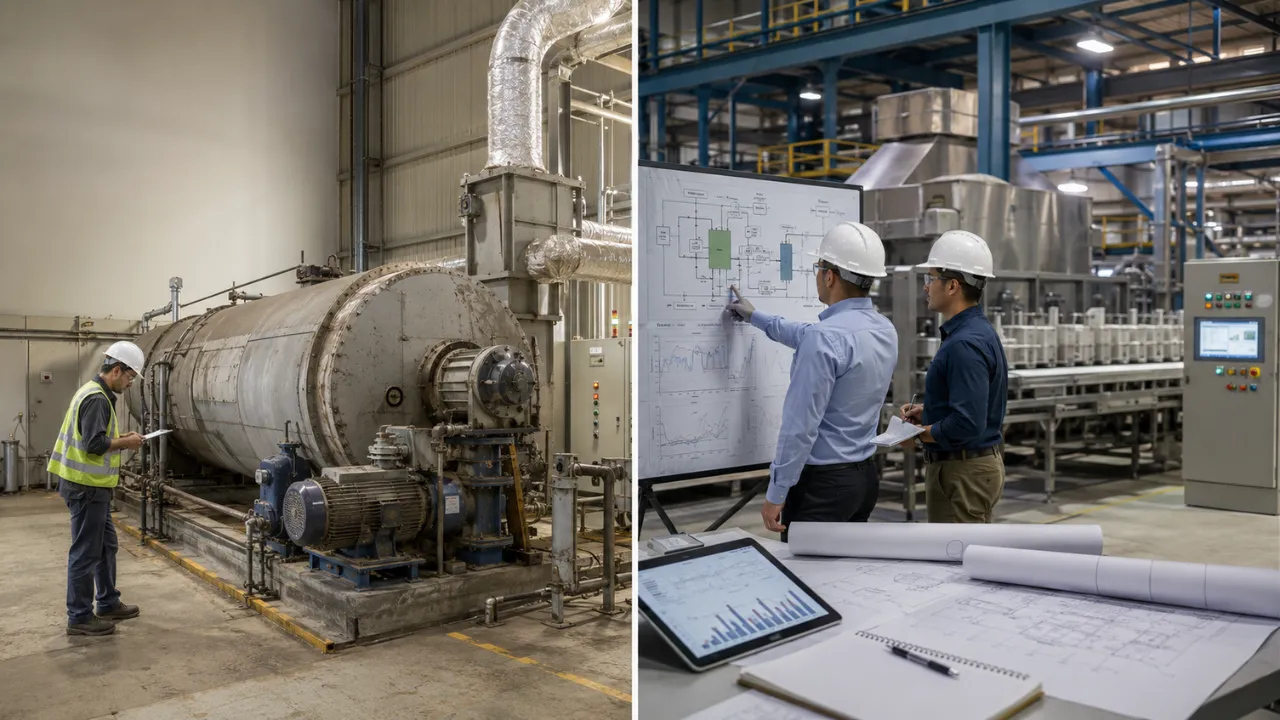

Walk into almost any manufacturing plant with an ageing dryer, and you'll hear the same conversation sooner or later.
"The dryer has become inefficient."
"Maintenance costs are getting out of hand."
"We've already spent too much on repairs."
The conclusion usually comes quickly: it's time to replace the dryer.
On paper, that sounds like the right decision. After all, industrial dryers don't last forever. Bearings wear out, burners lose efficiency, insulation deteriorates, and spare parts become harder to source. Eventually, every piece of equipment reaches a point where replacing it makes more financial sense than repairing it.
But here's something I've noticed after years of looking at drying operations.
The dryer itself is often blamed long before anyone looks at the process around it.
That's where expensive mistakes begin.
I've seen plants spend months comparing quotations from equipment manufacturers, discussing heating methods, negotiating prices, and evaluating installation schedules. Yet very little time is spent asking a much simpler question.
Has the process changed since this dryer was originally installed?
Surprisingly often, the answer is yes.
The raw material may now come from a different supplier. Moisture content may fluctuate far more than it did ten years ago. Production targets may have doubled. Product specifications may have become stricter because customers expect greater consistency. Energy prices may have changed enough to make yesterday's "good enough" solution far less attractive today.
None of those changes are caused by the dryer, but every one of them affects how the dryer performs.
That's why replacing an industrial dryer isn't really an equipment project. It's a process engineering project.
Unfortunately, many plants treat it the other way around.
The "Like-for-Like" Trap
One of the most common replacement decisions sounds perfectly reasonable.
"The existing dryer is a hot air dryer, so we'll install another hot air dryer with the same capacity."
There's comfort in that approach. Operators already know how to run it. Maintenance teams are familiar with the design. Production doesn't need to adapt to a completely different system.
Sometimes that decision is exactly right.
But sometimes it's based on an assumption that nobody stops to question.
- The assumption is that the original dryer was the correct choice, and that it still is.
- Think about a dryer installed fifteen or twenty years ago.
- Was production running at today's capacity?
- Were energy costs the same?
- Were environmental regulations identical?
- Was automation as advanced as it is now?
- Was the product exactly the same?
Usually, the answer to most of those questions is no. Yet the replacement project often starts by copying yesterday's design instead of evaluating today's process. That's a missed opportunity.
Replacing major equipment gives a plant a rare chance to step back and ask whether the entire drying operation still makes engineering sense. Once the new dryer is installed, that opportunity may not come again for another twenty years.
The Dryer Is Rarely Working Alone
One visit to a production floor is often enough to understand why blaming the dryer can be misleading.
I've seen dryers criticised for inconsistent moisture levels when the real issue was unstable feed material arriving from upstream processing.
In another case, operators complained that drying time had increased over the years. The equipment hadn't changed at all. The incoming material had. Moisture levels were significantly higher than the dryer had originally been designed to handle.
From the control room, both situations looked like dryer problems.
From a process engineer's perspective, they were something else entirely.
A dryer doesn't create moisture problems, fix poor material handling, or compensate for inconsistent feeding. It responds to the conditions it's given.
That's why experienced engineers spend as much time studying the process before the dryer as they do examining the dryer itself.
Looking Beyond the Machine
Once you stop looking at the dryer as the problem, the questions become far more interesting.
Instead of asking, "Which model should we buy?", the discussion shifts to "What exactly are we trying to improve?"
That's an important difference.
If the goal is lower energy consumption, a replacement dryer might help, but it might also reveal that the biggest losses are coming from poor insulation, inefficient airflow, or unnecessary heat escaping elsewhere in the process.
If the objective is higher production, the dryer may not even be the bottleneck. I've seen projects where the drying system received all the attention, only for the real limitation to be found in material feeding or discharge equipment. The new dryer had plenty of capacity, but the rest of the line simply couldn't keep up.
Product quality tells a similar story.
When operators see uneven moisture levels, it's easy to blame the dryer. Sometimes that's justified. Just as often, the problem starts much earlier. Variations in particle size, inconsistent feed rates, changing raw material properties, or fluctuating moisture content can all produce inconsistent results before the product even enters the drying chamber.
Replacing the machine without understanding those variables is a bit like replacing a thermometer because the weather keeps changing.
The Questions Worth Asking
Before any replacement project moves from the drawing board to procurement, it's worth slowing the conversation down for a moment.
Ask questions that challenge assumptions rather than confirm them.
- Is the material we process today the same as it was five or ten years ago?
- Have customer quality expectations changed?
- Are we trying to increase production, reduce operating costs, or solve a quality issue?
- Does the current process generate reliable production data, or are we making decisions based on estimates?
- Have utility costs changed enough to justify evaluating a different drying method?
- Are maintenance teams spending time repairing the same components repeatedly?
- If production doubles in the next few years, will the replacement still meet future demand?
None of these questions point to a specific dryer technology, and that's exactly the point.
Good engineering decisions rarely begin with equipment. They begin with understanding the process.
A Replacement Project Is Also a Chance to Improve
One aspect of dryer replacement doesn't receive enough attention.
It offers an opportunity to improve far more than drying.
Modern projects often include better instrumentation, improved process controls, more accurate moisture monitoring, safer maintenance access, and stronger integration with upstream and downstream equipment. These improvements may not be as visible as a new dryer, but they often have a greater impact on daily plant performance.
Operators gain better control over the process. Maintenance teams spend less time troubleshooting recurring issues. Production becomes more predictable because the process is easier to monitor and adjust.
Those benefits don't come from replacing old equipment alone. They come from taking the time to understand how the entire system works together.
The Best Replacement Projects Start With Curiosity
After every successful dryer replacement I've been involved with, one thing has stood out.
The engineering team spent more time asking questions than discussing equipment.
They wanted to understand why production had changed, where energy was being lost, how the material behaved, and what operators struggled with during a normal shift. Only after those answers became clear did equipment selection begin.
That approach doesn't always lead to a different type of dryer. Sometimes the existing technology is still the right choice. Sometimes only minor process improvements are needed. And occasionally, the investigation reveals that the dryer wasn't the real problem at all.
That's why replacing an industrial dryer shouldn't be viewed as the end of an equipment's life. It should be seen as an opportunity to rethink the entire drying process.
The next time a replacement project lands on the meeting table, resist the urge to jump straight into catalogues and quotations. Spend a day on the production floor.
Watch the material move through the line. Look at production data instead of assumptions.
The answers you find there will almost always be more valuable than the specifications printed in any equipment brochure.




























Sign in to leave a comment.