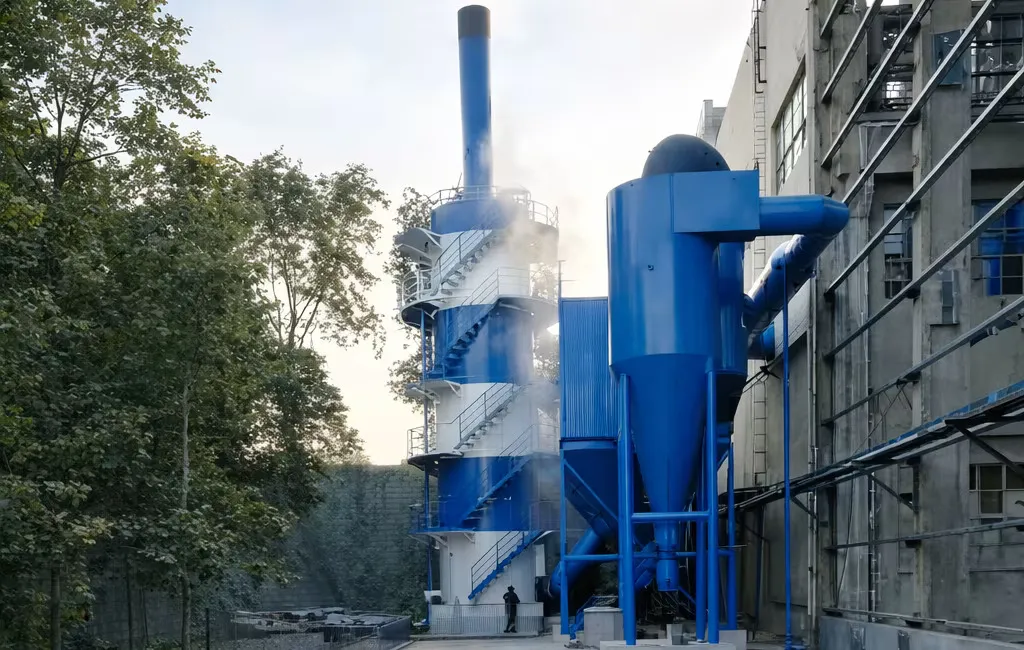

The Misconception Engineers Carry Into Calcination Projects
Most process engineers approaching their first calcination specification treat the equipment as little more than a high-temperature conveyor: heat the material, drive off volatiles, and collect the product. That framing is technically incomplete, and it leads to poor equipment choices. Calcination is not dehydration in a different shell. Depending on the material system, it involves carbonate decomposition, phase inversion, crystal structure collapse and reformation, and in some cases selective oxidation or reduction, each carrying its own reaction kinetics, activation energy threshold, and sensitivity to atmosphere composition. The equipment must manage all of these simultaneously, often across a single continuous pass.
What actually happens inside a well-engineered calcination system is a staged thermal programme. Material entering the feed end passes first through a drying and preheating zone, then into the reaction zone where endothermic decomposition occurs, and finally through a controlled cooling stage where post-calcination crystallography is set. Miss the temperature window in the reaction zone by 40°C and you get incomplete decomposition. Overshoot it and you risk sintering or phase contamination. The equipment's job is to hold the material within that window long enough, the residence time, to drive the reaction to completion without crossing the next phase boundary.
What the Thermal Profile Is Actually Controlling
The relationship between heat transfer rate and reaction kinetics governs everything. In a rotary kiln, heat reaches the material bed through a combination of radiation from the flame and hot gas, convection from the gas phase, and conduction through the tumbling bed itself. The relative contribution of each mechanism shifts with temperature: above approximately 900°C, radiation dominates, while convective and conductive transfer carry more of the load below that threshold. This is why kiln geometry, shell diameter, inclination, rotation speed, and dam ring design cannot be decoupled from the thermal programme. These are not mechanical parameters. They are heat transfer parameters.
Atmosphere control deserves equal weight. For materials that oxidise readily at elevated temperatures, an air-swept direct-fired kiln is often entirely appropriate. For catalyst supports or specialty pigments where surface chemistry must be preserved, even trace combustion products in the gas phase can degrade BET surface area or shift colour values. Indirect heating through a muffle or refractory shell eliminates that contamination pathway. Fine chemical raw materials typically require temperature control accuracy of ±5°C, a target that direct-fired gas burners rarely achieve without multi-zone PID control and careful burner-to-product separation across the full kiln length.
Two Plants, Same Principle, Different Behaviour
A 120 tonne/day bauxite calcination plant in Odisha running a direct-fired rotary kiln at 1,350°C will tolerate feed variability of ±3% moisture without meaningful impact on product quality. The kiln's thermal mass absorbs minor fluctuations. Residence time at that scale, typically 90 to 120 minutes depending on inclination and shell speed, gives the endothermic reaction enough dwell to complete even when feed arrives slightly wetter than specification. The plant manager there once noted that the kiln runs more consistently than the quarry that feeds it, which is about the most accurate description of a well-sized rotary calciner you will hear on a plant floor.
A pharmaceutical-grade calcium carbonate producer in Gujarat running a batch tube calciner at 750°C faces an entirely different set of constraints. Feed particle size distribution matters down to the micron level. Residence time is fixed by the batch programme rather than kiln mechanics, and thermal uniformity across the tube cross-section must stay within ±8°C



























Sign in to leave a comment.