
A drying operation can account for 40–60% of total process energy consumption in many manufacturing facilities.
The root cause is often the limitation of conductive and convective heat transfer. Heat must travel from the material surface toward the core, creating temperature gradients and uneven moisture migration.
Those variations increase processing time, create quality inconsistencies, and restrict production throughput during high-demand periods.
Microwave Heating Dryer technology addresses this challenge by generating heat directly inside the material rather than transferring it from the outside.
Why Conventional Drying Struggles with Moisture Uniformity
Most conventional dryers rely on surface heating. A product entering a dryer at 65% moisture content and leaving at 10% moisture rarely dries evenly throughout its thickness. Temperature differences of 15–25°C between the outer layer and the core are common during processing.
A Microwave Heating Dryer uses electromagnetic energy operating at frequencies such as 915 MHz and 2450 MHz. Instead of heating the surface first, energy penetrates the material and interacts directly with moisture-bearing molecules. Moisture moves from the interior toward the surface, allowing drying rates that are often 50–70% faster than conventional hot-air systems.
A pharmaceutical intermediate producer in Western India installed a 60 kW continuous Microwave Heating Dryer processing 800 kg/hr of wet granulated material. Drying time dropped from 90 minutes to 28 minutes. Product moisture variation fell below ±1.5%, while energy consumption decreased by 32%. Comparable hot-air systems handling similar volumes typically require 60–120 minutes to achieve the same moisture target.
How Electromagnetic Energy Creates Faster Drying
Microwave energy is frequently misunderstood as simply another heat source. In reality, the heating mechanism is different. Energy conversion occurs through dipole rotation, where water molecules continuously align and realign with an alternating electromagnetic field millions of times every second.
That molecular activity generates heat throughout the material volume. Internal temperatures can reach 80–110°C rapidly while surface temperatures remain more controlled. Production rates of 500–2,000 kg/hr become achievable without exposing heat-sensitive products to prolonged thermal stress.
A ceramic materials manufacturer in Southeast Asia operating continuous 16-hour production shifts installed a 75 kW Microwave Heating Dryer for specialty ceramic powders. Drying time fell from 45 minutes to 14 minutes. Throughput increased by 38%, and product cracking rates declined significantly. Conventional airflow-based dryers processing similar materials typically require larger footprints and substantially longer residence times.
Energy Efficiency Gains Become Significant at Scale
Drying is ultimately an energy management process. Any heat lost through exhaust streams, ductwork, or surrounding equipment becomes a direct operating expense.
Because a Microwave Heating Dryer delivers energy into the product itself, thermal losses are substantially lower. Facilities replacing older gas-fired systems frequently report energy reductions between 25% and 40%. Many legacy dryers operate below 60% thermal efficiency, while microwave-based systems often achieve effective energy utilization above 80% under suitable process conditions.
Consider a food ingredient processor in South Asia producing dehydrated vegetable products at 1,200 kg/hr. After installing a 100 kW microwave drying line, specific energy consumption decreased from 1.8 kWh/kg to 1.1 kWh/kg. Annual energy savings exceeded 240,000 kWh. In practical terms, that difference becomes highly visible when production operates 24 hours per day across multiple shifts.
There is one important operating consideration. Microwave drying performs best when incoming feed moisture remains reasonably consistent above 20–25%. Large fluctuations can require advanced control strategies to maintain uniform drying performance.
System Design Has a Direct Impact on Performance
Drying performance depends on more than microwave power alone. Material density, moisture content, residence time, and throughput requirements all influence equipment configuration.
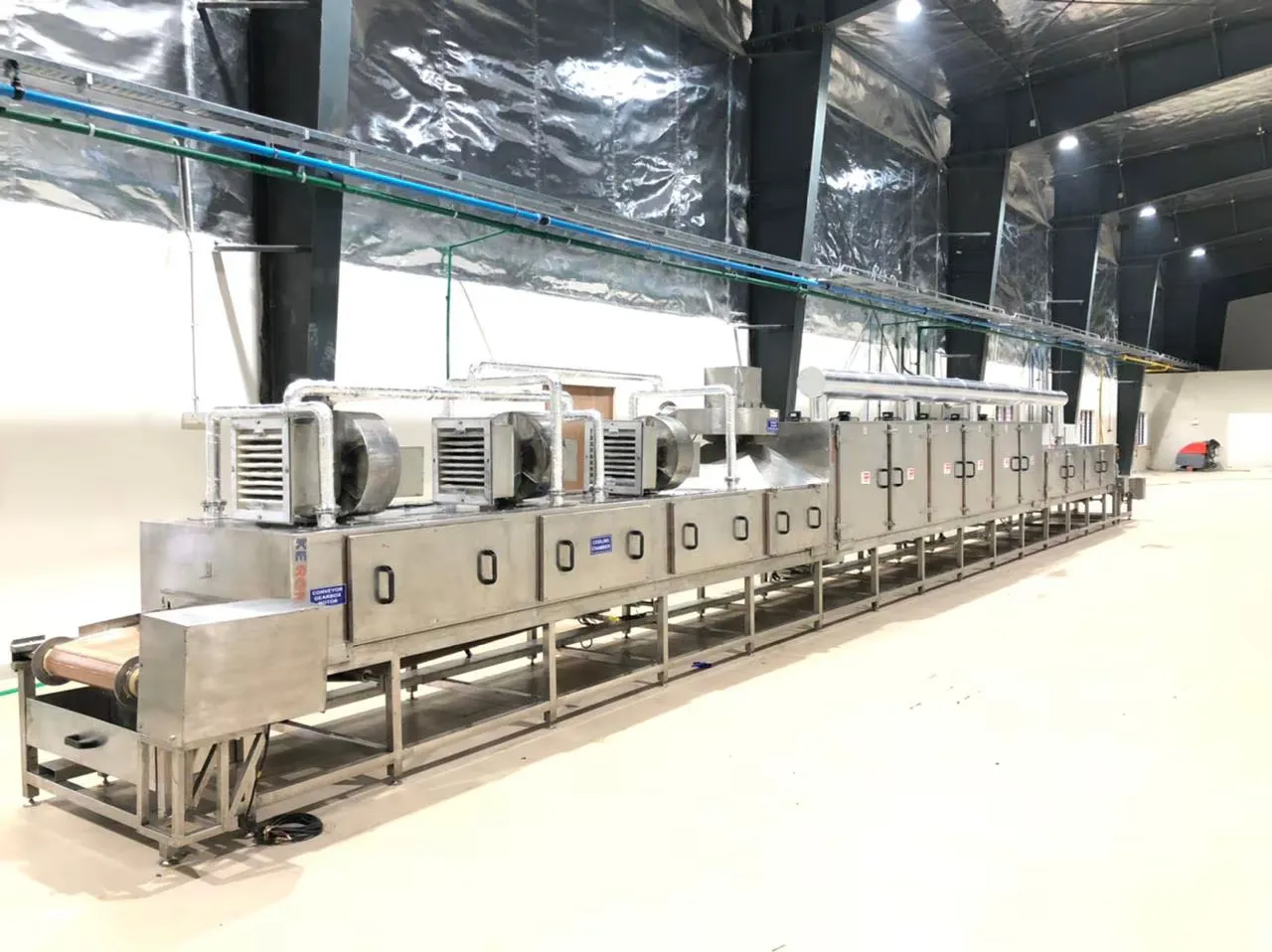
Batch systems commonly process between 50 kg and 500 kg per cycle. Semi-batch units support variable production schedules. Continuous conveyorized systems frequently exceed 2,500 kg/hr throughput, while tunnel configurations provide extended residence times for dense or difficult-to-dry products.
A specialty chemical producer near Mumbai integrated a continuous microwave tunnel system with variable belt speeds ranging from 0.5 to 5.0 m/min. Moisture consistency improved by 27%, and product losses declined by 12%. Traditional chamber dryers often require multiple handling stages and additional processing time to reach similar moisture uniformity levels.
Where Microwave Heating Dryer Technology Delivers the Greatest Value
Applications requiring precise moisture control typically generate the highest returns from microwave drying. Pharmaceutical intermediates, food ingredients, ceramics, specialty chemicals, minerals, and advanced engineered materials all benefit from uniform internal heating.
Modern control systems allow operators to adjust power output from 0% to 100% while maintaining temperature control within ±2°C. Response times below 10 seconds enable rapid process adjustments when operating conditions change. That level of control becomes especially valuable when product quality depends on narrow moisture specifications.
A food processing facility in the Middle East producing starch-based ingredients installed a conveyorized 60 kW Microwave Heating Dryer equipped with automated PLC controls. Drying consistency improved by 35%, and production capacity increased from 700 kg/hr to 950 kg/hr. Conventional thermal systems often require longer stabilization periods before reaching optimal operating conditions.
Accuracy, response time, and energy efficiency increasingly determine competitiveness in industrial manufacturing. Microwave Heating Dryer technology addresses all three by heating materials from within, reducing thermal losses, shortening process cycles, and improving moisture uniformity across demanding applications.
Kerone designs Microwave Heating Dryer systems that combine decades of process engineering expertise with advanced microwave technology to deliver reliable industrial drying performance. Which moisture inconsistency or production bottleneck costs your facility more?




















Sign in to leave a comment.