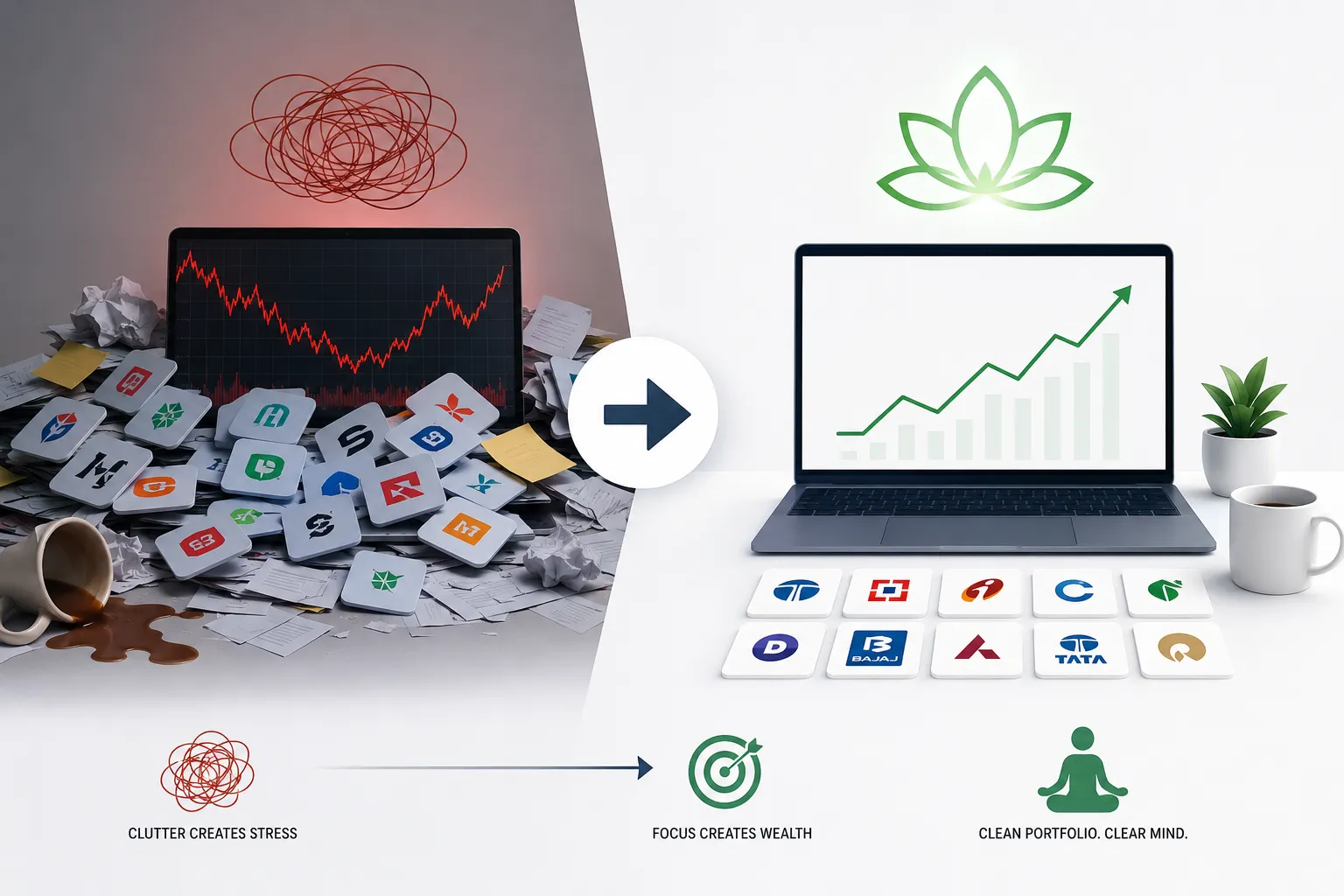

There is a distinct mental weight that comes with clutter. Whether it is a crowded closet, a chaotic digital desktop, or a workspace buried under sticky notes, physical disarray triggers subtle, persistent anxiety. In recent years, millions of people have embraced the art of minimalism to reclaim their time and mental clarity, organizing their living spaces for maximum calm and efficiency.
Yet, many of these same individuals tolerate severe, systemic clutter in a place where it hurts their peace of mind the most: their financial dashboard.
Opening a brokerage account only to be greeted by a chaotic patchwork of thirty, fifty, or even one hundred mismatched equity holdings is the financial equivalent of an unorganized room. It is visually overwhelming, emotionally draining, and structurally inefficient. If you find yourself holding fractional shares of companies you barely remember buying, perhaps tipped by a well-meaning colleague or a trending social media post, it is time for an aesthetic and structural transformation.
By looking at the distinct strategies utilized by the top investors in India, we can learn how to audit our investments, trim the financial "fat," and build a clean, high-performing stock portfolio designed for stress-free growth.
The Spectrum of Order: Minimalist Conviction vs. Hyper-Diversification
In the world of professional wealth management, organization isn't just about neatness, it dictates how capital behaves. When we look at an institutional investors portfolio, we generally see two starkly contrasting design philosophies. Understanding where your current holdings fall on this spectrum is the first step toward your makeover.
1. The Ultra-Minimalist Layout (High-Conviction, Concentrated)
On one end of the spectrum is the hyper-focused, minimalist layout. This philosophy is practiced by seasoned market veterans who believe that true wealth is generated by deep focus rather than scattered placement.
Consider the architectural precision of an investor like Rajendra Prasad Bubna & Associates. Rather than collecting dozens of tickers, their public footprint often highlights an incredibly lean selection, sometimes holding fewer than ten highly concentrated, high-conviction positions. When capital is concentrated this sharply, every single asset serves a definitive, powerful purpose. There are no placeholder stocks, no redundant positions, and no decorative holdings. It is a financial framework built on the premise that if a company isn't worth allocating a significant percentage of your wealth to, it isn't worth owning at all.
2. The Over-Furnished Layout (Hyper-Diversified)
On the other end of the spectrum is the sprawling, hyper-diversified approach. It is not uncommon to see institutional portfolios or retail accounts containing 60, 80, or well over 100 individual stocks.
While broad diversification is traditionally championed as a safety net against volatility, there is a tipping point where diversification degenerates into "diworsification". When a portfolio holds too many moving pieces, tracking corporate governance, quarterly earnings reports, and macroeconomic shifts becomes a grueling, full-time job. For an individual investor, an over-diversified layout creates an indexing effect, your returns simply mimic the broader market, but you take on the exhausting operational stress of managing a massive, unruly web of individual equities.
| Metric / Feature | The Ultra-Minimalist Layout (High-Conviction, Concentrated) | The Over-Furnished Layout (Hyper-Diversified) |
| Number of Positions | 15–20 high-conviction holdings | 80+ uncoordinated stocks & mutual funds |
| Cognitive Load | Low; effortless tracking and updates | High, overwhelming "noise" and tracking paralysis |
| Capital Allocation | Intentional; material capital per idea | Diluted micro-allocations limit overall impact |
| Market Mobility | Swift and decisive rebalancing | Sluggish; chaotic execution during corrections |
| Primary Objective | Purposeful, compounding growth | Illusion of safety via structural clutter |
Step-by-Step: The Financial "Closet Edit"
Cleaning up a cluttered workspace requires pulling everything out into the open, assessing each item's functional value, and discarding what no longer serves a purpose. Here is how to apply that exact structural workflow to achieve your best portfolio layout.
Step 1: The Inventory Disclosures (The Visual Audit)
Log into your investment platforms and aggregate every single equity holding into a single, clean spreadsheet or tracking dashboard.
- Group your holdings by sector (e.g., Information Technology, Financials, Pharmaceuticals, Consumer Discretionary).
- Calculate the exact percentage weight each stock occupies relative to your total net worth.
The Visual Reality Check: If you look at your dashboard and notice that your top five holdings comprise 60% of your value, while the remaining 40% of your capital is fragmented across 45 different micro-positions, your financial house is cluttered. Those tiny, fractional holdings are generating visual noise without possessing enough mathematical weight to meaningfully impact your long-term wealth.
Step 2: Sorting Assets into Definitive Categories
Just as you would sort clothing into piles to Keep, Donate, or Discard, segment your equities using strict, emotionless criteria:
- The Foundations (Keep): These are your core, high-conviction businesses. They possess resilient balance sheets, transparent corporate governance, clear competitive advantages, and strong tailwinds. You understand how they make money, and you would gladly buy more of them if the market dipped tomorrow.
- The Sentimental Clutter (Evaluate): These are stocks you bought based on old narratives, legacy tips, or historical performance that has since stalled. You might be holding them simply because you are waiting to "break even."
- The Financial "Lint" (Discard): These are speculative micro-positions, impulse buys, or legacy holdings that occupy less than 1% to 2% of your overall capital. They distract your focus and add zero material value to your compounding journey.
Step 3: Trimming the "Fat" and Executing the Consolidation
Now comes the active clearing process. Consolidating your holdings requires overcoming the psychological barrier of loss aversion.
- Liquidate the Noise: Systematically exit the tiny, speculative positions that have structural vulnerabilities or lack a clear future thesis.
- Reallocate to the Pillars: Funnel the liquidated capital directly into your foundational, high-conviction holdings.
- Establish a Cap: For the average retail investor balancing a career and personal life, a clean, highly manageable equity layout typically consists of 15 to 25 stocks. This range provides ample sector diversification to mitigate catastrophic risk while remaining compact enough for you to thoroughly read quarterly financial results and track major corporate disclosures.
The Structural Benefits of a Streamlined Layout
[ Messy Layout: 60+ Stocks ] ──> High Anxiety + Diluted Returns + Operational Fatigue
[ Clean Layout: 15-25 Stocks ] ──> Peace of Mind + Focused Growth + Seamless Tracking
Embracing an organized, intentional approach to wealth management yields profound advantages that go far beyond mere aesthetics:
Reduced Cognitive Load
When you scale down your holdings to a balanced, intentional number, financial management ceases to be a chore. You no longer have to sift through dozens of irrelevant news alerts or try to decipher the earnings calls of thirty different management teams. Your mind is free to focus deeply on the macroeconomic trends affecting your core businesses.
Intentional Capital Allocation
In an optimized system, every single rupee is deployed with absolute intent. Your capital isn't scattered thin across mediocre enterprises out of a fear of missing out; instead, your hard-earned money works with maximum leverage inside businesses that you thoroughly trust and understand.
Swift, Decisive Mobility
When market dynamics inevitably shift, a clean financial layout allows you to move with agility. Evaluating a structural change across 15 clear positions is a straightforward, logical exercise; attempting to reposition a sprawling web of 80 uncoordinated stocks during a market correction frequently results in emotional paralysis.
Designing for Sustainable, Long-Term Order
A successful lifestyle makeover is not a one-time event; it requires a commitment to structural habits that prevent clutter from accumulating again in the future. To maintain a pristine investment environment, establish a strict "One-In, One-Out" policy. Before adding a brand-new corporate ticker to your dashboard, challenge yourself to identify which existing holding you are willing to liquidate to make room for it. If a prospective company isn't compelling enough to replace something you already own, it simply doesn't deserve a place in your financial life.
True financial sophistication does not lie in the sheer volume of things you accumulate. By learning from the focused execution of the top investors in India, we can view our portfolios not as chaotic collections of random tips, but as carefully curated, highly efficient vehicles for long-term independence. Clear away the noise, protect your focus, and organize your wealth for clean, purposeful growth.
Frequently Asked Questions
What is the difference between a high-conviction and a hyper-diversified portfolio?
A high-conviction portfolio consists of a smaller number of carefully chosen stocks that the investor believes will perform well, while a hyper-diversified portfolio contains many stocks, often leading to diluted returns and increased management complexity. Investors with high conviction focus on quality over quantity.
What should I do with underperforming stocks in my portfolio?
Evaluate these stocks critically to determine if they belong in your portfolio. If they are no longer aligned with your investment goals or lack growth potential, consider liquidating them and reallocating the capital to stronger, high-conviction positions.
How do I maintain a clean investment portfolio after decluttering?
Implement a 'One-In, One-Out' policy, where you commit to selling an existing holding before adding a new one. This practice helps prevent clutter from accumulating and ensures that each new investment is thoughtfully considered.
What are the cognitive benefits of a streamlined investment portfolio?
A streamlined portfolio reduces cognitive load by minimizing the number of stocks you need to track, allowing you to focus on key market trends and the performance of your core investments. This leads to less stress and more effective management of your financial decisions.
How many stocks should I ideally have in my portfolio?
For most retail investors, a balanced portfolio typically consists of 15 to 25 stocks. This range allows for adequate sector diversification while remaining manageable enough for thorough monitoring and timely decision-making.
What is 'diworsification' in investing?
Diworsification occurs when an investor holds too many stocks in an attempt to diversify, which can lead to poor performance and increased complexity. It transforms diversification from a risk management strategy into a hindrance that mimics market performance without any real benefit.































Sign in to leave a comment.