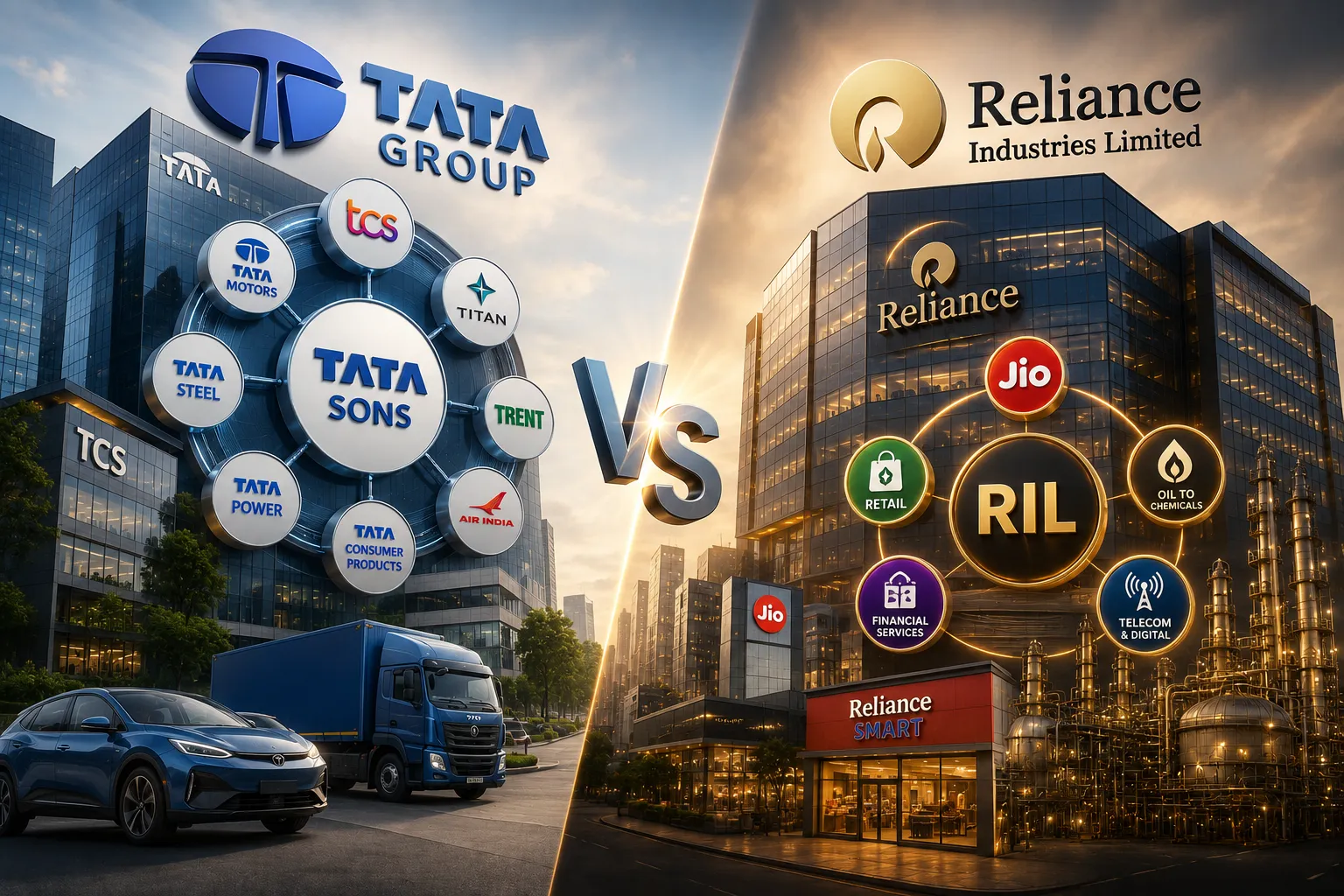

When assessing corporate power in India, two empires consistently frame the conversation: the Tata Group and the Mukesh Ambani Group (Reliance ecosystem). For retail and institutional investors alike, determining which ecosystem is safer, more profitable, or faster-growing is an ongoing study in corporate strategy.
Both groups wield staggering influence, yet they operate under fundamentally different architectures. While one represents a decentralized, multi-industry powerhouse with deep historical roots, the other is a highly integrated, consumer-facing juggernaut.
A data-backed comparison reveals how these two corporate giants match up across market capitalization, sector dominance, and growth trajectories.
The Scale: Tata vs Ambani Market Cap & Listed Footprint
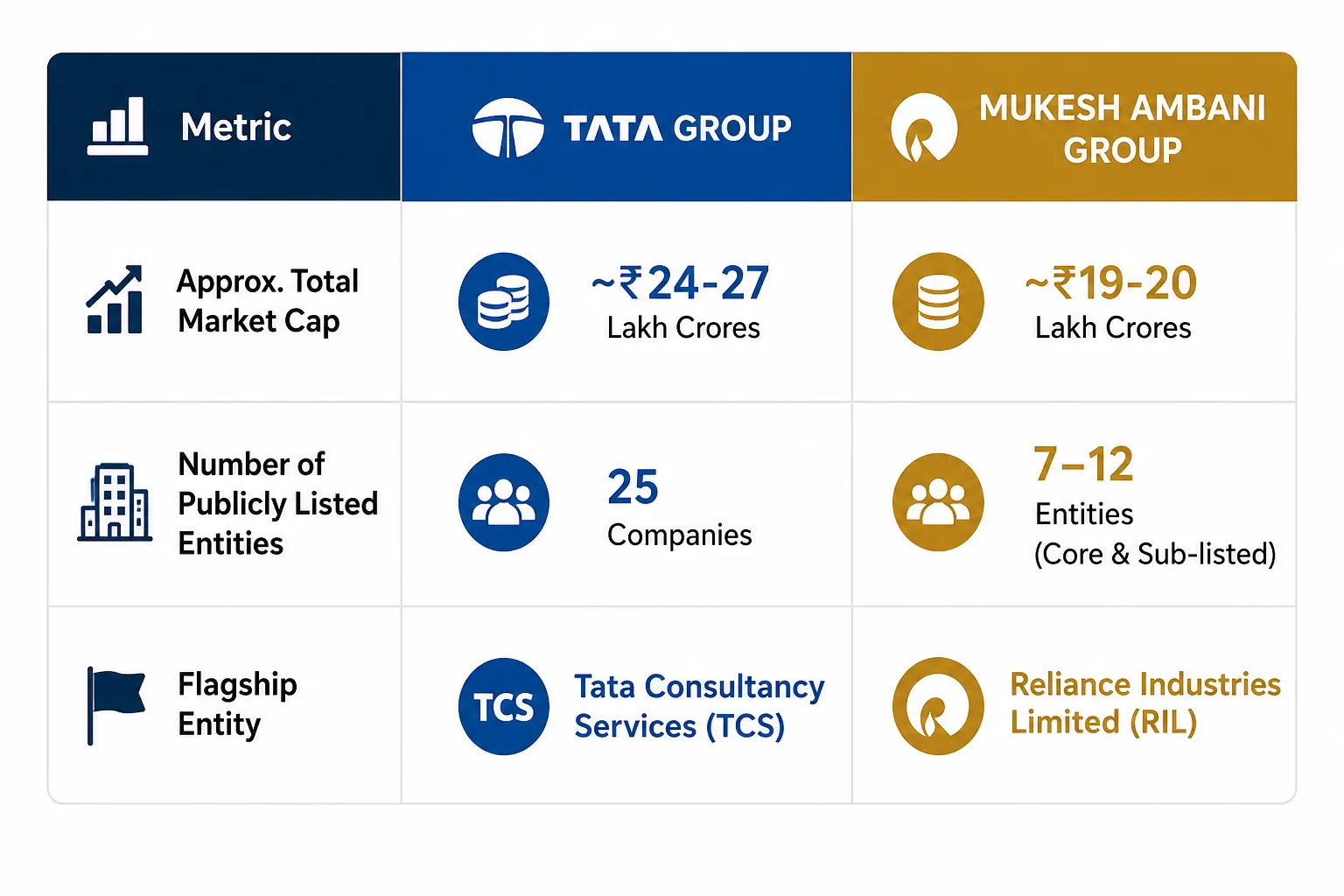
A primary structural distinction lies in the Tata group total listed companies compared to the highly centralized structure of the Mukesh Ambani Group.
Tata Group: The Power of Decentralization
The Tata Group operates as a federation of independent companies under its primary promoter and holding entity, Tata Sons. With 25 publicly listed companies, its valuation is distributed across a wide array of sector leaders, including TCS, Tata Motors, Titan, Tata Power, and Trent. This decentralized structure provides diversification across industries, allowing strong performance in sectors such as retail, automobiles, or consumer products to partially offset weakness in others like information technology or commodities.
Mukesh Ambani Group: The Concentrated Heavyweight
Conversely, the Mukesh Ambani Group represents a highly centralized model. The absolute majority of the group's market valuation is anchored directly within a single mega-conglomerate: Reliance Industries Limited (RIL). RIL acts as the direct holding ecosystem for its multi-billion-dollar subsidiaries in telecom, retail, and digital services. Smaller listed satellite entities, such as Jio Financial Services, Just Dial, and Network18, complement the core business. This structure gives the Ambani group immense capital-allocation agility, using the massive cash flows generated by its legacy businesses to fund next-generation mega-projects.
Sector Dominance: Tech & Auto vs. Oil & Retail
The structural differences between the two largest business houses in India are highlighted by where they focus their capital:
[Tata Group] ---------> Dominates: B2B Technology (TCS), Automotive (Tata Motors), Premium Retail (Titan, Trent)
[Ambani Group] -------> Dominates: Energy & Petrochemicals, Telecom (Jio), Mass Consumer Retail (Reliance Retail)
Tata's Defensive Moat: Technology, Automobiles, and Consumption
Historically, Tata’s primary value driver has been information technology. Despite cyclical headwinds impacting global IT spending, Tata Consultancy Services remains the cash cow of the group.
Beyond tech, the group dominates India's automotive sector via Tata Motors (particularly in electric vehicles) and the premium consumer retail space via Titan Company and Trent. This gives the Tata Group a balanced mix of steady institutional B2B revenue and premium domestic retail consumption.
Ambani's Growth Engine: Energy, Telecom, and Digital Platforms
The Mukesh Ambani Group dominates the foundational layers of the Indian economy: energy, digital infrastructure, and mass retail.
RIL's legacy Oil-to-Chemicals (O₂C) business remains a major cash-generating business for the group. This capital has been aggressively deployed to establish dominant market share in telecom via Jio Platforms and in mass-market retail via Reliance Retail. The focus here is on absolute digital and physical scale, capturing everyday consumer transactions across India.
Trajectories and Unlocking Value
The strategic evolution of both corporate groups provides insight into where future market value will be unlocked.
The Rise of High-Growth Satellites
While TCS has historically anchored the Tata portfolio, the group’s recent trajectory is increasingly driven by high-performing consumer and engineering businesses. Strong execution in premium retail has made Trent one of the strongest wealth creators within the Tata Group over the past few years, while Tata Steel's performance continues to be influenced by global steel prices and commodity cycles. The group continues to grow through selective public listings of core subsidiaries, creating distinct entry points for targeted investor capital.
Restructuring and Mega-Listings
The Mukesh Ambani Group is focused on aggressive corporate restructuring to unlock massive shareholder value. Having already spun off and listed Jio Financial Services to create a standalone financial powerhouse, the group’s key focus centers on massive digital value creation.
Jio Platforms has filed its Draft Red Herring Prospectus (DRHP) with SEBI, marking a major milestone toward what is expected to be one of India's largest technology IPOs. The proposed listing reflects Reliance's continued strategy of unlocking value from its digital businesses while accelerating its transition from an industrial conglomerate into a consumer and technology-driven ecosystem.
The Investor’s Perspective: Stability vs. Disruptive Scale
When contrasting these corporate ecosystems, investors are looking at two distinct philosophies of capital allocation:
- The Tata Group offers a diversified, resilient framework. Its multi-company structure allows investors to buy into specific sectors cleanly while benefiting from a legacy of corporate governance. If one engine slows down, other consumer or industrial segments frequently absorb the impact.
- The Mukesh Ambani Group represents a bet on concentrated execution and market disruption. Investing in this ecosystem means aligning with a highly integrated engine designed to scale rapidly and dominate new industries through sheer financial size.
Institutional Architecture & Global Footprint
1. Global Footprint and Exposure Risk
- Tata Group: Exhibits a heavily diversified global footprint. Entities like Tata Motors (via Jaguar Land Rover), Tata Steel (Europe), and TCS derive a significant portion of their revenues from international markets. This provides a resilient hedge against domestic downturns but exposes the group to macroeconomic fluctuations in Europe and North America.
- Mukesh Ambani Group: Historically focused on the domestic market, leveraging India’s massive consumption boom. While its Oil-to-Chemicals (O₂C) business is globally integrated, its primary high-growth engines, Jio Platforms and Reliance Retail, are fundamentally centered around capturing the expanding Indian wallet.
2. Corporate Governance & Ownership Architecture
- Tata Group: Governed by a philanthropic framework where the majority of the holding company, Tata Sons, is owned by charitable trusts (Tata Trusts hold roughly 66%). This structural layout prioritizes multi-generational value creation and social capital over immediate, short-term quarterly maximization.
- Mukesh Ambani Group: Operates under a more centralized promoter-led family ownership structure, with the Ambani family holding an equity stake of approximately 50.39% in Reliance Industries Limited (RIL). This allows for rapid decision-making, swift capital deployment, and aggressive execution of megaprojects.
3. Capital Structure and Debt Profiles
- Tata Group: Features an extremely decentralized balance sheet structure. Each listed entity manages its own debt-to-equity ratio and capital allocation independently, which prevents a financial contagion in one sector (e.g., steel or aviation) from destabilizing the broader conglomerate.
- Mukesh Ambani Group: Relies on a highly consolidated capital management framework. RIL utilizes the steady, monumental cash flows generated by its legacy energy refining businesses to aggressively fund and scale up its modern digital and retail verticals.
Conclusion: The Evolutionary Trajectories of Indian Corporate Leadership
Evaluating market dominance between the Tata Group and the Mukesh Ambani Group reveals that leadership is multi-dimensional. While Tata thrives on institutional decentralization and a diversified global footprint, Ambani embodies high-impact, centralized execution capable of disrupting entire industries through sheer scale. As both giants pivot toward next-generation frontiers like green energy and AI, their shifting market dynamics will continue to redefine the benchmarks of corporate power. Ultimately, both ecosystems illustrate the diverse strategic frameworks utilized by the leading business houses of India to navigate emerging global market realities.
Disclaimer: This document is intended solely for educational and informational purposes. It does not constitute financial, investment, or legal advice. Readers should conduct their own independent research before making any investment decisions.



























Sign in to leave a comment.