
For a while it was easy to write off touch-free fixtures as a pandemic reflex that would fade once the worry passed. It has not faded. The touchless cleaning future looks less like a trend and more like a new baseline, since the reasons behind it hold up long after any single health scare. This article looks at why the approach took root, the systems behind it, and why it is not going anywhere.
Why Touchless Took Hold
The pandemic put a spotlight on shared surfaces. Every doorknob, faucet handle, and flush lever became a spot where germs could pass from one person to the next, and buildings scrambled to cut those handoffs. Touch-free fixtures were the obvious fix, since a surface no one touches cannot pass anything along.
What kept the idea alive after the urgency dropped is that it solved problems that were always there. Restrooms were never pleasant to touch, water and paper were always wasted, and germs always spread through shared handles. The pandemic just made those old problems impossible to ignore, and the fixes turned out to be worth keeping.
The Systems Behind It
Touchless covers two related ideas. One is the fixtures people interact with, and the other is how crews clean without spreading grime.
Sensor Fixtures
Automatic faucets, flush valves, soap dispensers, and paper towel units run on motion sensors, so hands never meet a shared surface. Hands-free entry adds automatic doors and foot pulls at the spots almost everyone in a building touches. These are the parts a visitor notices.
No-Touch Cleaning Methods
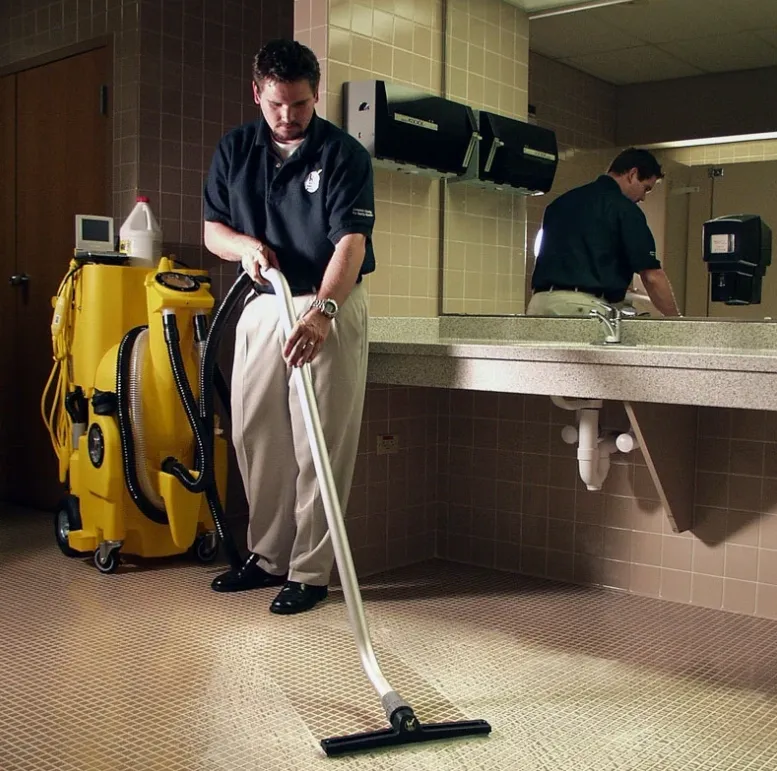
On the crew side, spray-and-vac systems let a worker apply cleaner, rinse, and vacuum up the liquid without wiping by hand. This reaches grout and corners a cloth skips, and it avoids the cross-contamination that comes from dragging one rag across every fixture. The result is a surface that is cleaner in a way hand-wiping struggles to match.
Why It Is Not Going Away
A few forces keep touchless in place. People now expect it, and a building that reverted to shared handles would feel behind. Sensor fixtures also save water and product over time, since they only run when triggered, which offsets their higher purchase price and appeals to any budget-minded manager.
There is a health case that outlasts any one outbreak too. Cold and flu season comes around every year, and shared surfaces spread those bugs the same way they spread anything else. A method that removes touchpoints keeps paying off season after season, not just during a crisis.
Where It Fits Best
Touchless earns its place fastest where traffic and stakes are highest. Restrooms top the list everywhere, since they combine heavy use with the surfaces most tied to germ spread. Healthcare leans on touch-free systems to hold infection standards. Food service uses them to keep hands clean and satisfy inspectors.
High-traffic public buildings, from gyms to schools to office lobbies, all gain from cutting shared touchpoints. Schools in particular feel it during cold and flu season, when one shared handle can move a bug through a whole class in a day.
The Limits Worth Knowing
Touchless is one layer of a plan, not the whole plan. A sensor faucet removes a touchpoint, but the counter beside it still needs regular cleaning. A wave-to-open door does nothing for the surfaces around it. So the approach reduces spread without eliminating the need for hands-on work.
Sensors also need upkeep. A dead sensor is worse than a manual fixture, since no one expects it to fail. Batteries run down, and a unit placed in the wrong spot frustrates people more than a plain handle would. Building routine checks into the plan is what keeps the whole thing paying off rather than quietly breaking down.
Balancing the Upfront Cost
Going touch-free asks for money up front, and that is the main thing that slows adoption. Sensor fixtures cost more than manual ones, and a no-touch cleaning system is an equipment purchase. So the smart approach is to spend where the return is clearest rather than converting everything at once.
The highest-value moves land in restrooms and at entry points, since those are the surfaces the most hands meet. A building can start there, prove the benefit, and expand from there. The water and product savings from sensor fixtures also chip away at the higher price over time, since a faucet that runs only when triggered wastes far less than one left to a person's habits. Spread over a few years, the running savings soften the sting of the install.
How Providers Fold It In
The touchless shift changes what a cleaning provider brings to a building. No-touch cleaning methods reach surfaces hand-wiping misses, and a crew trained on them delivers a cleaner restroom with less cross-contamination. Providers that keep sensor fixtures maintained round out the picture.
Regional cleaning companies have folded these methods into everyday service. Legacy Shines Services, a provider in Concord, North Carolina, works across offices and other facilities where cutting shared touchpoints and reaching hard angles matters, applying the same thinking that makes touchless appealing in the first place. For most buildings, the shift shows up not as a dramatic overhaul but as a steadier, cleaner routine.
The Long View
Touch-free hygiene has settled in as part of what people expect from a well-run building. It slows the spread of germs, saves water and product, and reaches surfaces that hand-wiping leaves behind. None of those benefits are tied to a single event, which is exactly why the approach outlasted the moment that popularized it. A building that invested in touch-free fixtures during the scramble is still getting the payoff years later, long after the reason for the rush faded. The mix of sensor fixtures and no-touch methods gives a space fewer shared surfaces and a cleaner result on the ones that remain. That is not a passing fashion. It is a new standard, and by every sign it is here to stay.



























Sign in to leave a comment.