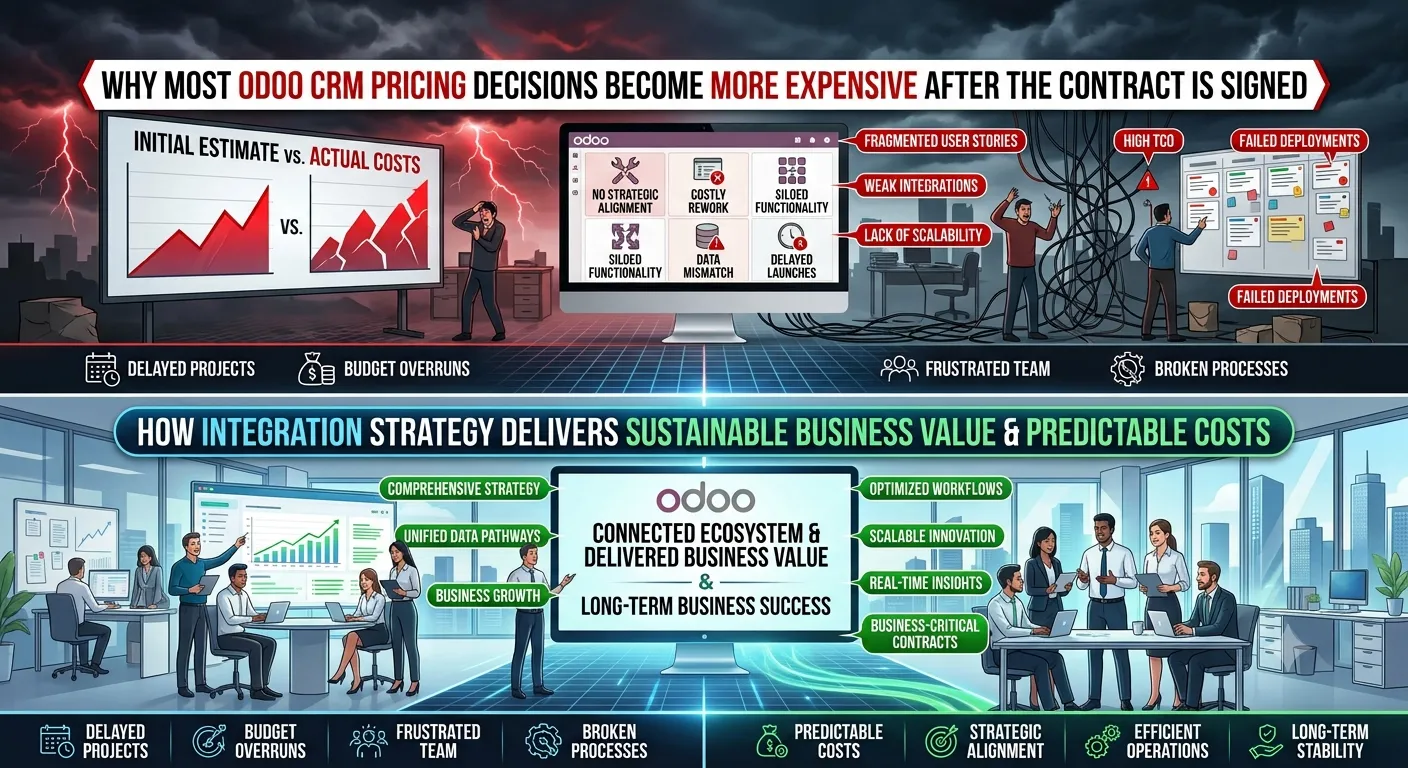

A manufacturing company recently compared three CRM platforms and chose Odoo because the subscription cost appeared significantly lower than competing enterprise solutions. Six months later, the project budget had nearly doubled. The reason wasn't hidden licensing fees. It was the cost of customizations, integrations, user onboarding, and implementation planning that had been overlooked during evaluation. This is why Odoo CRM Pricing has become a strategic discussion for CIOs and founders rather than a simple software purchase. Businesses evaluating Odoo CRM Pricing need to understand the complete cost of ownership instead of focusing only on the monthly subscription.
According to Gartner, worldwide CRM software spending is projected to grow at a compound annual growth rate of 14.4% through 2029 as organizations continue investing in customer experience and AI-enabled capabilities. At the same time, software subscription models are becoming easier to purchase but more complex to evaluate over the entire implementation lifecycle.
Why This Is Happening Now
Enterprise software buying has changed considerably over the last few years.
Earlier, organizations compared software products primarily on feature lists and licensing costs. Today, technology leaders evaluate implementation complexity, integration requirements, scalability, vendor flexibility, and long-term operational costs before making investment decisions.
Odoo reflects this market shift.
Its pricing model includes different deployment options, subscription plans, hosting choices, and implementation approaches that can significantly influence the final investment. While the platform remains competitive, Odoo CRM Pricing depends on much more than the advertised per-user subscription.
Another industry trend is the growing demand for connected business applications. CRM platforms are expected to exchange data with ERP, accounting, marketing automation, eCommerce, customer service, and analytics systems. As a result, implementation planning often contributes more to project success than licensing decisions alone.
Understanding Odoo CRM Pricing Beyond Subscription Costs
Odoo CRM Pricing should begin with business requirements, not license comparisons
Many organizations start by asking a simple question:
"How much does Odoo CRM cost per user?"
While understandable, that question rarely produces an accurate project budget.
A more useful starting point is identifying how sales teams manage opportunities, customer communication, approvals, reporting, automation, and integrations. Those operational requirements determine whether standard functionality is sufficient or whether customization will become part of the implementation.
When Odoo CRM Pricing is evaluated alongside business workflows, organizations gain a far more realistic picture of the total investment required.
Odoo CRM Pricing changes when integrations become business critical
Modern CRM platforms rarely operate independently.
Sales teams depend on accounting software.
Marketing platforms require synchronized customer information.
Customer support teams need shared interaction history.
Management expects real-time dashboards.
Each integration introduces additional planning, testing, and governance requirements.
According to Odoo's current pricing structure, subscription plans provide access to different deployment capabilities, while implementation requirements remain unique to every organization. This is why Odoo CRM Pricing should always be evaluated together with integration strategy rather than software licensing alone.
Odoo CRM Pricing should include long-term operational planning
The first implementation is only one stage of the CRM journey.
Businesses continue adding users.
Departments expand.
Approval workflows evolve.
Reports become more sophisticated.
Artificial intelligence capabilities continue entering CRM platforms.
Without planning for future expansion, organizations often return to redesign workflows only a year or two after deployment.
A well-planned Odoo CRM Pricing strategy therefore considers scalability from the beginning instead of treating implementation as a one-time technology purchase.
What Oodles Has Seen in Practice
From our experience helping growing enterprises implement CRM and ERP solutions, one common observation stands out.
Organizations that focus exclusively on software licensing often underestimate implementation planning.
Recently, we worked with a multi-location distribution business that wanted to replace spreadsheets and disconnected sales tools with Odoo CRM. Their initial expectation was that licensing represented the majority of the project cost.
Instead, our consulting team began by mapping lead management, quotation approvals, customer segmentation, reporting requirements, and ERP integration before discussing configuration.
This discovery-first approach reduced unnecessary customization, shortened implementation timelines by nearly 30%, and improved user adoption across sales and operations teams within the first three months. Rather than optimizing only Odoo CRM Pricing, the organization optimized its overall CRM investment.
Additional digital transformation initiatives delivered by Oodleserp demonstrate that organizations achieve stronger long-term returns when pricing decisions are aligned with operational goals instead of software features alone.
The broader lesson is clear. Odoo CRM Pricing is not simply about choosing between subscription plans. It is about understanding how licensing, implementation, customization, integrations, training, and future expansion work together to determine the real cost of a successful CRM initiative.
Conclusion
For many organizations, the biggest mistake is assuming that CRM pricing ends with the subscription invoice. In reality, Odoo CRM Pricing should be evaluated as part of a broader technology strategy that includes implementation, integrations, user adoption, customization, and future scalability. Businesses that assess these factors early are better positioned to avoid unexpected costs while creating a CRM platform that continues delivering value as operations grow.
As customer expectations evolve and AI-driven sales processes become increasingly common, decision-makers who approach Odoo CRM Pricing with a long-term perspective will build systems that remain adaptable instead of requiring costly redesigns. The most successful CRM investments are those where pricing decisions are aligned with business objectives from the very beginning.
Every organization has different sales processes, integration requirements, and growth plans. If you're assessing Odoo CRM Pricing for your business, our consultants can help you identify the right licensing approach, implementation strategy, and customization roadmap before you invest.
Frequently Asked Questions
1. What is included in Odoo CRM Pricing?
Odoo CRM Pricing generally includes software licensing, while the overall project cost may also involve implementation, customization, integrations, user training, data migration, and ongoing support depending on business requirements.
2. Is Odoo CRM suitable for small and mid-sized businesses?
Yes. Odoo CRM is designed to support startups, SMEs, and large enterprises. Its modular architecture allows businesses to begin with CRM and gradually expand into ERP, accounting, inventory, or HR as operational needs increase.
3. What factors influence the total cost of an Odoo CRM implementation?
The total investment depends on the number of users, deployment model, required customizations, third-party integrations, data migration complexity, workflow automation, and implementation services rather than subscription pricing alone.
4. Can Odoo CRM integrate with existing business applications?
Yes. Odoo CRM supports integration with ERP systems, accounting platforms, eCommerce solutions, marketing tools, payment gateways, and external applications through APIs and middleware, enabling organizations to build a connected business ecosystem.
5. How should organizations evaluate Odoo CRM Pricing before making a decision?
Instead of comparing subscription costs alone, organizations should evaluate Odoo CRM Pricing alongside implementation scope, future scalability, integration requirements, internal processes, and long-term maintenance to understand the true total cost of ownership.

























Sign in to leave a comment.