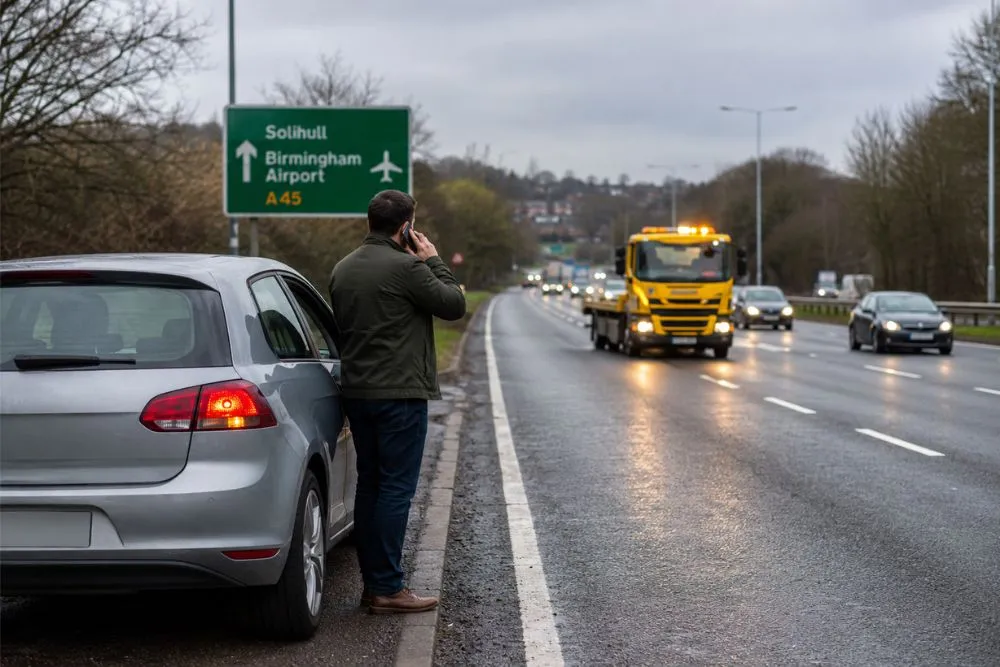

A breakdown never happens at a good time. Whether you're stuck on the A45 near Birmingham Airport, stranded outside the Touchwood centre, or sitting on the hard shoulder of the M42 with the hazards ticking, the questions are always the same: who do I call, how long will they take, and what's this going to cost me?
This guide covers everything a driver in Solihull needs to know about breakdown recovery — from choosing between a local recovery firm and a national breakdown club, to understanding what happens to your car once it's loaded onto a flatbed, to knowing your rights if a recovery goes wrong.
What "Breakdown Recovery" Actually Covers
The term gets used loosely, so it helps to separate the different services that fall under it:
- Roadside assistance — a mechanic comes to you and tries to fix the fault on the spot (a flat battery, a puncture, a snapped fan belt).
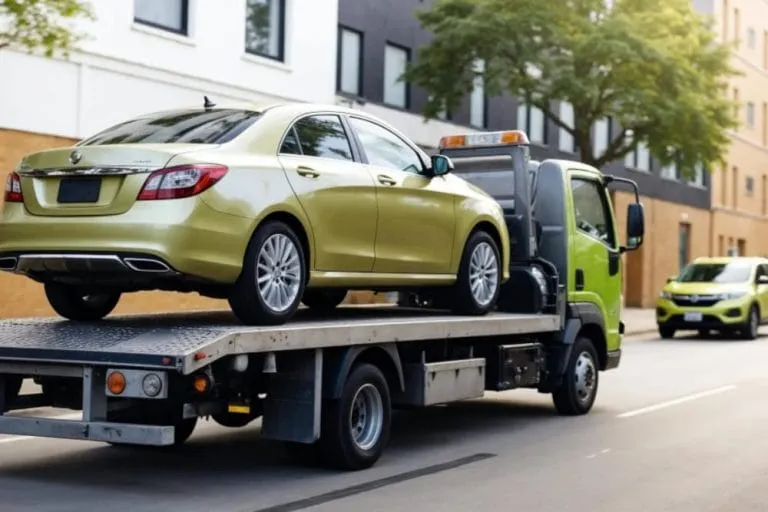
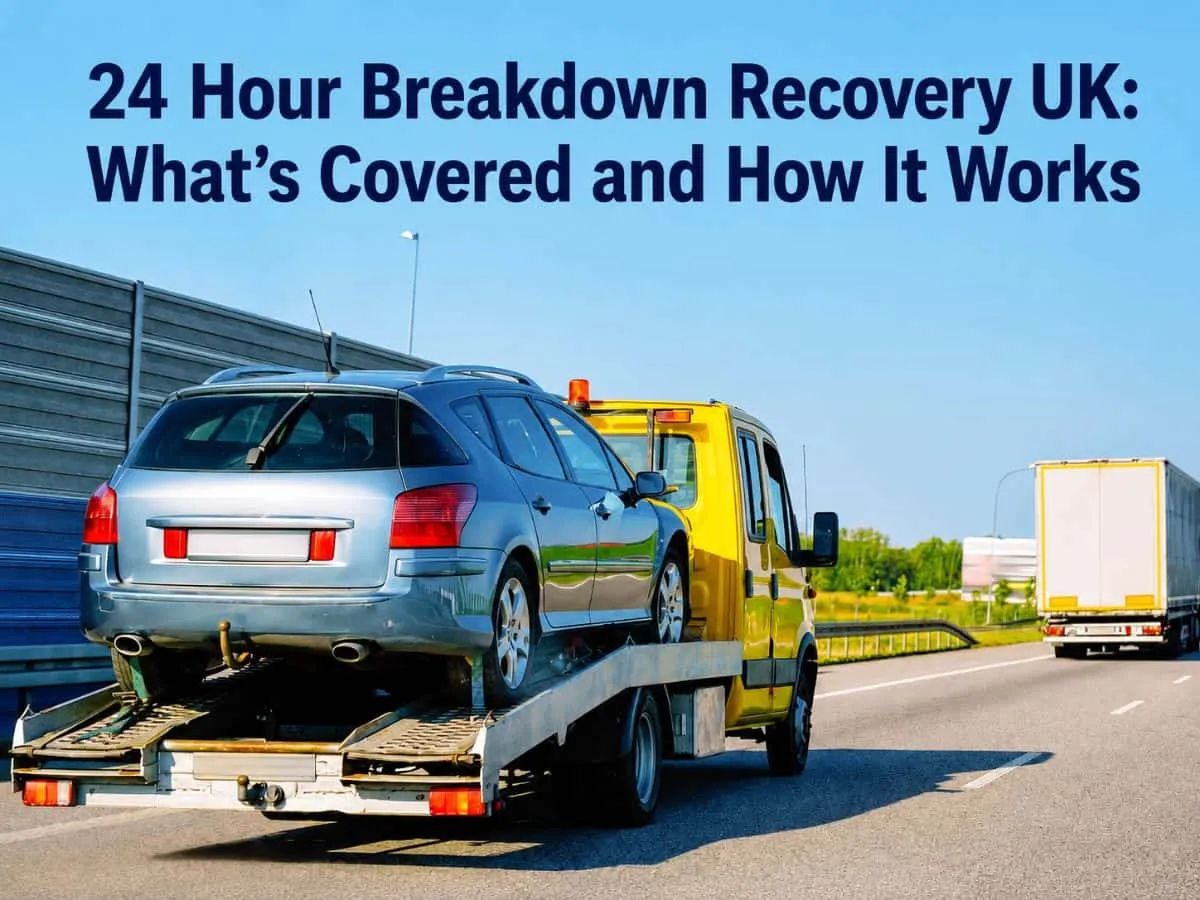
- Vehicle recovery — your car can't be fixed where it stands, so it's loaded onto a flatbed or towed to a garage, your home, or another location of your choice.
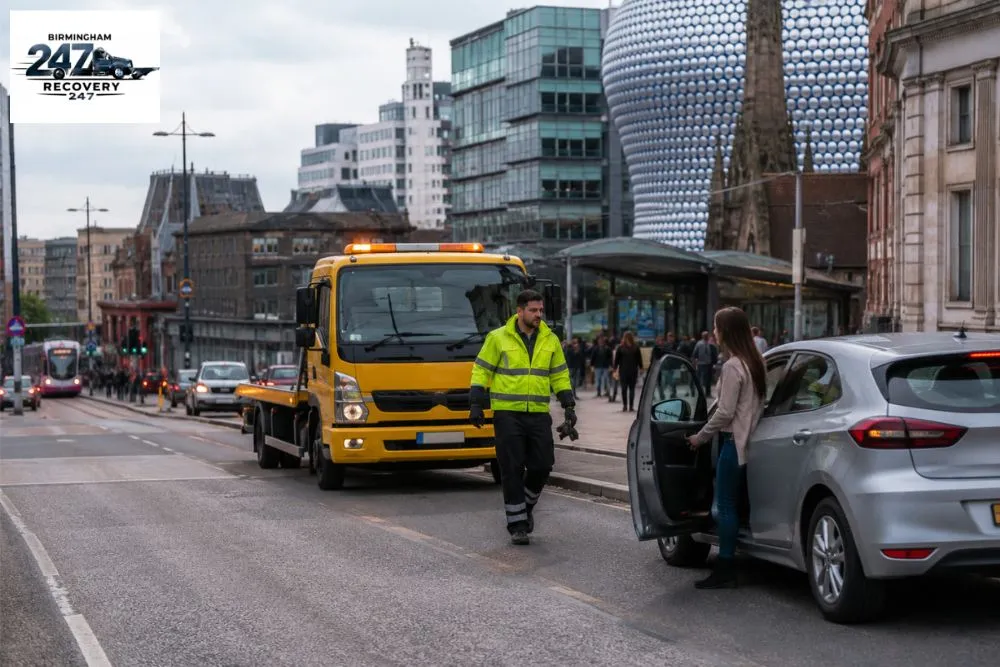
- Accident recovery — recovery following a collision, often involving insurers, police, and sometimes vehicle storage while a claim is assessed.
- Long-distance transport — moving a car (running or not) between two points, such as after buying a vehicle privately or relocating.
Most breakdown providers offer roadside assistance and local recovery as standard, with accident recovery and long-distance transport either included in higher tiers or charged separately.
Common Reasons Drivers in Solihull Call for Recovery
Local recovery operators report a fairly consistent pattern of callouts, and understanding these helps with prevention:
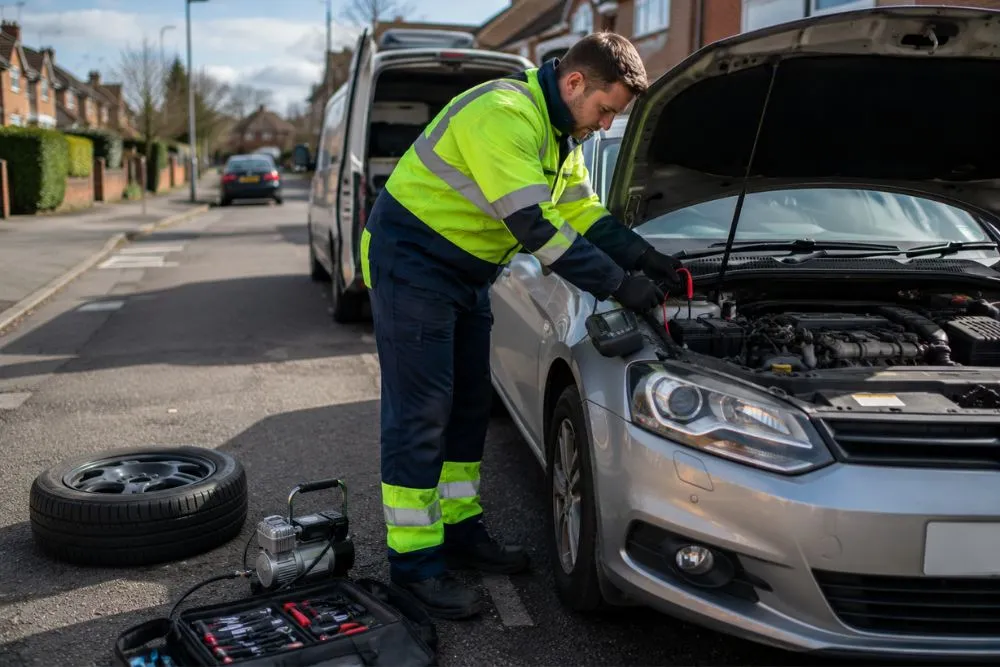
- Flat or failing batteries are the single most frequent cause of breakdowns, particularly during cold snaps in winter and after short, stop-start journeys around town that don't give the alternator enough time to recharge the battery properly.
- Tyre problems come next — punctures from debris on routes like the A34 and A452, plus underinflated or worn tyres that fail under load, especially on faster stretches of the M42 and M6.
- Fuel and AdBlue issues are a growing category, including drivers running out of fuel, misfuelling (putting petrol in a diesel car or vice versa), and AdBlue system faults in newer diesel vehicles.
- Mechanical and electrical faults cover everything from a failed alternator or timing belt to warning lights that suddenly appear on the dashboard and prompt a driver to stop rather than risk further damage.
- Key and lockout problems are also common, particularly with keyless entry systems where a flat key fob battery leaves the car unable to start.
Choosing Between Local Recovery and a National Breakdown Club
This is the decision most Solihull drivers get stuck on, so here's a straightforward comparison.
| Factor | Local Recovery Firm | National Breakdown Club (AA, RAC, Green Flag) |
|---|---|---|
| Response time in Solihull | Often faster for local jobs, as vehicles are already based nearby | Depends on van availability in the area at the time |
| Cost per callout | Usually cheaper if paid per incident | Cheaper over a year if you break down more than once |
| Motorway coverage | Varies — check they're licensed for hard shoulder recovery | Standard across most cover levels |
| Onward recovery to a garage of your choice | Commonly included | Sometimes limited by mileage or requires an upgrade |
| Best suited to | Drivers who rarely break down and want to pay only when needed | Drivers who want fixed annual costs and UK-wide cover |
Neither option is universally better. A driver who does most of their mileage within a few miles of Solihull town centre and rarely has car trouble may find a local recovery firm, paid for when needed, works out cheaper. A driver who regularly travels further afield, or simply wants the certainty of a fixed annual fee, is usually better served by a breakdown club membership.
What to Do When You Break Down in Solihull
On a Normal Road
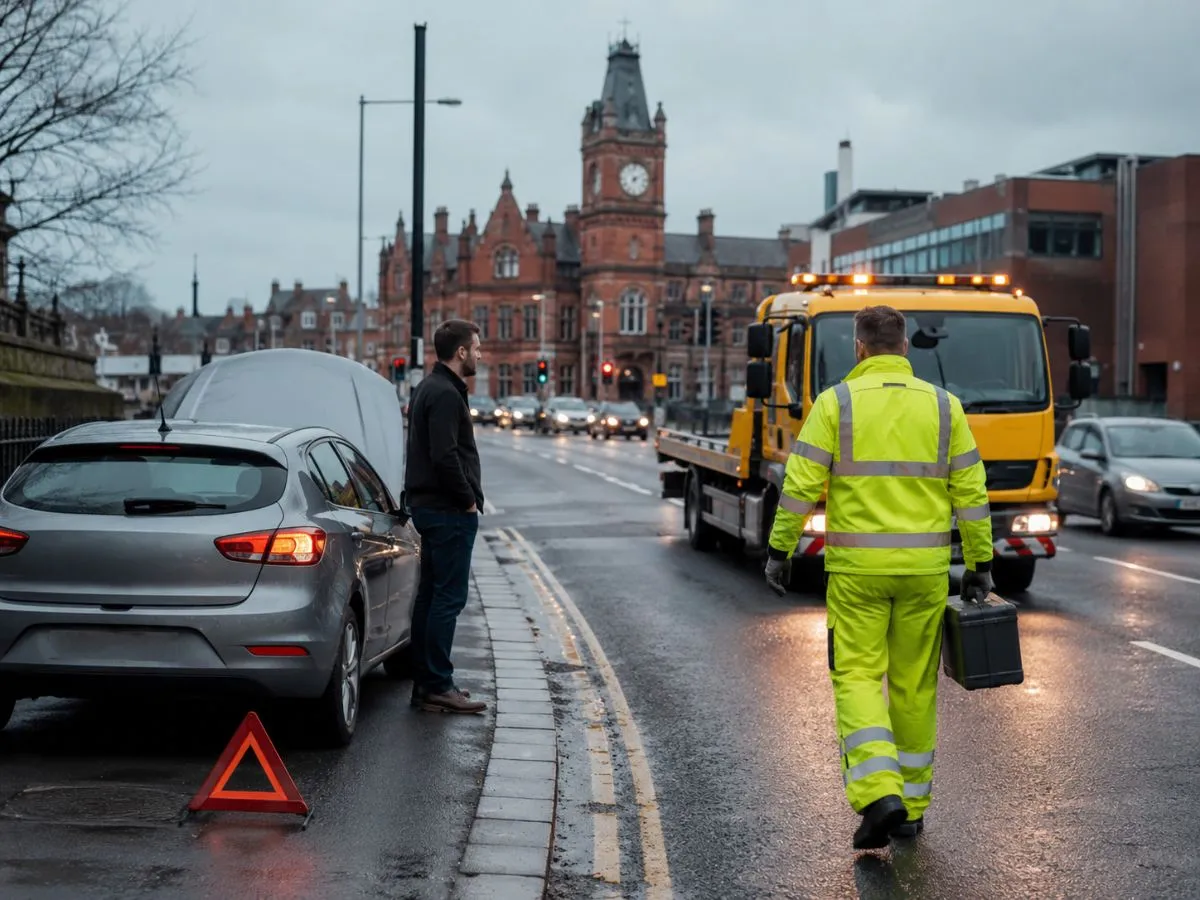
Move the car to a safe position if you can do so without creating further risk — onto a side street, a driveway, or a wide verge. Switch on your hazard lights, and if it's dark or visibility is poor, put out a warning triangle if you carry one. Stay with the vehicle unless it's unsafe to do so, and call your recovery provider with your exact location, ideally using what3words or a nearby landmark.
On the M42, M6, or a Dual Carriageway
This is where the process changes significantly for safety reasons:
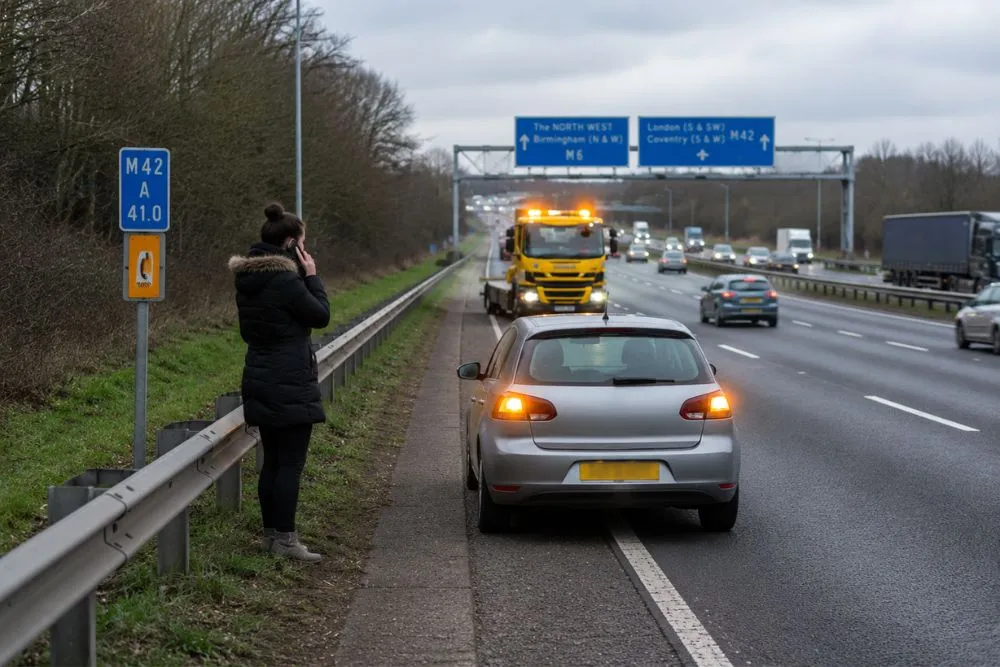
- Get off the carriageway if you possibly can. Aim for the hard shoulder, or better still, the next exit or a service area.
- Exit the vehicle from the passenger side and stand behind the barrier, well away from moving traffic — never wait inside the car or immediately next to it.
- Call for help using an emergency roadside phone if available, or your mobile if you have signal, and give your location using the marker posts along the hard shoulder.
- Do not attempt to fix the problem yourself on a live carriageway, even something as simple as changing a tyre.
- Wait at a safe distance until recovery arrives, and let the operator know you're clear of the vehicle when they call to confirm the job.
Highways England (National Highways) and the recovery services operating on Solihull's motorway network are well used to this routine, but the safety steps only work if you follow them in order.
What Affects the Cost of Breakdown Recovery in Solihull
Recovery pricing isn't random, even though it can feel that way when you're stranded. The main variables are:
- Distance travelled — both how far the recovery vehicle has to come to reach you, and how far your car then needs to be towed.
- Time of day and day of the week — callouts late at night, early morning, or on bank holidays often carry a premium.
- Vehicle type — larger vehicles, vans, and cars fitted with low-profile tyres or specialist suspension may need a different type of flatbed or loading method, which can affect price.
- Motorway versus local road recovery — motorway recovery generally costs more due to the additional safety requirements and licensing involved.
- Membership versus pay-as-you-go — if you're calling a recovery firm directly without cover, expect to pay the full cost of the job on the day, which can run from around £70–£90 for a short local tow up to several hundred pounds for a longer-distance recovery.
Always ask for a price, or at least a clear estimate, before agreeing to the job. A reputable recovery operator will give you this over the phone without hesitation.
How to Choose a Trustworthy Recovery Company
A few practical checks go a long way:
- Check they're a member of a trade body, such as the British Vehicle Rental and Leasing Association's recovery operator standards, or ask whether they hold public liability insurance.
- Ask if they're licensed for motorway hard shoulder recovery, since not every operator is permitted to work on the strategic road network.
- Look for a fixed business address and landline, not just a mobile number, as this usually signals a more established operator.
- Read recent reviews, focusing on comments about response time and how the driver communicated, rather than the star rating alone.
- Confirm payment terms before the vehicle arrives, including whether they accept card payment on-site.
Breakdown Recovery and Your Insurance
Breakdown cover and car insurance are separate products, and it's worth understanding the difference:
- Car insurance covers damage, theft, and liability, and typically only includes recovery if you've been in an accident.
- Breakdown cover is a separate policy (or add-on) that covers mechanical failure, flat batteries, punctures, and similar issues, and is what most people mean when they talk about "recovery."
Some comprehensive insurance policies bundle in a basic level of breakdown cover, so it's worth checking your existing policy documents before paying twice for the same protection.
Preventing Breakdowns: A Short Seasonal Checklist
Before winter:
- Have the battery tested, particularly if it's more than three or four years old.
- Check antifreeze levels and tyre tread depth, since worn tyres perform noticeably worse in wet and icy conditions.
- Keep a torch, warm layer, and phone charger in the car for shorter days.
Before a long summer journey:
- Check tyre pressures when the tyres are cold, including the spare if you carry one.
- Check oil and coolant levels, especially before motorway driving in hot weather, which puts extra strain on the cooling system.
- Confirm your breakdown cover is active and note the contact number somewhere accessible without needing to unlock your phone.
Key Takeaways
- Breakdown recovery covers several distinct services — roadside repair, local recovery, accident recovery, and long-distance transport — and it's worth knowing which one you actually need.
- Battery failure and tyre problems are the most common causes of breakdowns for Solihull drivers.
- Motorway breakdowns require a different, safety-first response: get off the carriageway, exit from the passenger side, and stand behind the barrier while you wait.
- Compare local recovery firms against national breakdown clubs based on how often you actually break down, not just the headline price.
- Always confirm licensing, insurance, and price before agreeing to a recovery job.
Last Thoughts
Breakdowns are stressful largely because they're unplanned, but knowing what to expect takes a lot of that stress out of the situation. Whether you end up calling a local Solihull recovery firm or a national breakdown club, the basics stay the same: get to a safe position, communicate your location clearly, ask about cost upfront, and check that whoever is coming to help is properly licensed for the job. A little preparation — a charged phone, a known contact number, and a car that's had its battery and tyres checked before winter — prevents a fair number of breakdowns from happening in the first place.
Frequently Asked Questions
Q: How quickly can I expect recovery to arrive in Solihull?
A: Response times vary by provider and time of day, but local recovery firms typically aim for 30–60 minutes for non-motorway callouts, while motorway recovery can take longer due to safety protocols and traffic conditions.
Q: Can I be towed by a friend instead of calling a recovery service?
A: It's legal in principle, but towing a car with a rope or tow bar on public roads carries real risk if the driver isn't experienced, and it isn't permitted at all on motorways except by a licensed recovery operator. For anything beyond a very short, low-speed tow on a quiet road, professional recovery is the safer option.
Q: What happens to my car if it can't be repaired at the roadside?
A: It will usually be loaded onto a flatbed and taken to a garage of your choosing, your home address, or a location specified by your insurer if the breakdown follows an accident.
Q: Does breakdown cover include a courtesy car?
A: This depends entirely on the level of cover you've bought. Basic policies rarely include one, while more comprehensive tiers from providers such as the AA or RAC often do, sometimes with a mileage or day limit.
Q: Is it cheaper to join a breakdown club or pay for recovery only when I need it?
A: If you break down rarely, paying per incident can work out cheaper over several years. If you break down more than once every year or two, or want the reassurance of fixed costs and UK-wide cover, a breakdown club membership usually pays for itself.
























Sign in to leave a comment.