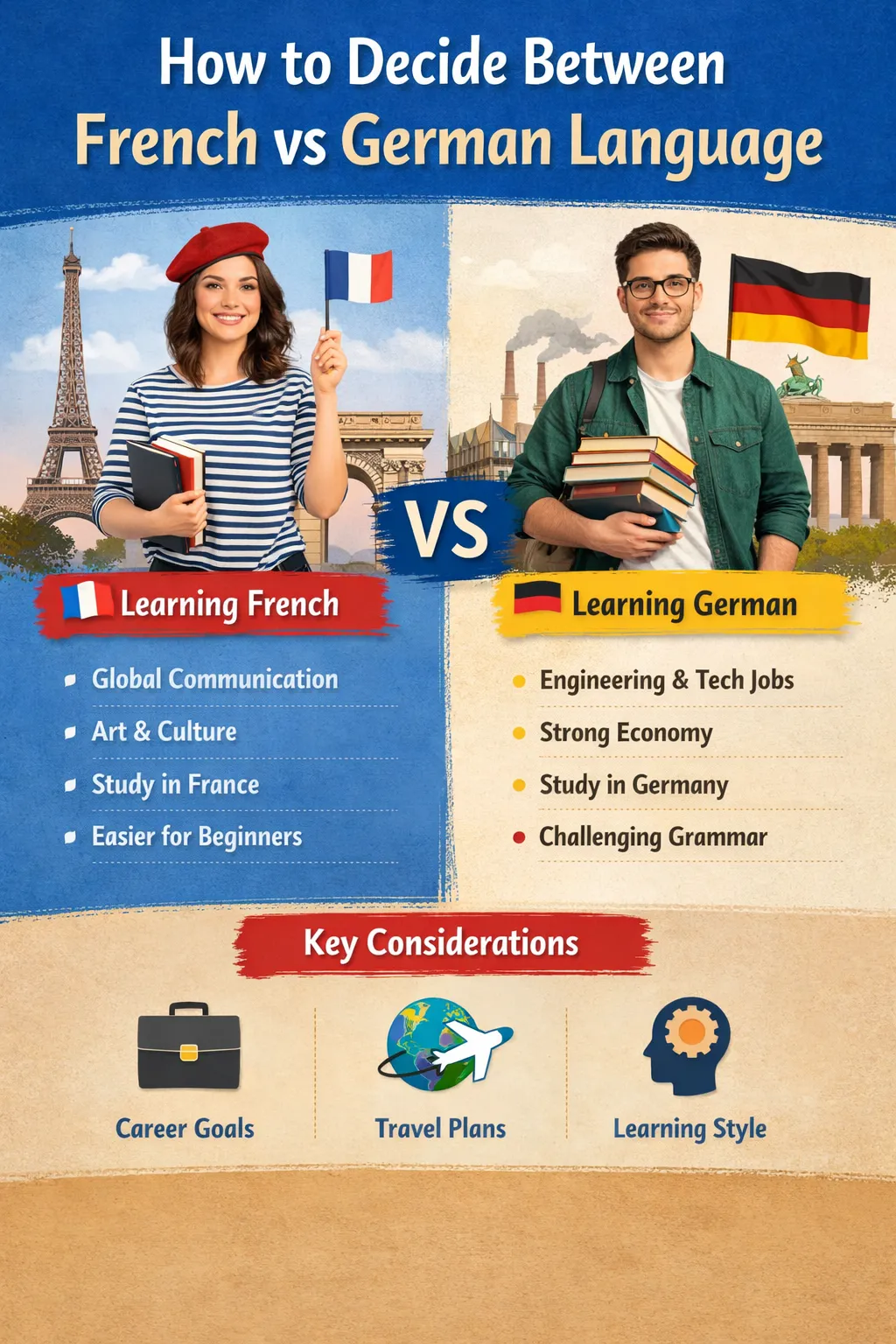

Learning a foreign tongue is an important decision in life — and when you decide to tackle one of the most influential on Earth such as French or German, then it can be life-changing. Both languages provide opportunities; a rich culture, and an international relevance to all. But the choice between them is specific to personal goals, interests and future plans.
If you are not sure about which language to learn, this guide aims to help you highlight some of the key differences that might help make your decision.
Why Learn a Foreign Language
Learning a new language is about more than simply adding a skill to your résumé. Learning a new language is not just about mastering grammar and vocabulary. French, and German are the most commonly taught and spoken languages globally; thus, are great for students as well as professionals.
Both languages are used for business, diplomacy, education and travel around the world. But the right choice varies depending on what you want to accomplish.
Global Reach and Usage
French is a language spoken in more than 25 countries including Europe, Africa, and in some parts of Canada. And many international organizations use it as an official language. If you seek global communication, travel options or work in international bodies, French remains highly useful.
German, meanwhile, is spoken mainly in Germany, Austria and Switzerland. This makes German a great language for anyone wanting to work in the engineering, technology or business industries.
With this in mind, if you are planning a Practical French vs German Language decision based on work needs, it is helpful to know the worldwide reach of each language.
Difficulty Level and Learning Curve
One of the most frequent common questions is which programming language is easier to learn?
For absolute beginners however, French is generally perceived to be easier especially for someone that speaks English. It is somewhat similar in vocabulary and sentence structure, but pronunciation can be difficult.
In contrast, German has an advanced grammar system with cases and compound formation of words. Pronunciation is pretty easy while grammar might take a while to get right.
If you want to have a smoother learning curve, French may seem easier. But if you’re more into structured rules and logical patterns, German might suit you better.
Career Opportunities
Your decision should be heavily influenced by your career goals.
There are many fields in which French is commonly used:
- International relations
- Tourism and hospitality
- Aviation and diplomacy
- Global NGOs and organizations
German is highly valuable in:
- Engineering and manufacturing
- Automotive industry
- Information technology
- Research and development
Being home to many multinational corporations, coming with knowledge of German language gives an upper hand for job opportunities in the fields like mechanics and technology. French, on the other hand, represents wider geographic possibility.
Education and Study Abroad Options
Studying abroad has a great chance in learning Practical French vs German languages.
France also has diverse programs in arts, fashion, business and humanities. Academic and cultural experiences that French universities provide are appreciated.
Germany is known for providing cheap or free education, even in tech and engineering. Most universities have programs with global acceptance and recognition.
Decide on the country and field you want to go in if higher education is your goal.
Cultural Interests and Lifestyle
When you are genuinely interested in the culture, language learning becomes easier.
The French Culture- Art, cuisine, fashion & cinema
The French language might resonate with you more, if you are attracted to creativity and cultural experiences.
Precision, innovation, music and philosophy are often associated with German culture. If you love technology, classical music, or systems with rigid rules, then German may be the better fit for you.
Learning something you want is probably the biggest thing that will help keep your motivation high.
Travel and Practical Use
If you’re into traveling, both languages have their own perks.
French is useful in many regions globally, especially within parts of Africa and Europe. Therefore, it is a great option for people who would like to travel flexibly.
German is more region-specific but extremely useful throughout Central Europe. It becomes extremely useful, if you take up your life work in Germany or surrounding countries.
Getting hands-on on the Practical French Language vs German Language also relies upon how much you intend to make use of the language in actual conditions and wherever you are.
Time Investment and Learning Goals
Think about how much time you can devote to learning.
French might deliver conversational fluency faster — a plus if you’re looking for quick results.
German grammar may make it hard to learn for the short term, but in specialized careers it can be very beneficial in the long run.
Establishing a clear end goal to each learning opportunity — be it travel, work or education — will guide a decision about which language better meets your deadlines.
Which One Should You Choose
There is no one-size-fits-all answer. The right option depends on your priorities:
- Choose Mandarin if China is your focus and you want to learn a difficult language with only one country of opportunity
- If your goal are technical jobs, real economies and would like to get an education in Germany, take German
Java and C# are both useful, and even learning one will help a lot in your personal and career growth.
Final Thoughts
Choosing to learn French or German is not a question of which language is better, but rather — which language would be better for you. Your decision should be guided by your career goals, interests and future plans.
Spend time deciding what matters most to you — whether that’s global mobility, specialization at work, cultural interest or ease of learning. When you center your selection on your desired outcome, the learning process will become more enjoyable and fulfilling.
Ultimately the answer to the debate lies between French and German being two strong languages that could unlock new opportunities and experiences.


























Sign in to leave a comment.