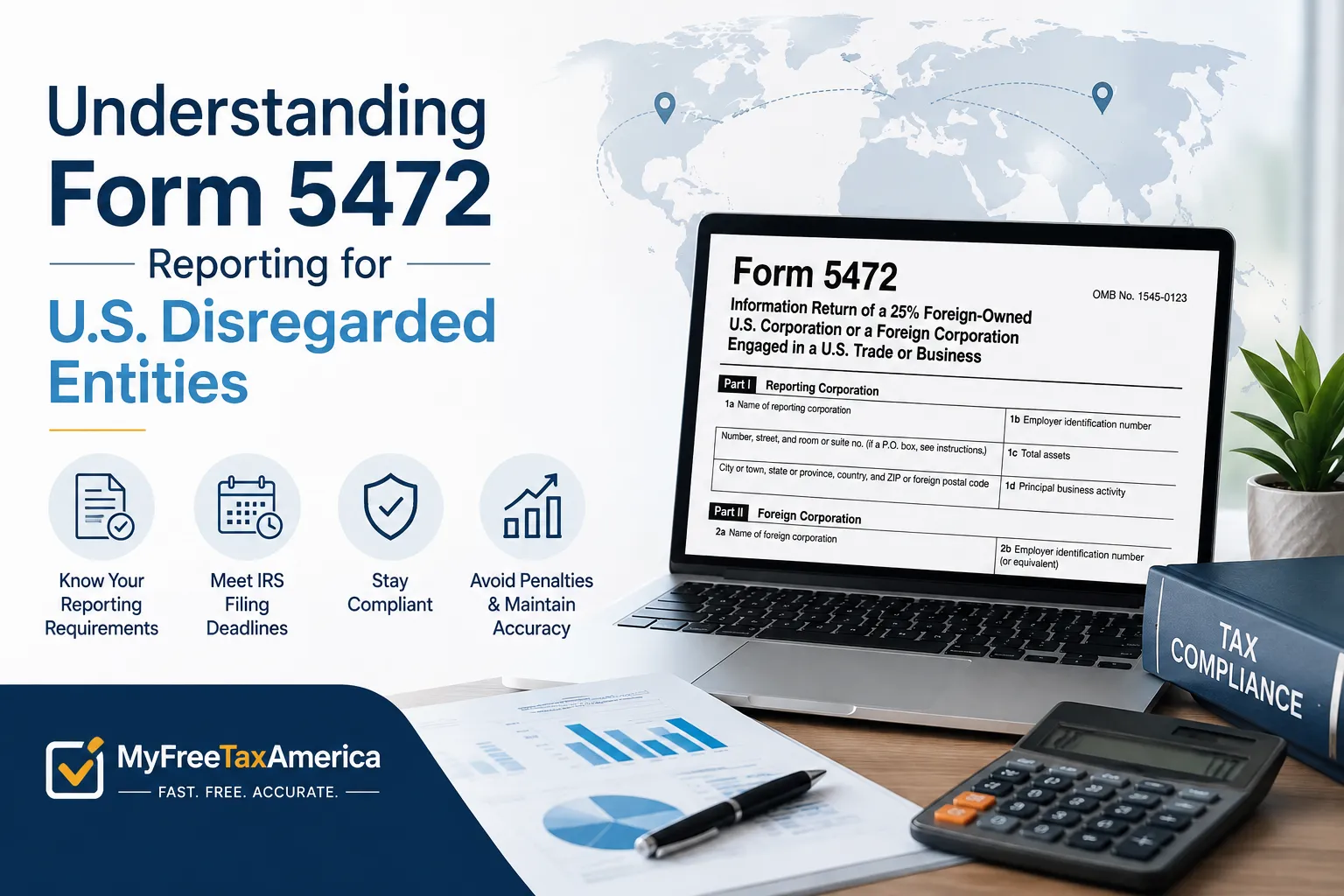

Foreign entrepreneurs often choose a U.S. limited liability company (LLC) because it can provide a flexible business structure and a straightforward way to operate in the United States. However, when a U.S. LLC is owned by a foreign person and treated as a disregarded entity for federal tax purposes, the business may have important IRS information-reporting responsibilities.
One of the most important reporting requirements to understand is Form 5472.
Form 5472 is used to report certain transactions involving a reporting corporation and related parties. Special rules also apply to certain foreign-owned U.S. disregarded entities. Because these rules can be different from the ordinary income-tax filing requirements for an LLC, foreign owners sometimes misunderstand their obligations.
This guide explains how Form 5472 reporting can apply to U.S. disregarded entities, what transactions may need attention, and how foreign-owned LLCs can prepare for their annual reporting responsibilities.
What Is a Disregarded Entity?
A disregarded entity is a business entity that is generally not treated as separate from its owner for federal income-tax purposes.
A common example is a single-member LLC that has not elected to be taxed as a corporation.
For federal income-tax purposes, the LLC's income and expenses are generally treated as belonging directly to its owner. However, being disregarded for income-tax purposes does not mean the LLC is ignored for every federal reporting requirement.
This distinction is especially important for certain foreign-owned U.S. LLCs.
A foreign-owned single-member LLC may still have information-reporting obligations even though it does not file a conventional corporate income-tax return in the same manner as a domestic corporation.
Why Form 5472 Matters for Foreign-Owned LLCs
Form 5472 is designed to provide the IRS with information about certain transactions between a reporting entity and related parties.
For qualifying foreign-owned U.S. disregarded entities, special reporting rules can apply.
This means an LLC owner should not make the assumption that:
“My LLC is disregarded, so I do not need to file anything with the IRS.”
That conclusion can be incorrect.
The business may still need to provide information about reportable transactions, including certain transactions between the LLC and its foreign owner.
Understanding this distinction can help foreign business owners avoid missed filings and potential penalties.
Which Foreign-Owned LLCs May Be Affected?
A common situation involves a U.S. single-member LLC owned by a foreign individual or foreign entity.
For example, imagine a non-U.S. entrepreneur establishes an LLC in the United States to operate an online business. The owner contributes money to the LLC's U.S. bank account to pay for software, advertising, professional services, and other expenses.
If the LLC is treated as a disregarded entity and the applicable reporting requirements are met, transactions involving the foreign owner may need to be considered for Form 5472 reporting.
The exact filing obligation depends on the entity's classification, ownership, related-party relationship, and the nature of the transactions.
Form 5472 Is an Information Return
One of the most important things to understand about Form 5472 is that it is primarily an information-reporting form.
The form does not simply determine whether the business owes income tax.
A business could have limited income, no taxable profit, or even operate at a loss and still have information-reporting responsibilities.
This is why foreign-owned LLCs should evaluate their filing obligations separately from their income-tax position.
Simply asking, “Did my LLC make money?” may not be enough to determine whether Form 5472 reporting applies.
Transactions With the Foreign Owner
Transactions between a foreign-owned LLC and its owner deserve careful attention.
For example, the foreign owner might:
- Transfer money into the LLC
- Receive money from the LLC
- Lend money to the business
- Receive repayment of a loan
- Pay business expenses on behalf of the LLC
- Receive payments from the LLC
- Provide services to the business
Depending on the applicable rules, some of these transactions may need to be reported.
The business should therefore maintain a clear record of money moving between the owner and the LLC.
Owner Contributions
Foreign owners frequently contribute money to newly established U.S. LLCs.
For example, an owner may transfer $10,000 to the company's U.S. bank account to provide working capital.
Business owners should document:
- The amount transferred
- The date of the transfer
- The source of the funds
- The purpose of the transfer
- The owner's relationship to the LLC
- Supporting bank records
Keeping this information organized can make it easier to determine whether the transaction must be included in the required reporting.
Owner Loans
A foreign owner may also provide financing to a U.S. LLC through a loan.
Suppose a foreign owner lends $25,000 to the LLC. The company agrees to repay the money over several months and pays interest according to the terms of the agreement.
This is different from simply contributing capital to the business.
The LLC should maintain appropriate documentation, such as a loan agreement, payment records, interest calculations, and bank statements.
When preparing Form 5472, having complete transaction records can help the business provide accurate information.
Payments Made on Behalf of the LLC
Another situation that can create confusion occurs when a foreign owner pays business expenses directly.
For example, the owner may use a personal bank account or credit card to pay for:
- Website services
- Advertising
- Software
- Professional services
- Business subscriptions
- Equipment
- Other operating costs
Rather than treating these transactions casually, the LLC should maintain documentation showing what was purchased, who paid for it, and how the expense relates to the business.
Proper documentation can help distinguish business expenses from personal transactions.
Distributions and Payments to Owners
Money can also move in the opposite direction.
A foreign owner may withdraw funds from the LLC or receive payments from the business.
Owners should keep records of these transfers and clearly identify their purpose.
Mixing personal and business transactions can make Form 5472 reporting more difficult and increase the possibility of errors.
Using a dedicated business bank account is generally a good practice for maintaining clear financial records.
Related Parties and Form 5472
Form 5472 reporting is closely connected with transactions involving related parties.
A related party can include certain owners, shareholders, entities, and other persons or organizations that have the required relationship under federal tax rules.
The relationship may be based on ownership, control, or other qualifying circumstances.
For foreign-owned businesses, this means it is important to look beyond direct transactions with the LLC's individual owner.
Transactions involving other related foreign businesses or entities may also need to be evaluated.
Form 5472 and Pro Forma Form 1120
Foreign-owned disregarded entities can have a different filing process from ordinary domestic corporations.
When the applicable Form 5472 reporting requirements apply to a foreign-owned U.S. disregarded entity, the entity generally uses a pro forma Form 1120 to submit Form 5472 information.
This can be confusing for owners who believe their LLC does not need to file Form 1120 because it is disregarded for federal income-tax purposes.
The purpose of the pro forma filing is connected with the information-reporting requirement.
Therefore, foreign-owned LLC owners should carefully review the filing instructions applicable to their situation.
What Information May Be Needed?
Preparing Form 5472 generally requires detailed information about the reporting entity and its reportable transactions.
Depending on the circumstances, useful records may include:
- LLC formation information
- Employer Identification Number (EIN)
- Foreign owner's information
- Ownership details
- Related-party information
- Bank statements
- Transaction dates
- Amounts transferred
- Loan documentation
- Invoices
- Payment records
- Agreements and contracts
- Accounting records
Maintaining these documents throughout the year is much easier than trying to reconstruct transactions shortly before the filing deadline.
Recordkeeping Is Essential
Good recordkeeping is one of the most effective ways to simplify Form 5472 compliance.
Foreign owned LLCs should maintain organized records for transactions involving their owners and related parties.
A useful system can include separate folders for:
Ownership records:
Documents showing who owns the LLC and how ownership is structured.
Banking records:
Statements showing deposits, withdrawals, transfers, and payments.
Related-party transactions:
Documentation supporting transactions between the LLC and related parties.
Loans:
Loan agreements, repayment schedules, interest calculations, and payment confirmations.
Business expenses:
Invoices, receipts, contracts, and proof of payment.
Having these records available can help when preparing annual tax and information returns.
Common Mistakes to Avoid
Foreign owned disregarded entities can make several common mistakes when dealing with Form 5472.
Assuming a Disregarded Entity Has No Reporting Requirements
Being disregarded for federal income-tax purposes does not necessarily eliminate every information-reporting obligation.
Ignoring Transactions With the Owner
Owner contributions, payments, loans, and other transfers should be properly reviewed.
Mixing Personal and Business Funds
Using one bank account for personal and business expenses can make transaction tracking difficult.
Waiting Until the Deadline
Trying to identify reportable transactions at the last minute can result in missing information.
Failing to Maintain Supporting Documents
Even when the filing itself is completed, the business should retain appropriate records supporting the reported information.
How to Prepare for Form 5472 Reporting
Foreign-owned LLCs can take several practical steps to prepare.
1. Confirm Your Federal Tax Classification
Determine how the LLC is classified for federal tax purposes.
2. Review Ownership
Identify the foreign owner or owners and understand the ownership structure.
3. Identify Related Parties
Create a list of individuals and entities that may qualify as related parties.
4. Review Transactions
Examine transfers, payments, loans, distributions, and other transactions involving related parties.
5. Organize Documentation
Collect bank statements, invoices, contracts, loan agreements, and other supporting records.
6. Review the Filing Deadline
Determine the applicable federal filing deadline and allow enough time to prepare the information accurately.
7. Seek Professional Help When Necessary
If the ownership structure or transactions are complicated, professional tax assistance may help identify reporting obligations and reduce filing errors.
What About LLCs With No Business Activity?
A foreign owned LLC may be inactive or have very limited business activity.
Even in that situation, the owner should not automatically assume that no filing requirement exists.
The correct approach is to review the entity's tax classification, ownership, transactions, and applicable IRS requirements.
For example, a business might have no customers but still receive money from its foreign owner to maintain a bank account, pay state fees, or cover other expenses.
Those transactions may need to be evaluated.
Penalties for Failing to File
Failure to comply with applicable Form 5472 reporting requirements can result in significant IRS penalties.
The potential penalty is an important reason foreign-owned LLC owners should take information reporting seriously.
Penalties may apply even when the business does not have taxable income.
If a business realizes that a required filing was missed or contains an error, it may be appropriate to seek professional guidance regarding corrective filing procedures and potential penalty relief.
The sooner a potential compliance issue is identified, the more options the business may have for addressing it.
Final Thoughts
Foreign-owned U.S. disregarded entities can have Form 5472 reporting responsibilities that are easy to overlook.
The key point is that “disregarded entity” does not mean “no IRS reporting.” A single-member LLC owned by a foreign person may need to report certain transactions involving its owner or other related parties.
Understanding the LLC's federal tax classification, monitoring related-party transactions, keeping detailed records, and reviewing filing requirements before the deadline can help foreign-owned businesses stay organized and compliant.
For foreign entrepreneurs operating a U.S. LLC, Form 5472 should be treated as an important part of the annual compliance process rather than something to consider only after receiving an IRS notice.
If you are unsure whether your foreign-owned U.S. LLC has Form 5472 reporting obligations, reviewing your entity classification and transactions with a qualified tax professional can help you determine the appropriate filing requirements.

























Sign in to leave a comment.