The success of an artificial intelligence model depends on the data used to train it. Whether you develop a computer vision model, build an autonomous system, or fine-tune a large language model (LLM), high-quality training data determines the model's performance.
As AI adoption increases across industries, many organizations opt to outsource data annotation rather than building an in-house labeling team. Outsourcing can reduce operational costs and accelerate development by eliminating the need to recruit, train, and manage an in-house team, but selecting the wrong data vendor can lead to inconsistent labels, delayed project timelines, compliance issues, and poor model performance. Evaluating an AI training data company is not as simple as comparing pricing or reviewing a marketing brochure. With hundreds of companies offering similar services, it can also be difficult to distinguish a legitimate, enterprise-ready partner.
So, how can you verify that an AI training data company is legitimate and the right fit for your project?
The blog will answer these questions by guiding you on the key factors to evaluate a service provider before signing a contract, how to identify a legit data annotation company, and more.
Why Your AI Training Data Partner Matters More Than You Think
Data annotation is not a supporting task in AI development, as it directly impacts how a model performs. An experienced service provider contributes more than labeled data by establishing guidelines and maintaining consistency across large datasets while adapting as project requirements evolve. It becomes more crucial in domains like autonomous driving, healthcare, retail, and agritech, where labeling errors can lead to major business consequences. Therefore, it matters to select the right annotation company early to reduce development risk and improve model reliability.
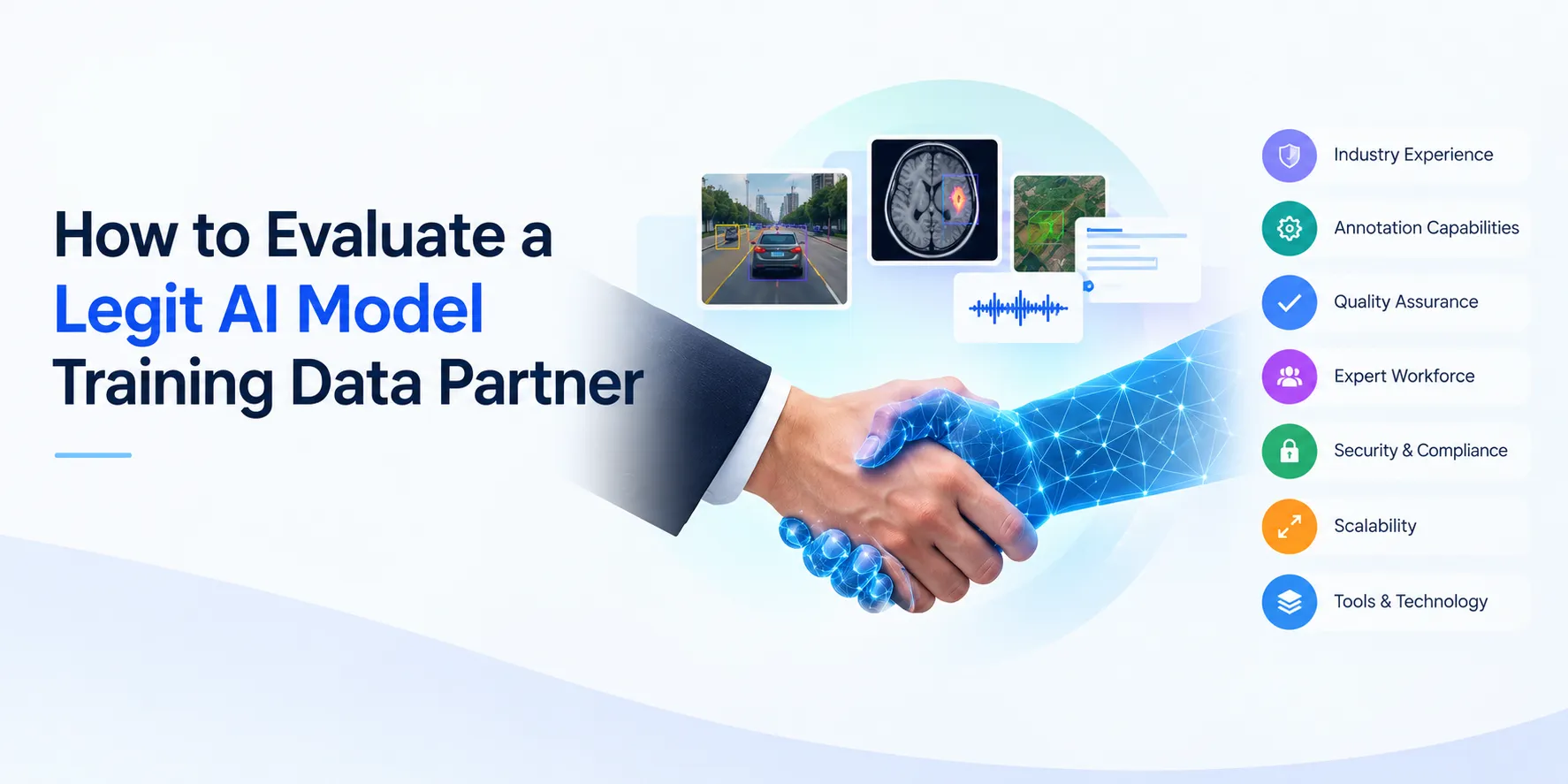
- Evaluate Industry Experience
Not every AI training data company has experience with all types of AI projects. A vendor that performs well on medical imaging might not be a good fit for satellite imagery, legal documents, or robotics. The first step is to find a legit data annotation company, ask about the industries they have worked with, and then request references for similar projects to yours. Look for evidence of domain-specific knowledge, such as medical imaging standards, agricultural imagery, or autonomous vehicle datasets.
Questions to ask
- Have they completed projects in your industry?
- Can they share case studies or references?
- Do they have domain and subject matter experts?
2. Assess Annotation Capabilities
The selected vendor must have the technical expertise to handle different data modalities and recommend AI training data strategies that align with your AI model. The right provider can support your current project while scaling with future AI initiatives.
When evaluating a legitimate provider, verify whether they have experience with datasets relevant to your use case, such as:
- Image, video, text, and audio annotation
- LiDAR, 3D point-cloud, and geospatial datasets
- Medical imaging and multimodal AI datasets
Beyond the data types they support, assess whether they understand which labeling technique is best suited for your model. A reliable partner should be proficient in methods such as bounding boxes, semantic and instance segmentation, keypoint annotation, 3D cuboids, and NLP tasks like named entity recognition and intent labeling. More importantly, they should be able to recommend the most appropriate approach based on your business objectives rather than applying a one-size-fits-all approach.
3. Understand Quality Assurance Process
Quality assurance is a strong indicator of a legitimate company. You should understand how quality is maintained throughout the model training lifecycle rather than asking whether a provider performs quality checks.
Look for providers that follow practices such as:
- Multi-level QA reviews and human-in-the-loop validation
- Random quality audits and continuous feedback
- Expert review for high-risk or specialized datasets
Leading companies also implement quality metrics instead of relying merely on manual reviews. Metrics such as Intersection over Union (IoU) and Dice Similarity Coefficient (DSC) evaluate the accuracy of segmentation tasks, while Inter-Annotator Agreement (IAA) and Cohen's Kappa measure consistency between annotators. Such measures allow for finding inconsistencies earlier and ensure that final results meet quality parameters.
4. Assess the Expertise of Annotation Workforce
The quality of annotations hinges on the people creating them. A provider with access to subject matter experts can significantly improve quality for complex projects. Before signing a contract, you must ask some crucial questions. Who performs the AI training data work? Are datasets labeled by general annotators, or do projects involve domain experts whenever necessary?
Check whether their team comprises:-
- Radiologists for CT, MRI, X-ray, and ultrasound annotation
- Pathologists for whole-slide histopathology datasets
- Linguists for NLP, sentiment analysis, and multilingual language models
- Engineers for autonomous driving, robotics, and LiDAR annotation
- GIS specialists for satellite imagery and geospatial datasets
- Native language experts for speech, translation, and regional language annotation
5. Review Security and Compliance Standards
AI datasets often contain proprietary business information, customer records, healthcare images, or other sensitive data. A legit annotation vendor should have robust security measures in place to safeguard data throughout the AI training data lifecycle. Ask how they handle sensitive data like PII or PHI and whether they have documented governance policies for secure data management.
When evaluating a provider, verify whether they implement:
- End-to-end data encryption
- Role-based access control (RBAC)
- Secure cloud infrastructure and file transfer protocols
- NDAs, audit logs, and data retention policies
- Workforce access controls and activity monitoring
In case your project operates in a regulated industry, make sure the provider complies with relevant standards such as HIPAA, GDPR, ISO 27001, FDA guidance, SOC 2, or the EU AI Act.
- Check Scalability
Many providers perform well during pilot projects but struggle to maintain quality and delivery speed as datasets scale to hundreds of thousands or even millions of files. A reliable partner should have the people, processes, and infrastructure to support growing project demands without compromising quality.
Ask how the provider manages large-scale projects. Consider questions such as:
- How many annotators can be assigned?
- Can additional teams be added quickly?
- What turnaround times can they support?
- How do they maintain quality while scaling?
- Proficiency in Annotation Tools and Technology
Data quality depends not only on expert annotators but also on the tools used for data labeling annotation. A trusted data partner must have proficiency in handling industry-standard platforms and is capable of selecting the right tool based on your project's requirements.
Ask whether the provider works with platforms such as:
- CVAT
- Label Studio
- SuperAnnotate
- RedBrick AI
- Datasaur
- Prodigy
Red Flags to Watch For
Certain warning signs may indicate that a data provider lacks the processes or expertise required for enterprise AI projects.
| Red Flag | Potential Risk |
| Extremely low pricing | May indicate poor-quality annotations |
| No documented quality process | Inconsistent labeling and higher rework costs |
| No domain expertise | Increased annotation errors in specialized projects |
| No compliance certifications | Security and regulatory risks |
| Unrealistic delivery timelines | May compromise annotation quality |
Questions to Ask Before Signing a Contract
Before selecting an AI training data partner, ask:
- Have you handled projects similar to ours?
- What quality assurance process do you follow?
- How do you measure annotation quality?
- Can you support custom guidelines?
- Which annotation tools do you use?
- How do you protect sensitive data?
- Can your teams scale to meet our project's needs?
- Do you have a team of subject matter experts?
- What support is available after project delivery?
Conclusion
The success of an AI initiative is directly influenced by the selection of a legit AI training data company. Beyond pricing, organizations must evaluate industry expertise, a team of domain and subject matter experts, security standards, and scalability. A trusted partner not only delivers high-quality labeled data but also helps establish consistent workflows, reduce development risks, and accelerate AI deployment. By taking the time to thoroughly evaluate potential providers, organizations can build a strong data foundation that supports accurate, reliable, and scalable AI systems for years to come.

























Sign in to leave a comment.