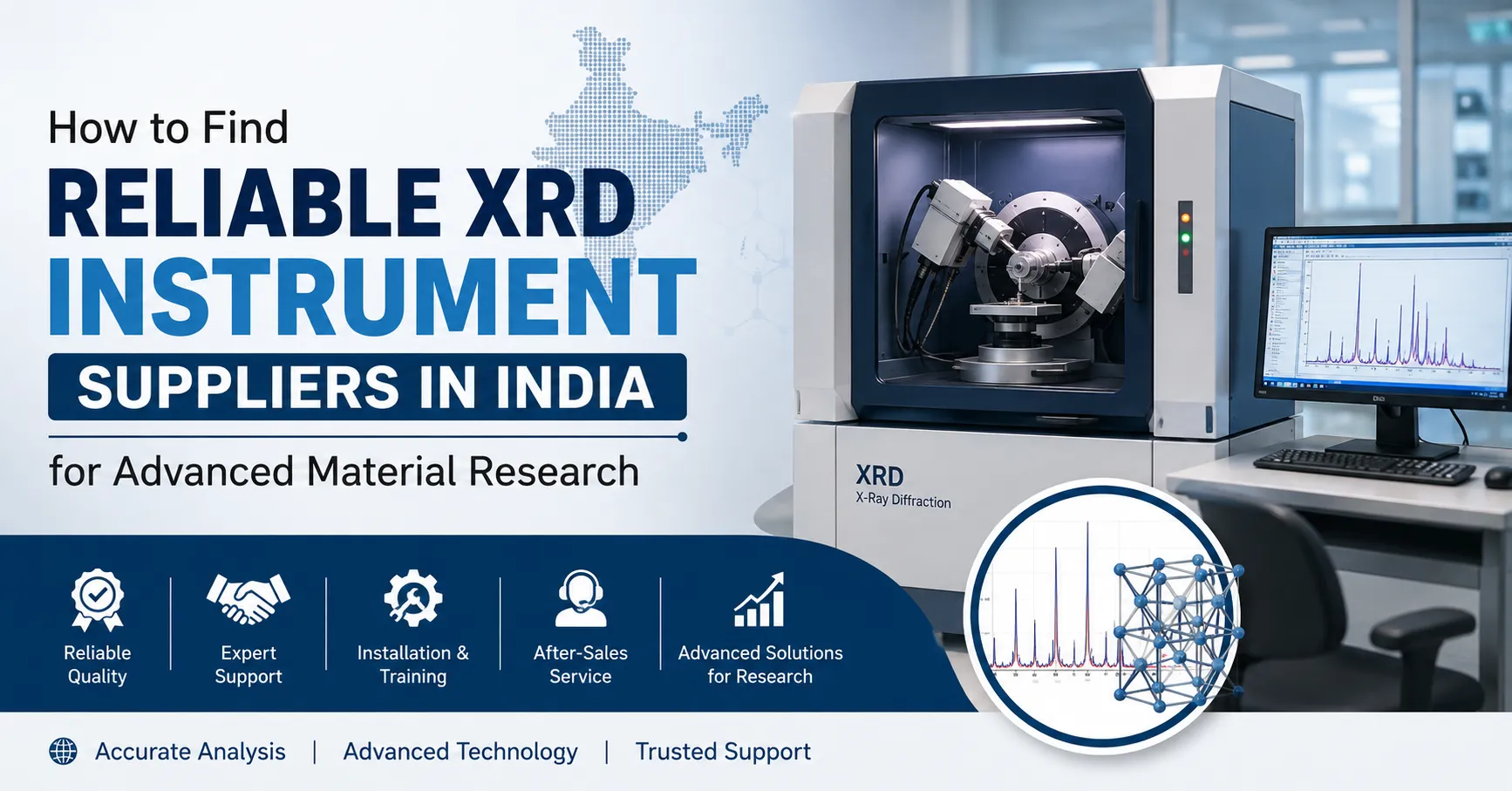
Advanced material research requires accurate, repeatable, and reliable characterization techniques. Among the various analytical methods available today, X-ray diffraction (XRD) plays an important role in understanding crystal structures, identifying phases, studying crystallinity, and analyzing material properties.
However, the performance of an XRD system depends not only on the instrument itself but also on the supplier you choose. A reliable supplier can help laboratories select the right configuration, install the system correctly, provide training, and offer technical support throughout the instrument's lifecycle.
For researchers and laboratories looking for XRD instrument suppliers in India, it is therefore important to evaluate suppliers carefully before making an investment.
What Is XRD and Why Is It Important in Material Research?
X-ray diffraction is a non-destructive analytical technique used to investigate the structural characteristics of crystalline materials. When X-rays interact with a crystalline sample, they are diffracted at specific angles. The resulting diffraction pattern provides information about the material's crystal structure and phases.
XRD is widely used for:
- Phase identification
- Crystal structure analysis
- Crystallinity measurement
- Lattice parameter determination
- Residual stress analysis
- Crystallite size estimation
- Thin-film characterization
- Qualitative and quantitative phase analysis
- Research and development of advanced materials
It can be applied to materials such as metals, ceramics, minerals, polymers, catalysts, pharmaceuticals, semiconductors, nanomaterials, and composites.
Why Choosing the Right XRD Instrument Supplier Matters
An XRD instrument is a significant investment for a research laboratory. Selecting a supplier based only on the initial equipment price can create problems later, particularly when technical support, maintenance, calibration, or application assistance is required.
A reliable XRD instrument supplier in India should provide more than just the instrument. They should understand your research requirements and help you select an appropriate system.
The right supplier can support you with:
- Instrument selection
- System configuration
- Installation and commissioning
- Application-specific guidance
- Operator training
- Software support
- Preventive maintenance
- Calibration services
- Spare parts and accessories
- Technical troubleshooting
- After-sales service
These factors can have a direct impact on laboratory productivity and research quality.
Key Factors to Consider When Choosing XRD Instrument Suppliers in India
1. Evaluate the Supplier's Technical Expertise
Start by assessing the supplier's experience with XRD technology. A supplier with strong technical knowledge should be able to explain important specifications and recommend a system based on your application.
Ask whether the supplier has experience supporting applications such as:
- Powder XRD
- Thin-film analysis
- Phase identification
- Residual stress measurement
- Crystallite size analysis
- Rietveld refinement
- Quantitative phase analysis
A supplier that understands your research objectives can help prevent unnecessary equipment costs and configuration issues.
2. Check the Instrument Specifications
Different XRD systems are designed for different research requirements. Before choosing an instrument, carefully evaluate its specifications.
Important parameters may include:
- X-ray source
- Generator power
- Detector technology
- Angular range
- Angular resolution
- Goniometer configuration
- Sample stage
- Measurement speed
- Temperature-controlled sample stages
- Software capabilities
- Automation options
The ideal configuration depends on the type of materials you study and the analyses you need to perform.
3. Consider Your Research Applications
Instead of selecting an XRD system simply because it has advanced specifications, first define your laboratory's applications.
For example, a laboratory working primarily with powders may prioritize powder diffraction capabilities, while a thin-film research facility may require specialized sample holders and measurement geometries.
Similarly, laboratories working with high-temperature materials may benefit from suitable temperature-controlled stages.
A reliable supplier should discuss your applications before recommending a particular XRD system.
4. Evaluate Software and Data Analysis Capabilities
Modern XRD systems rely heavily on software for data collection, processing, visualization, and interpretation.
When comparing XRD instrument suppliers in India, ask about the software included with the instrument and whether it supports your intended analysis workflows.
Depending on your requirements, useful capabilities may include:
- Peak identification
- Background correction
- Phase matching
- Profile fitting
- Quantitative analysis
- Rietveld refinement
- Crystallite size calculations
- Lattice parameter calculations
- Data export
- Automated reporting
Good software can make complex diffraction data easier to process and interpret.
5. Look at Installation and Commissioning Support
Proper installation is important for obtaining reliable measurements. Environmental conditions, alignment, system configuration, and other factors can influence XRD performance.
Before purchasing, confirm whether the supplier provides:
- Site preparation guidance
- Instrument installation
- System alignment
- Performance verification
- Initial calibration
- User training
- Application demonstration
A supplier that provides complete commissioning support can help laboratories begin their research work more efficiently.
6. Assess After-Sales Technical Support
After-sales service is one of the most important factors when selecting an XRD supplier.
Even a high-quality instrument may require troubleshooting, software updates, calibration, preventive maintenance, or replacement components over time.
Ask potential suppliers about:
- Service response time
- Preventive maintenance
- Technical support
- Calibration services
- Spare parts availability
- Software support
- Warranty coverage
- Annual maintenance contracts
For research laboratories with continuous testing requirements, dependable technical support can help reduce unexpected downtime.
7. Ask About User Training
XRD analysis requires an understanding of both instrument operation and diffraction data interpretation.
A good supplier should provide appropriate training for researchers and laboratory staff. Training may cover:
- Instrument operation
- Sample preparation
- Measurement setup
- Data collection
- Data processing
- Phase identification
- Basic troubleshooting
- Software operation
- Safety procedures
Proper training helps users operate the system effectively and can reduce errors caused by incorrect measurement settings.
8. Review Application-Specific Accessories
The right accessories can significantly expand the capabilities of an XRD system.
Depending on your research requirements, you may need:
- Different sample holders
- Thin-film attachments
- High-temperature stages
- Low-temperature accessories
- Controlled-atmosphere chambers
- Specialized sample stages
- Automated sample changers
Discuss these requirements with the supplier before purchasing so that the system can be configured appropriately from the beginning.
9. Compare Total Cost of Ownership
The purchase price is only one part of the overall cost of an XRD system.
Consider the total cost of ownership, including:
- Initial instrument cost
- Installation
- Software licenses
- Accessories
- Training
- Calibration
- Preventive maintenance
- Service contracts
- Spare parts
- Future upgrades
A slightly higher initial investment may be worthwhile if it provides better long-term reliability, technical support, and application flexibility.
10. Check References and Previous Installations
Before selecting an XRD instrument supplier, ask about previous installations and customers with similar applications.
This can help you understand:
- Instrument reliability
- Supplier responsiveness
- Service quality
- Training effectiveness
- Application support
- Long-term customer experience
If possible, request references from laboratories, universities, research organizations, or industries using similar XRD systems.
Common Applications of XRD in Advanced Material Research
XRD has applications across numerous research and industrial fields.
Nanomaterials
Researchers use XRD to study phase composition, crystallinity, crystallite size, and structural changes in nanomaterials.
Metals and Alloys
XRD can help researchers investigate phases, lattice structures, residual stresses, and structural changes in metals and alloys.
Ceramics
XRD is commonly used to identify crystalline phases and investigate phase transformations in ceramic materials.
Battery Materials
In battery research, XRD can be used to study structural changes in electrode materials during synthesis and cycling.
Catalysts
Researchers can use XRD to characterize crystalline phases and investigate structural changes in catalyst materials.
Pharmaceuticals
XRD can help distinguish crystalline and amorphous phases and characterize solid-state forms of pharmaceutical materials.
Geological and Mineralogical Research
XRD is widely used to identify and characterize minerals based on their diffraction patterns.
Why Local Support Can Be Valuable
For laboratories in India, working with a supplier that can provide local technical support can offer practical advantages. Faster communication, easier service coordination, training availability, and access to technical expertise can all contribute to smoother instrument operation.
When comparing XRD instrument suppliers in India, consider not only their product portfolio but also their ability to provide long-term support within the country.
Red Flags to Watch Out For
While evaluating suppliers, be cautious if a supplier:
- Cannot clearly explain the instrument specifications
- Provides limited application support
- Has no clear after-sales service process
- Cannot provide installation or training
- Does not offer adequate warranty information
- Has limited access to spare parts
- Avoids providing customer references
- Focuses only on price rather than application requirements
These factors may create difficulties after the purchase.
Final Checklist for Selecting an XRD Supplier
Before making your final decision, compare suppliers based on the following checklist:
| Factor | What to Evaluate |
| Technical expertise | Knowledge of XRD applications |
| Instrument specifications | Source, detector, goniometer, resolution, etc. |
| Software | Data collection and analysis capabilities |
| Accessories | Compatibility with your research requirements |
| Installation | Setup, alignment, and commissioning |
| Training | Operator and application training |
| After-sales support | Service and troubleshooting |
| Spare parts | Availability and accessibility |
| Warranty | Coverage and duration |
| References | Previous installations and customer experience |
| Total cost | Equipment plus long-term operating costs |
Conclusion
Finding reliable XRD instrument suppliers in India requires more than comparing product prices. Laboratories should evaluate technical expertise, instrument specifications, software, accessories, installation, training, after-sales support, and long-term service capabilities.
For advanced material research, the right XRD system can provide valuable insights into crystal structure, phase composition, crystallinity, and other important material properties. However, achieving consistent and reliable results also depends on proper system selection, installation, operation, and technical support.
By carefully evaluating suppliers and selecting one that understands your specific research requirements, laboratories can make a more informed investment and build a dependable XRD analysis capability for long-term research and development.


























Sign in to leave a comment.