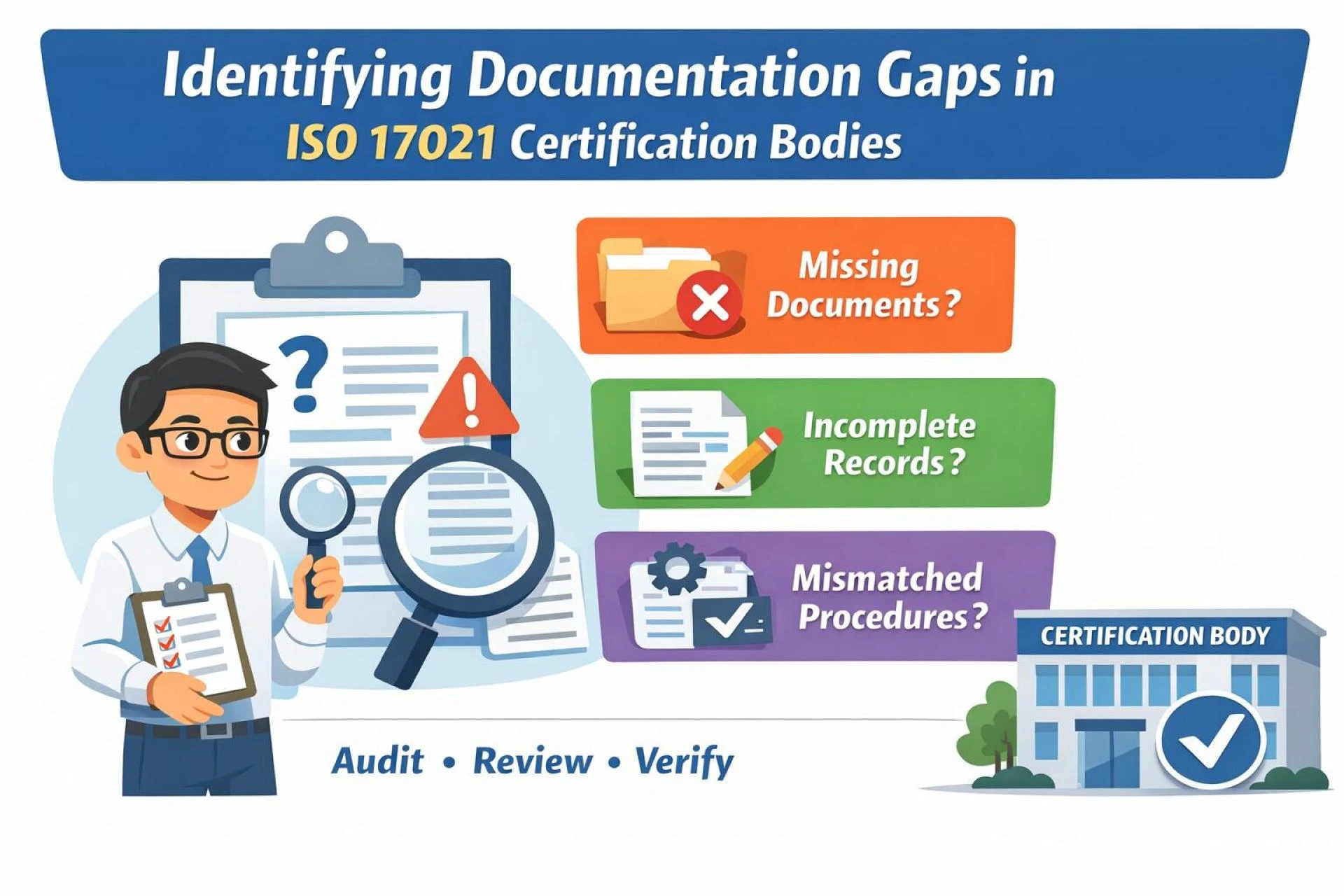

Most of the certification bodies mainly focuses on operational execution, in this documentation gap becomes one of the critical reasons for nonconformities during accreditation assessment.
The ISO 17021 Documentation is not merely a formality but it is evidence of demonstrating consistency, transparency and accountability in the certification body. In this article we’ll explore that how certification bodies can systematically identify documentation gaps before they turn into accreditation findings.
Understanding Documentation Gaps in ISO 17021
To identify documentation gap in the ISO 17021 we should keep following points in mind that required documents are:
- Completely missing
- Incomplete or inadequately defined
- Not implemented as documented
- Not aligned with ISO 17021 requirements
Documentation gaps can be broadly classified into:
- Missing documents (e.g., no impartiality risk analysis)
- Weak documents (procedures exist but lack clarity or controls)
- Mismatch gaps (actual practice differs from documented procedures)
Even well-established certification bodies often face gaps due to outdated documents, generic templates, or undocumented practices.
Why Identifying Documentation Gaps Is Critical
Identifying Documentation Gaps is critical because while failing to identify documentation gaps may lead to so many difficulties such as, Major or minor nonconformities during accreditation assessment, Delays in accreditation approval or scope expansion, Increased corrective action workload, Loss of confidence from clients and accreditation bodies.
More importantly, documentation gaps can threaten impartiality, competence, and certification integrity, which are core principles of ISO 17021.
Key ISO 17021 Documentation Areas to Review
To identify gaps certification bodies must focus on following critical ISO 17021 Documentation areas:
- Management system documentation and policies
- Impartiality policy, risk analysis, and committee records
- Confidentiality agreements and controls
- Certification process procedures (application to decision)
- Auditor and technical expert competence records
- Risk management documentation
- Appeals and complaints handling procedures
- Internal audit and management review records
These areas are frequently reviewed in detail by accreditation assessors.
Step-by-Step Process to Identify Documentation Gaps
1.Clause-Wise Document Review
Start by mapping each clause of ISO 17021 against existing documents. This helps identify:
- Clauses with no documented coverage
- Clauses addressed only partially
- Overlooked sub-requirements
2.Document vs Practice Comparison
Many documentation gaps arise when:
- Procedures are documented but not followed
- Practices are followed but not documented
Interview key personnel, observe processes, and verify whether actual certification activities align with documented procedures.
3.Record Sampling and Verification
Records demonstrate implementation. Sample records such as:
- Audit reports
- Certification decisions
- Auditor evaluations
- Impartiality risk assessments
Check for completeness, authorization, traceability, and consistency. Missing signatures, incomplete evaluations, or inconsistent formats indicate documentation gaps.
4. Risk-Based Gap Identification
Not all gaps carry equal risk. Focus on high-risk processes, including:
- Certification decision-making
- Impartiality management
- Auditor competence and authorization
Gaps in these areas often result in major nonconformities.
Common Documentation Gaps in ISO 17021 Certification Bodies
Based on accreditation assessments, common gaps include:
- Missing or outdated impartiality risk assessments
- Incomplete auditor competence evaluation records
- Weak certification decision documentation
- Poor document control and version management
- Insufficient management review inputs and outputs
Identifying these early can significantly reduce assessment risk.
Conclusion
Identifying documentation gaps in ISO 17021 certification bodies is not a one-time activity but a continuous compliance process. A structured, clause-wise, and risk-based approach enables certification bodies to prevent nonconformities, improve system robustness, and maintain accreditation confidence.



























Sign in to leave a comment.