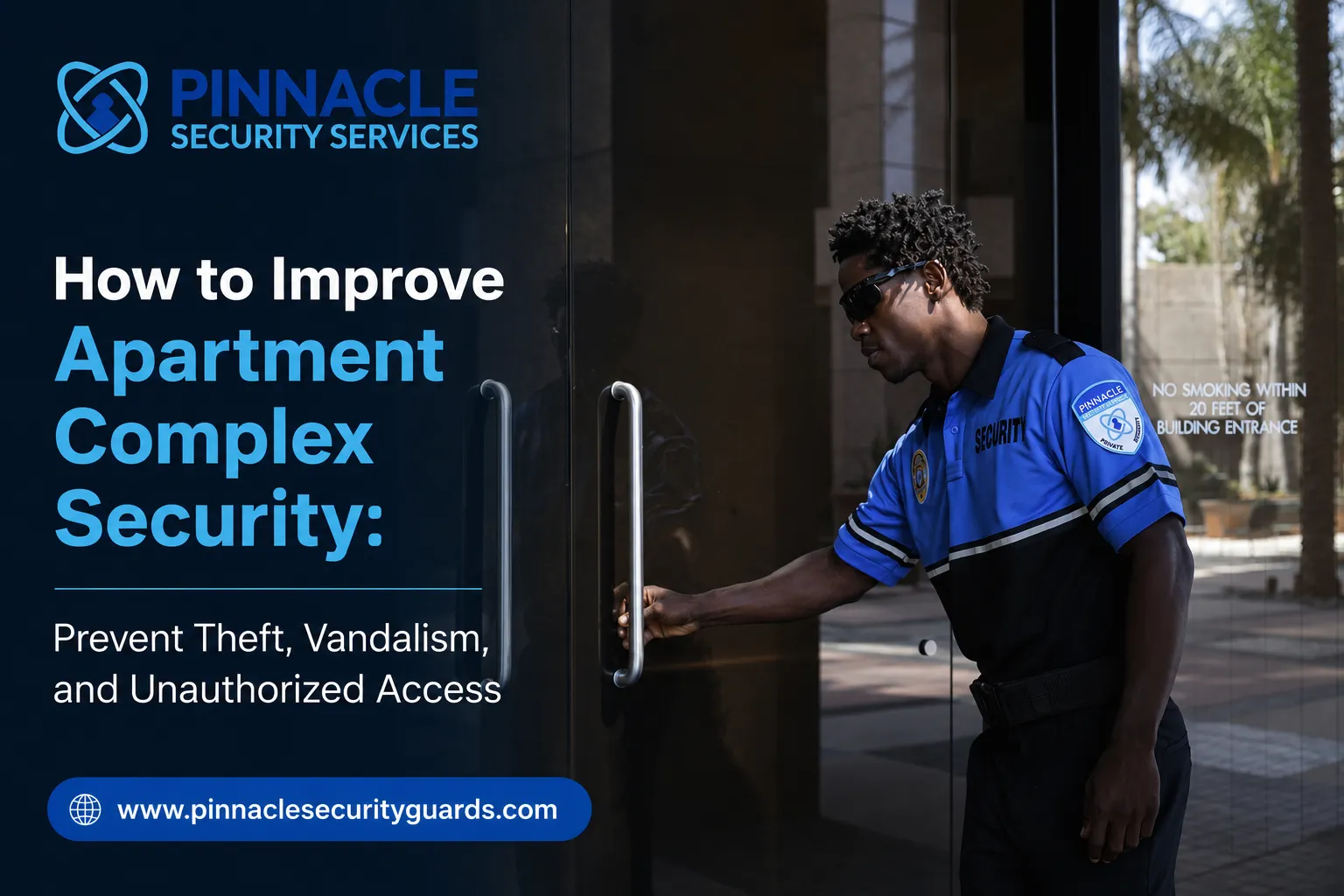

It's late in the evening, and the property manager receives a call from a concerned resident who spotted someone wandering through the parking lot and trying door handles. Incidents like this aren't rare in apartment communities. With dozens or even hundreds of residents, shared amenities, and constant visitor traffic, maintaining a safe environment can be challenging. That's why Apartment Complex Security is more than just having gates or surveillance cameras it's about creating a secure community where residents feel comfortable walking to their cars at night, collecting their packages, and enjoying common areas with confidence.
Effective Apartment Complex Security focuses on preventing problems before they happen, rather than simply responding after an incident occurs. From package theft and vehicle break-ins to vandalism, trespassing, and unauthorized visitors, apartment communities face security risks that can impact resident safety, property value, and tenant satisfaction. In this article, we'll examine the most common security threats affecting apartment complexes and explain how on-site security guards help deter crime, protect residents, and create a safer living environment for everyone.
Why Apartment Complexes Face Higher Security Risks
Single-family homes typically have one door, one driveway, and an owner who knows exactly who belongs on the property. Apartment communities don't have that luxury. A mid-size complex might have a dozen entry points, hundreds of residents cycling in and out each year, and a steady stream of delivery drivers, guests, contractors, and rideshare drivers at all hours.
That constant flow of people creates opportunity. Shared parking lots, mailrooms, gyms, and pools are open to anyone who slips through a propped door or follows a resident inside, a tactic known as tailgating. High turnover means fewer neighbours recognize each other, so a stranger loitering near a stairwell doesn't raise the suspicion it would on a quiet cul-de-sac. Add in minimal supervision overnight, and you have the exact conditions opportunistic crime depends on.
The data backs this up. According to the National Crime Prevention Council, apartment and condo communities experience burglary at meaningfully higher rates than single-family homes, largely because shared spaces feel like public property rather than someone's home.
5 Common Security Threats in Apartment Complexes
Before looking at solutions, it helps to understand exactly what property managers are up against. These five issues show up again and again in apartment communities, regardless of size, age, or location.
Unauthorized Visitors and Trespassing
Tailgating is one of the easiest ways for an unauthorized person to get inside a gated community all it takes is following a resident through a door before it closes. Unsecured side entrances, propped fire doors, and broken gate arms make it even easier. Once inside, a trespasser can wander hallways, test unlocked units, or target parked cars unquestioned.
This erodes the sense of security that gated access and key fobs are supposed to provide, and it raises liability questions if an incident occurs and the property can't show it took reasonable steps to control access. A visible residential security guard changes that equation immediately by verifying who belongs and who doesn't.
Package Theft
E-commerce has made porch piracy one of the most frequently reported crimes nationwide, and apartment residents are especially exposed. Packages often pile up in open mailrooms or lobbies with no one watching, and it only takes a few minutes for a thief to walk off with several boxes at once. Security.org's annual package theft research has found that apartment and condo dwellers are among the hardest-hit groups nationally.
Beyond the inconvenience to residents, repeated theft damages a property's reputation and keeps the leasing office fielding complaints. An on-site presence near mailrooms during peak delivery hours removes the easy opportunity thieves rely on.
Vehicle Break-Ins and Parking Lot Crime
Parking lots and structures are frequently the least supervised part of an apartment property, and criminals know it. Poor lighting, rows of vehicles that block sightlines, and long stretches with little foot traffic make parking areas an easy target for smash-and-grab thefts, catalytic converter theft, and vandalism. A string of break-ins can quickly generate angry resident complaints, insurance claims, and liability questions if a property didn't act after the first incident. Regular patrols through parking areas, especially after dark, disrupt the predictable patterns criminals count on.
Vandalism and Property Damage
Graffiti, broken lighting, and damaged amenities like pool furniture or gym equipment are more than cosmetic problems. They signal, to residents and would-be criminals alike, that a property isn't closely monitored, which tends to invite more of the same. Maintenance teams absorb the cost of constant repairs, and prospective renters touring a damaged property may look elsewhere. A visible security presence, paired with prompt reporting of new damage, helps break the cycle before small problems multiply.
Loitering and Suspicious Activity
Not every security issue involves theft or damage. Groups gathering in stairwells, courtyards, or parking areas late at night can intimidate residents even before any crime has technically occurred, and left unaddressed, loitering has a way of escalating into disturbances or confrontations between residents and outsiders. Staff aren't trained to confront strangers safely, and calling police for every gathering isn't practical. Trained guards are equipped to identify and de-escalate these situations early, before they become something more serious.
These patterns show up in property after property, but they aren't inevitable. Here's how a trained on-site guard works against each one.
How On-Site Security Guards Help Prevent Crime
Visible Deterrence
Most crime at apartment communities is opportunistic rather than carefully planned. Criminals look for properties where they're unlikely to be seen or challenged. A uniformed guard changes that calculation instantly a visible presence signals that someone is watching, which is often enough to send would-be trespassers, vandals, or thieves elsewhere before they act.
Routine Foot and Vehicle Patrols
Consistent patrols through parking lots, hallways, stairwells, entrances, and recreation areas disrupt the predictability criminals rely on. When patrol routes and timing vary, it's much harder for anyone to plan around a guard's schedule. Regular walkthroughs also mean small problems, a broken gate, a burned-out light, get caught before they become bigger vulnerabilities.
Access Control
On-site guards can verify visitors at the gate, confirm deliveries and contractors before they enter, and log every vendor who comes onto the property. This hands-on access control does what a keypad or gate arm alone can't: it puts a trained person in the loop to question anyone without a legitimate reason to be there, cutting down on tailgating and unauthorized entry.
Faster Emergency Response
When a disturbance, medical emergency, or fire alarm goes off, minutes matter. An on-site guard is already on the property and trained to respond immediately, rather than waiting for police or fire crews to arrive from elsewhere. That faster first response often limits how much a situation escalates, whether it's separating an argument before it turns physical or getting a resident help during a medical event.
Incident Documentation
Every incident a guard responds to gets documented: time, location, people involved, and what happened. That record supports insurance claims, helps identify recurring problems in specific areas of the property, and gives law enforcement a clear account if a situation requires follow-up.
Additional Ways to Improve Apartment Complex Security
On-site guards are most effective as part of a layered approach, not a standalone fix. Well-placed CCTV cameras extend a guard's visibility to areas they can't watch in person, and better lighting in parking lots and walkways removes the cover criminals depend on. Controlled access systems and visitor management tools reduce how often guards need to manually screen every person at the gate.
Clear security signage discourages casual trespassing, and resident awareness, simple reminders not to prop open doors or let strangers tailgate, closes gaps no amount of staffing can fully cover alone. Periodic security assessments help property managers see where a community's current setup still falls short, so upgrades happen before an incident rather than after one. Together with quality apartment security services, these measures close most of the gaps discussed above.
How Pinnacle Security Guards Helps Apartment Communities Stay Safe
Pinnacle Security Guards works with apartment communities and HOAs across California, from Sacramento and the Bay Area to Orange County and San Diego, to build security plans around each property's specific layout and risk profile. Rather than a one-size-fits-all package, Pinnacle starts by assessing entry points, parking areas, and incident history before recommending unarmed security guard services or armed officers, along with foot and vehicle patrols and access control support.
Every Pinnacle officer is licensed, background-checked, and trained in de-escalation, visitor verification, and detailed incident reporting, backed by 24/7 dispatch oversight and unannounced field supervisor check-ins a security partner who catches problems early instead of one that only shows up after something's gone wrong.
If your community is dealing with recurring theft, parking lot incidents, or unauthorized visitors, a security assessment for your property is a good place to start.
Conclusion
Apartment communities face a different set of security challenges than single-family neighborhoods: more entry points, more turnover, and less natural supervision. But most of the incidents that result is preventable, not inevitable. Package theft, parking lot crime, vandalism, and unauthorized visitors share a common thread they thrive wherever no one is watching.
On-site security guard services address that gap directly, offering far more than a uniform standing near the entrance. Through visible deterrence, consistent patrols, access control, and fast response, they help build communities where residents feel genuinely safe and property managers spend less time reacting to problems. If you're ready to strengthen security at your property, reach out to Pinnacle Security Guards to talk through your options.
Frequently Asked Questions
Why do apartment complexes need security guards? Apartment communities have multiple entry points, high resident turnover, and constant visitor traffic all factors that create more opportunities for crime than a typical single-family home. On-site security guards help by controlling access, patrolling common areas, and responding immediately when something looks wrong, preventing problems rather than just documenting them afterward.
How do on-site security guards reduce crime? Guards reduce crime mainly through deterrence. A visible, uniformed presence signals that a property is actively monitored, which discourages opportunistic criminals from targeting it. Combined with routine patrols, visitor verification, and fast response to suspicious activity, guards close the gaps that unsupervised properties tend to have, especially in parking lots and after-hours common areas.
What security threats are most common in apartment complexes? The most frequent issues include unauthorized visitors and tailgating, package theft, vehicle break-ins in parking lots, vandalism to shared amenities, and loitering that can escalate into more serious activity. These problems tend to cluster around the same conditions: unsupervised entry points, poor lighting, and areas with little foot traffic.
Should apartment complexes hire armed or unarmed security guards? It depends on the property's risk level. Many apartment communities are well served by unarmed security guard services focused on patrols, access control, and de-escalation. Properties with a history of violent incidents or in higher-risk areas may benefit from armed officers instead. A security assessment can help determine the right fit.
How can property managers improve apartment complex security? Layering multiple measures works best: on-site security guards, CCTV cameras, adequate lighting, controlled access systems, and clear signage all reinforce each other. Encouraging residents not to prop open doors or let strangers tailgate also helps. Periodic security assessments let property managers spot weak points before they turn into recurring problems.






























Sign in to leave a comment.