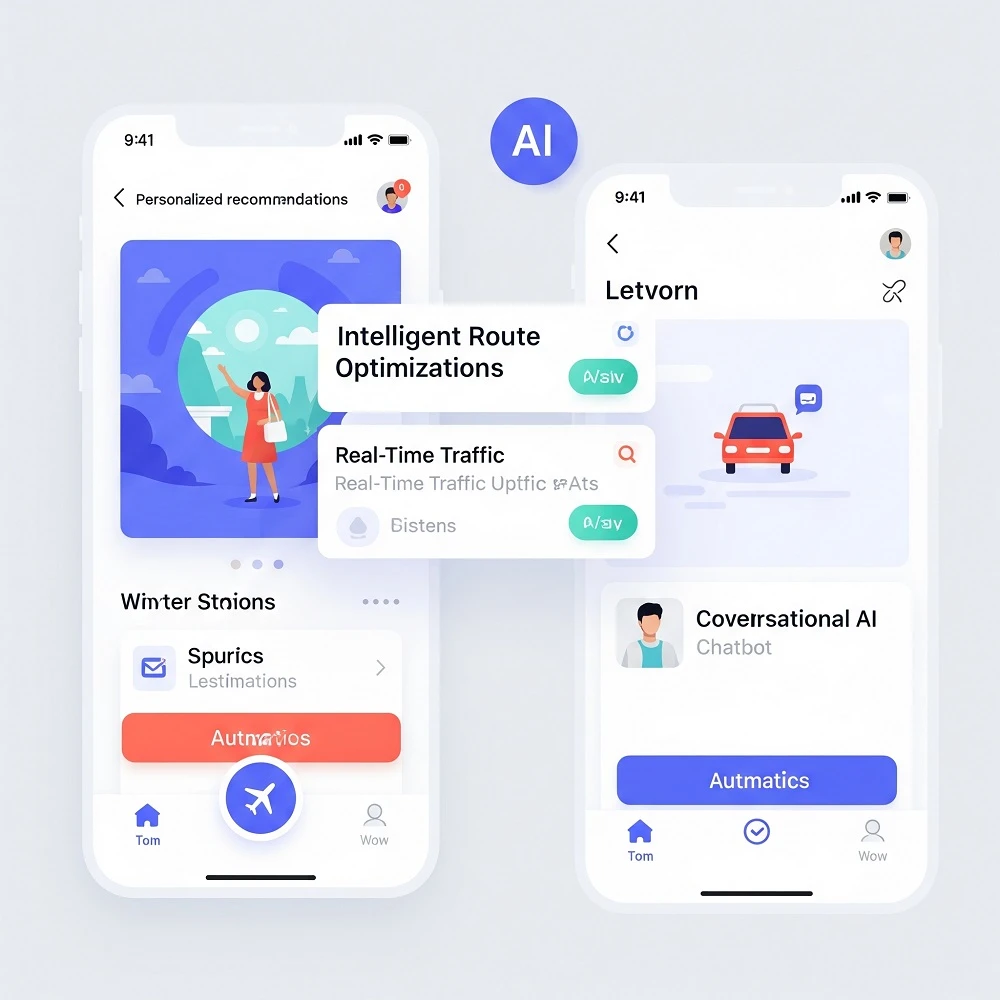

As AI technologies continue to evolve, travel and mobility industries are undergoing a fundamental transformation. From predictive analytics and intelligent routing to hyper-personalized customer experiences, Artificial Intelligence (AI) is now playing a pivotal role in reshaping how businesses deliver value to their customers. For business leaders operating in the travel or mobility sectors, integrating AI into your existing app is no longer a futuristic concept—it’s a strategic imperative.
In this article, we explore how to successfully integrate AI into your current travel or mobility application. Whether you’re a CTO, Product Head, or Business Leader, this guide provides practical insights, strategic considerations, and a roadmap for effective implementation.
The Case for AI in Travel and Mobility
Artificial Intelligence is fundamentally changing the way we build and interact with digital systems. For travel and mobility businesses, AI offers the capability to automate decision-making, forecast demand, optimize operations, and engage users more intuitively. Here are some real-world advantages:
1. Personalization at Scale
Modern travelers expect services tailored to their preferences. AI can analyze user data to recommend destinations, activities, or transportation options based on previous behavior, travel patterns, and contextual factors like weather or location.
2. Real-time Chatbots and Voice Assistants
AI-driven chatbots provide 24/7 customer support, answering frequently asked questions, handling bookings, and offering route information. Natural Language Processing (NLP) ensures these bots sound human and understand user intent more accurately.
3. Dynamic Pricing and Yield Management
Airlines, taxi aggregators, and hotel booking platforms are using AI to adjust pricing in real-time based on demand, seasonality, competitor pricing, and even events or holidays.
4. Fleet and Route Optimization
For mobility apps, AI algorithms help manage routes based on real-time traffic, weather conditions, and user demand. This not only improves efficiency but also reduces costs associated with fuel and vehicle maintenance.
5. Fraud Detection and Security
AI can detect unusual patterns of user behavior to flag potential fraudulent transactions or identity theft, ensuring safer user experiences.
5-Step Guide to AI Integration
Step 1: Define Your Business Goals
Begin by identifying the areas in your travel or mobility app where AI can deliver tangible value. Do you want to enhance customer support? Improve trip recommendations? Optimize fleet routing? Clarifying these objectives will shape the rest of your strategy.
Step 2: Assess Your Current Infrastructure
AI integration isn’t plug-and-play. Evaluate your current backend systems, databases, and APIs to determine if they are capable of supporting AI workloads. If your infrastructure isn’t scalable or real-time, consider transitioning to cloud-native architectures.
Additionally, AI thrives on data. Ensure your data collection mechanisms are compliant with data privacy laws (e.g., GDPR, CCPA) and structured to be usable for AI training.
Step 3: Choose the Right AI Technologies
Depending on your use case, different AI subfields will be applicable:
- Machine Learning (ML): Ideal for predictive models, recommendations, and pattern recognition.
- Computer Vision: Great for document scanning, facial recognition, and augmented reality features.
Working with teams that understand learning programming languages like Python, R, and JavaScript can give you a significant edge, as these languages are often used to build and train AI models.
Step 4: Develop and Train Models
You can either build your own models from scratch or leverage pre-trained models offered by cloud providers like AWS (SageMaker), Google Cloud (AI Platform), or Azure (ML Studio). For example:
- A ride-hailing app could use ML models to predict surge pricing and vehicle availability.
- A travel booking app might integrate NLP to handle user queries via a chatbot.
Once developed, continuously train your models with new data to improve their accuracy and relevance.
Step 5: Pilot, Monitor, and Scale
Begin with a pilot phase. Deploy your AI features to a small segment of users and collect feedback. Monitor key performance metrics such as:
- User engagement rates
- Conversion improvements
- Reduction in manual operations
Iterate on feedback and scale once you're confident in the performance and reliability of the solution.
Security and Compliance Considerations
AI systems often rely on personal data, making security and compliance non-negotiable. Make sure that:
- Data is encrypted both at rest and in transit.
- You obtain explicit consent for data usage.
- AI models are explainable, especially when used for decision-making.
Using AI responsibly also enhances your brand reputation and builds trust among users.
Integration Best Practices
API-first Design
Design AI services as independent microservices that can be consumed via APIs. This modular approach allows for better scalability and easier debugging.
Real-time Processing
Use event-driven architecture and stream processing frameworks (like Apache Kafka) to handle real-time data for applications like fleet tracking or traffic prediction.
UI/UX Alignment
Make sure that the AI features are seamlessly integrated into the user interface. For example, if you introduce AI-based recommendations, present them contextually and offer users the option to refine results.
Using React Native for AI-Enabled Mobility Apps
React Native has emerged as a powerful framework for building cross-platform mobile apps. Its flexible ecosystem makes it easier to integrate third-party AI SDKs and cloud APIs. Whether it’s implementing voice assistants, computer vision tools, or recommendation engines, React Native provides a stable and efficient development environment.
Moreover, its community-driven ecosystem and reusable components reduce development time and cost. If you’re looking to enhance your app without rebuilding from scratch, React Native is ideal for iterative, AI-powered upgrades.
Working with experienced partners that offer React Native app development services ensures that your application is scalable, high-performing, and future-proof. These specialists can help you align AI features with business goals while maintaining a smooth user experience.
Final Thoughts
Integrating AI into your travel or mobility app is no longer optional—it's a strategic move to stay relevant and competitive in a data-driven world. From personalized itineraries to optimized fleets and intelligent support, AI offers transformative potential.
As a business leader, your focus should be on choosing the right AI tools, ensuring infrastructure readiness, and partnering with experts who understand both technology and user expectations. Whether you're enhancing an existing platform or planning your next digital innovation, the time to act is now.
If you’re considering a cross-platform solution, don’t overlook the scalability and flexibility of React Native app development services, which can help accelerate your AI integration while ensuring robust performance across devices.



























Sign in to leave a comment.