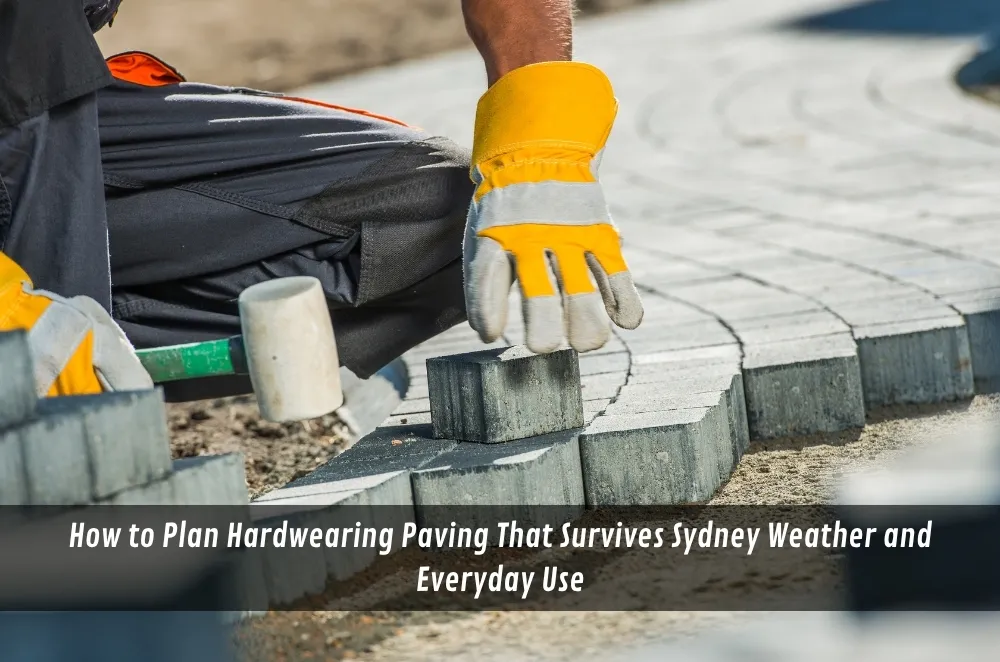

A paved area should feel effortless—until pooling water, wobbly corners, and weeds turn it into a weekend job. Most early failures aren’t about “bad pavers”; they’re about base, drainage, and edges being treated as optional.
In Sydney, hardwearing paving needs to handle hot sun, sudden downpours, and the slow movement that comes with real backyards.
The best outcomes come from planning the paving as a system, not a surface.
What “hardwearing” really means
Hardwearing paving stays level under the loads you actually place on it: foot traffic, outdoor furniture, bins, and sometimes vehicles.
It also manages water reliably, which means the surface has a consistent fall and water has somewhere to go.
Finally, it resists movement at the edges, because spreading is what turns tight joints into gaps that collect sand, dirt, and weeds.
The decisions that matter more than the paver
Base preparation is where durability is decided. The base depth, material choice, and compaction method should match the use case, not the mood.
Drainage is the other deal-breaker. If water sits, it finds joints, softens the bedding, and encourages settlement—especially around garden edges and downpipe runoff zones.
Edge restraints stop the whole field from creeping outward. Without them, even well-laid paving can slowly loosen as loads and ground movement do their work.
Operator experience moment: one quick reality check is to look for the first signs of “repeat puddles” after a solid rain. If the same low spots keep appearing, it’s rarely just a single paver—it’s usually a fall problem across a wider section. Fixing it early is far easier than chasing a patchwork of dips later.
Choosing materials for the job, not just the look
Start with function, then refine the look. A patio and a driveway can both be “paved,” but they don’t want the same structure underneath.
For pedestrian areas, many concrete and clay options perform well when the base and edges are done properly. For driveways, thickness and sub-base become far more critical because vehicles concentrate loads and expose weak points fast.
Also think about comfort and safety. Dark paving can run hot in full sun, and smoother finishes can get slick in shaded, damp corners—especially near fences and garden beds.
If it helps to compare finishes and use cases while you narrow options, A Bargain Gardener paving guide can act as a practical reference point mid-planning.
Common mistakes that cause early failure
Treating a driveway like a patio is a classic. Even if the pavers look sturdy, a light base often settles under vehicles.
Ignoring water pathways is another. Roof runoff, garden irrigation, and higher garden beds can all send water and silt into joints, washing sand out and inviting weeds.
Skipping strong edge restraints to save money usually costs more later, because the surface slowly spreads and loosens.
And rushed finishing details—awkward cuts, poor transitions at gates, uneven thresholds—can turn a “new” area into something that feels annoyingly unfinished every day.
Decision factors when choosing an approach or provider
If the project is small, flat, and purely pedestrian, a careful DIY job can work—provided base, drainage, and edges are treated as the main event.
If vehicles are involved, levels are complex, or drainage is already tricky, a professional paving installation for outdoor spaces approach usually reduces the risk of rework.
When weighing options, focus on specifics rather than vibe:
- Intended load (patio vs driveway vs service path)
- Site conditions (slope, runoff sources, nearby trees, soil behaviour)
- Base specification (depth, material, compaction in layers)
- Drainage plan (where water goes in a downpour)
- Edge restraint detail (what stops spread)
- Maintenance reality (joint sand, cleaning, sealing if used)
Practical opinions (3 lines total):
Prioritise drainage design before choosing a “feature” paver.
If vehicles are involved, assume the base needs to be engineered, not guessed.
Spend on edges and levels—you’ll feel those choices every day.
A simple first-actions plan for the next 7–14 days
Write a one-line purpose for the space (e.g., “outdoor dining for six” or “bins and side access”) so every decision has a test.
Map water flow by watching the site in rain or running a hose and noting where water naturally collects or heads toward buildings.
Measure key levels and constraints: thresholds, steps, gate clearances, retaining walls, and garden bed heights that limit finished levels.
Shortlist two or three material directions based on function: one low-maintenance, one design-led, and one budget-sensible.
Then seek a quote or plan that clearly states base depth, compaction method, drainage approach, and edge restraint type—because that’s where the lifespan is decided.
Local SMB mini-walkthrough (Sydney, NSW)
A small Sydney maintenance business often starts with a “simple” side path request that turns into a drainage and access project.
First, they identify downpipes, garden bed runoff, and any low points that push water toward structures.
Next, they confirm whether the path needs to handle bins, trolleys, or occasional vehicle loads.
Then, they choose a finish that stays safe where shade and moisture linger along fences.
After that, they lock in edge restraint details at lawn lines to prevent creep.
Finally, they plan neat transitions at gates and steps so the upgrade feels intentional, not piecemeal.
Key Takeaways
- Hardwearing paving is a system: base, drainage, edges, then surface choice.
- In Sydney conditions, water management often decides whether paving lasts or fails early.
- Choose materials based on load, slip risk, and heat—then worry about style.
- Good quotes and plans specify what’s underneath, not just what’s on top.
Common questions we get from Aussie business owners
Q1) Usually, is sealing pavers worth it for durability?
Usually, sealing helps most where staining risk is high or where joint sand stability is a priority, but it adds a maintenance cycle. A practical next step is to test-seal one spare paver to confirm the finish and traction. In Sydney, UV and heat can shorten coating life, so plan for reapplication rather than assuming it’s permanent.
Q2) It depends—can old paving be re-levelled instead of rebuilt?
It depends on the cause: isolated low spots may be lifted and re-bedded, while widespread rocking often points to base or drainage problems. The next step is to check whether issues cluster near runoff points, garden edges, or vehicle paths. In many NSW yards, water movement and soil change drive repeat settlement, so fixing levels without fixing flow can be short-lived.
Q3) In most cases, what should be checked before paving a driveway?
In most cases, confirm the base design is suitable for vehicles, edges are properly restrained, and runoff won’t create new problems for garages or neighbouring areas. A practical next step is to request a written base and drainage specification, not just a pattern and paver selection. In Sydney, crossfalls toward buildings and older stormwater layouts can change what “good drainage” needs to look like.
Q4) Usually, how do you reduce weeds between pavers without constant chemicals?
Usually, the best approach is prevention: strong edge restraints, well-compacted bedding, and correctly installed jointing sand that stays put. The next step is a simple maintenance rhythm—sweep regularly and top up joint sand before gaps widen. In Sydney’s humidity and sudden rain, weeds exploit small openings quickly, so early maintenance beats repeated cleanups.

























Sign in to leave a comment.