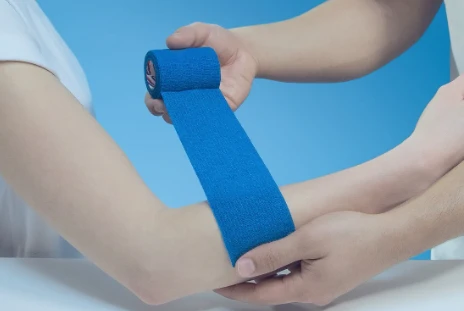

Self-adhesive bandages are also called cohesive bandages or wraps. As their name suggests, they are a type of bandage that sticks to their material rather than to skin, hair, or any other surface. This makes them the perfect choice for several injuries and conditions. This is not the only reason they are found in medical kits and first-aid boxes; cohesive bandages have many other benefits, as you will find in the rest of this article. You will also learn about some functions of cohesive bandages and where to get the best roll to suit your needs. Most importantly, by the end of this article, you will be able to apply a cohesive bandage to protect yourself from injuries properly. Let's get right into it!
Benefits of Self-Adhesive Bandage
We mentioned earlier that there are several reasons why you should consider using cohesive bandages; here are a few of them:
They do not stick to skin and hair. This is a major advantage of cohesive bandages, making application and removal easy.They are very comfortable because of their texture, lightness, and breathability.Their absorbency makes it so that they can be used to apply pressure to wounds. They can also be used as sweatbands.Lastly, their reusability can not be overlooked. Because cohesive bandages lack adhesive, they can be reused without the fear of losing their effectiveness.Functions of Self-Adhesive Bandage
Those are the major advantages of self-adhesive bandages. Now, where can they be applied?
Joint Support
You can use cohesive bandages as a form of musculoskeletal reinforcement. This can be after you have injured a joint or suffered from a condition that considerably weakens that area. You can apply cohesive tape to support and slightly compress a sprained ankle, knee, or shoulder. When applying the tape, avoid making it tight, as this can lead to poor circulation, which is detrimental to the whole purpose of wound healing. The self-adhesive tape will support you due to its firmness, and its breathability may help you heal faster.
Anchorage
When we talk about the anchorage, we are referring to wound dressings. Using an adhesive bandage to hold a wound dressing in place can make things messy. Redressing will also become an arduous task. But with cohesive tape, any adjustments can be made quickly and easily. It is, however, essential to note that cohesive bandages are unsterilized and should, therefore, not be used directly on open wounds.
Speaking of anchorage in less serious situations, athletes have found a fun use of a cohesive bandage. When they find that their club socks are not firm enough, they cut out the loose part and use a cohesive bandage as a replacement. They also use it to hold up shin pads. Its comfort and breathability make it perfect for this purpose.
Injury Prevention
Well, we have saved the best for the last. Injury prevention is a core function of cohesive bandages, and we will discuss it in more detail in the next section.
Cohesive Bandages for Injury Prevention
"Prevention is better than cure" commonly applies when caring for our bodies. This is why some people choose to wear tape before they even sustain any injury.
Many athletes use a cohesive bandage for their joints before engaging in athletic activities. It is especially common among sportsmen and women involved in hand sports. They wrap the tape around their knuckles to avoid hyperextension and bruising. For instance, the force that comes with playing volleyball can be harsh without any prior protection.
How to Apply Cohesive Bandage for Injury Prevention
Below are some tried and tested methods of applying self-adhesive bandages for injury prevention, focusing on our two extremities, the hand, and the foot:
The Hand
The hand is a very vulnerable part of the body. Apart from blunt force trauma, many hand injuries are caused by overexerting the muscles, bones, and ligaments in the body part itself. Taping the hand will provide support, limit excessive movement, and serve as a physical barrier against external forces. So, how do you protect yourself from hand injuries using cohesive bandages?
H-taping method: If you are a rock climber or engage in hand-to-hand combat, this method is for you. What you have to do is wrap the tape in a ring fashion above and below a finger joint. It is quite easy. Let's assume you are taping your index finger below the first joint; wrap a sufficient amount of tape circularly, and do the same for the space beneath the joint. Ultimately, you should have a slit of skin beneath these two wraps. This method helps prevent overexertion of your pulleys.Full method: As the name suggests, you'd be wrapping the entire finger for this method. It is often employed by volleyballers and goalkeepers who constantly have to catch and throw. This is easily the easiest method. Just keep wrapping, ensuring the layers overlap, until you get to the top of the finger. It prevents hyperextension of the fingers, which is common while catching a hard ball.X-taping: This method is mostly used by martial artists. They use it to protect the small ligaments called collateral ligaments and their volar plates, which are the thick ligaments beneath the middle finger joints. Start at the bottom of the finger and wrap circularly to achieve this taping style. After a few layers, pull the tape over to the other side diagonally. This is to form a crisscross beneath the middle joint of that finger. After that, continue wrapping circularly above it.Glove method: This is another method rock climbers use, especially those who stick their hand in the deepest crevices and hold on to the most jagged edges. This method covers the entire hand. You wrap it around your hand like a glove starting from the base of your hand or wrist. When you get the joint between your thumb and forefinger, you cross over it to allow mobility. The most extreme parts of the fingers can be left out for better grip.The Foot
The foot is another part of the body that is susceptible to injury. It is no surprise since it is at an extremity. As you might expect, athletes who use their legs a lot, footballers, for instance, would fall victim to these injuries more often. However, this doesn't restrict the following injury prevention methods for the foot to them:
Ankle taping: Few methods are available for taping the ankle unless you want to get creative. Taping the ankle is mostly for support, and here's how to do it. Flex your ankle such that the toe is facing you and start taping. Start around the ball of your foot and move upwards from there to a little above your ankle. By the time you are done, you should have a makeshift sock. This will support the muscles and ligaments at the back of your foot.To protect your toes, many of the methods for the fingers apply as well. They include the H-method and the full method. The only difference is you are applying it to the toe instead. There is also the buddy taping method that involves tapping two toes together to serve as a splint for each other. This method is often used after injury, but nothing stops you from using it as a preventive method, especially if you think one of the toes is weak.Below are some extra tips for applying cohesive bandages for injury protection:
Make sure it's not too tight. This can never be overemphasised. If it's too tight, you will feel the place going numb, and sometimes, it turns pale due to the obstruction of blood.Ensure it is light enough. You are trying to protect yourself from possible injury, but if you keep adding layer after layer, movement of that body part will eventually become difficult.If you plan to reuse the bandage, be careful on your first application. Even though cohesive tapes are reusable, if you have previously sweated or coated them with dust, it is not advisable to use them again. So, if you plan on making the most of your bandage, be conscious of how you handle it.Lastly, even though you don't need to shave before applying the cohesive tape, always ensure the area you want to apply it to is clean.Why Hampton Adams?
Now that you know the functions and benefits of cohesive tapes, the next step is to purchase your own. Hampton Adams is the perfect place to do this, and here's why. Our tape is the epitome of quality; every material our Hampton Adams self-adhesive bandage is made of is high-quality, medical grade, and hypoallergenic. So, why not get value for your money with us? Head over to our store at Hampton Adams to get your self-adhesive tape now.


























Sign in to leave a comment.