

Your AI just told a client your product does something it doesn't. The client quoted it in a proposal. Now you're on a damage control call at 9:00 AM on a Tuesday.
This is no longer hypothetical. It is a growing enterprise crisis. Many organizations rushed into Generative AI adoption and discovered that sounding convincing is not the same as being accurate. AI hallucinations—outputs that are factually incorrect but delivered with high confidence—are quietly becoming one of the biggest threats to enterprise AI ROI in 2026.
The good news? Hallucinations are not an unavoidable flaw. In most cases, they stem from weak retrieval systems or limited oversight, and that means they can be reduced strategically and at scale.
Why Enterprise AI Hallucinations Are a Growing Business Risk
Hallucinations are far more dangerous than traditional system failures because they often go unnoticed until the damage is already done. While generative AI development services have made it easy to deploy at scale, deployment speed and output reliability are two different things.
Cascading Failures: Hallucinations silently feed false data into workflows. A prominent 2025 example involved Deloitte Canada, where a $1.6 million government healthcare report was found to contain AI-generated, fabricated citations and nonexistent research references.
- Decreased Customer Trust: Rebuilding trust is costly. When customers encounter incorrect financial summaries or product recommendations, they lose faith in the entire system.
- High-Stakes Legal Liability: Courtrooms and regulators are holding firms responsible for AI results. In regulated fields, hallucinations are now treated as compliance failures with real legal consequences.
- Compounding Errors: A hallucinated output in step two of a ten-step automated pipeline travels downstream, influencing every subsequent action built on top of it.
How to Reduce Hallucinations Without Slowing Innovation?
Despite these concerns, AI adoption is accelerating. A McKinsey 2025 report found that while 92% of companies plan to increase AI investments, only 1% believe they have reached AI maturity. Hallucinations are the "hidden tax" on this rapid deployment.
1. Implement Retrieval-Augmented Generation (RAG)
RAG is the "gold standard" for reducing hallucinations. It grounds AI models in trusted, internal data rather than relying on pre-trained knowledge. By anchoring responses to authorized data from your CRMs or internal policy databases, the model acts as a librarian rather than a novelist.
2. Adopt Agentic AI Workflows
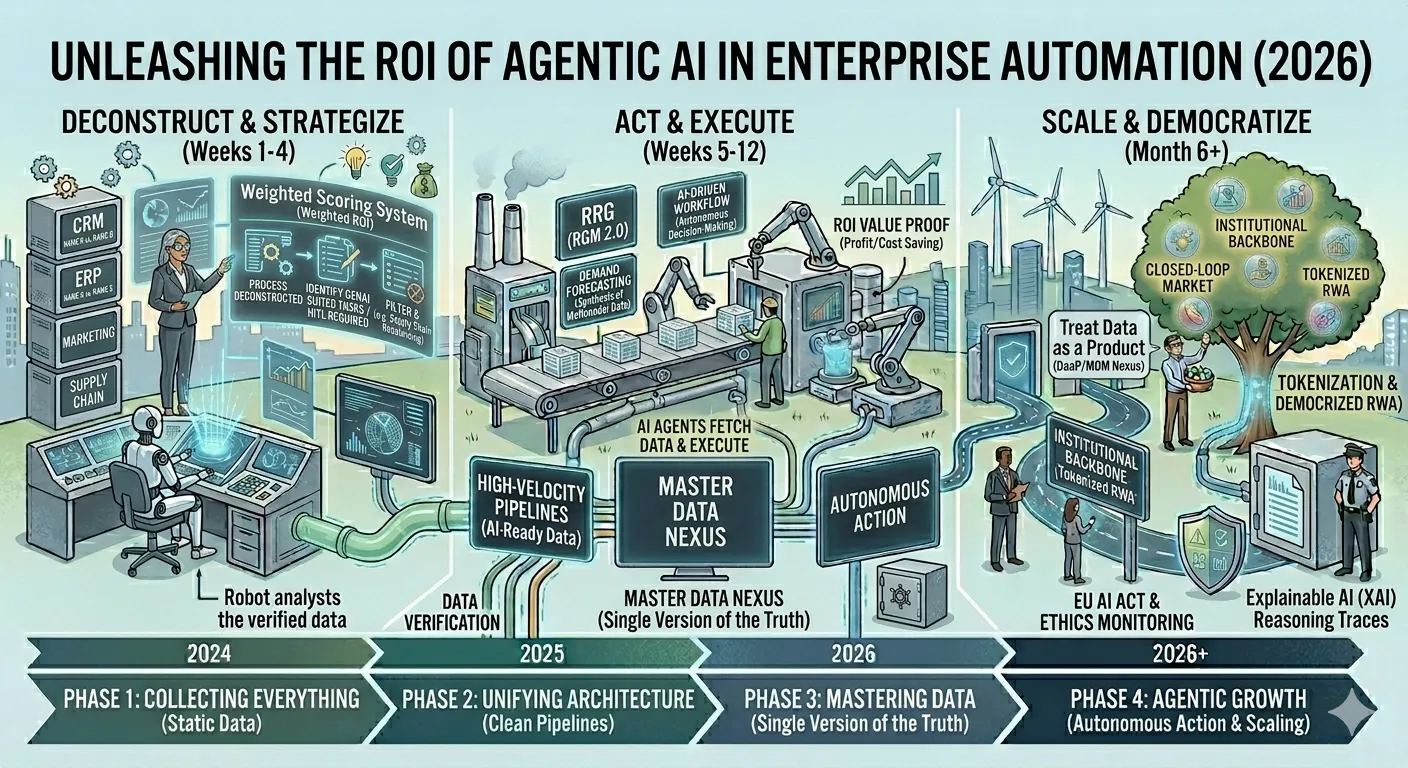
Instead of depending on a single linear prompt, divide complex tasks into a network of specialized autonomous agents. For a risk report, you might use a researcher agent to extract data, a writer agent to compose the narrative, and a validator agent specifically tasked with cross-referencing every figure against the source.
3. Standardize "Chain-of-Thought" Prompting
Encourage models to "show their work." By asking the AI to deconstruct its thinking into logical steps before offering a final response, human supervisors can easily identify where logic breaks down. This transparency allows the model to catch and correct smaller mistakes internally.
4. Fine-Tune Models on Domain-Specific Data
Fine-tuning turns a generalist AI into a specialist that understands the unique language and logic of your company. For industries like pharma, banking, or law, this is the difference between an AI that works in a demo and one that holds up in a high-stakes production environment.
5. Implement Human-in-the-Loop (HITL) Validation
While not every micro-task needs human eyes, critical decision points do. HITL validation ensures that human experts provide inspections at high-stakes points in automated procedures, such as a compliance officer confirming a legal contract before it is sent to a client.
Build Enterprise AI Systems Teams Can Actually Trust
For most businesses, a single incorrect output can undermine consumer trust or pose large-scale compliance problems. However, hallucinations can be reduced without impeding innovation with the right approach.
This is where partners like Straive play a critical role. Straive GenAI Solutions assist companies in transitioning from experimental AI adoption to production-ready AI ecosystems by combining enterprise AI expertise with scalable implementation methodologies. In the world of enterprise AI, success belongs to those who build systems that businesses can actually trust.



























Sign in to leave a comment.