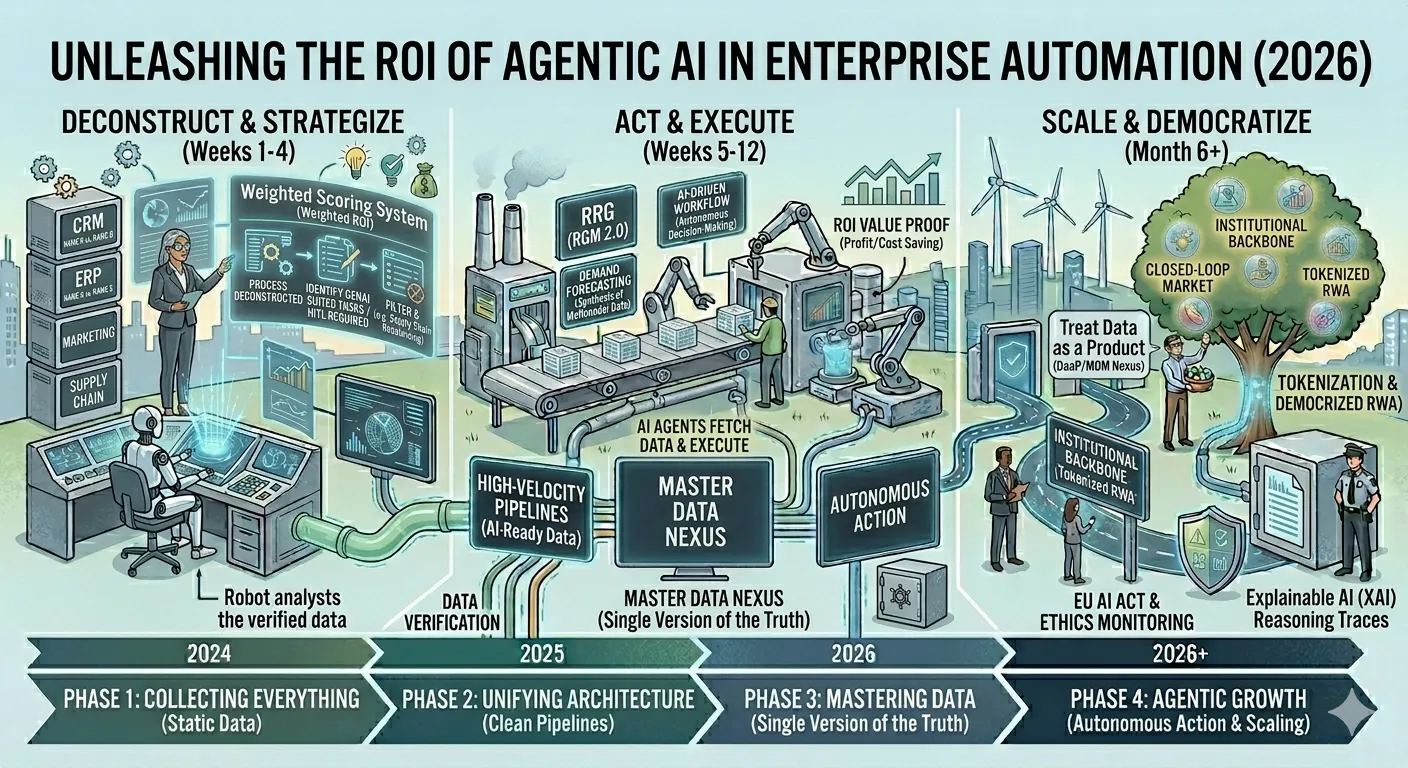

Enterprise automation was supposed to make things faster and smarter. It did. But it also hit a ceiling. The majority of systems still wait for commands, adhere to strict regulations, and don't actually make decisions. That gap is exactly where the next wave of competitive advantage is being built. Agentic AI stepped in as more than just an upgrade. It focuses on allowing systems that can comprehend intent, make judgments, and act with little assistance from humans, rather than just automating tasks.
In 2026, enterprises are no longer just experimenting with AI. Most modern enterprises are partnering with agentic AI companies. They are embedding it deep into core business functions to drive faster decisions and better customer experiences. Let’s take a closer look at how agentic AI is transforming key enterprise functions and delivering real business impact:
The most persistent myth about agentic AI is that it aims to remove the human from the equation. The most successful enterprises treat AI agents as high-productivity digital peers, enabled by thoughtful AI design and development that shapes human–AI interaction. We are moving from “human-in-the-loop,” where people check every micro-task, to “human-on-the-loop,” where they provide strategic direction and governance.
How Agentic AI Transforms Key Enterprise Functions
- From Rule-Based Execution to Goal-Driven Autonomy: Conventional automation, like Robotic Process Automation (RPA), is intrinsically more fragile. Agentic AI fixes this. Agents are given a destination rather than a strict map to follow. They self-correct when they run into a wall and utilize logic to get around obstacles. For example, campaigns are no longer limited by manual rules. AI agents continuously optimize targeting and budgets in real time to boost conversions and reduce costs.
- Proactive Intelligence Instead of Reactive Responses: In the traditional enterprise model, systems are reactive: a person or a legacy bot only steps in when a ticket is raised or a budget is exceeded. Agentic AI shifts the paradigm toward proactive intelligence. These agents monitor the environment and neutralize issues before they impact the bottom line rather than waiting for a trigger.
- Dynamic Workflows That Adapt in Real Time: Workflows in classical automation often take a straight line. The system would stall and require human intervention if a customer changed course mid-process or a data source failed. These fragile scripts have been replaced by dynamic workflows, thanks to agentic AI. Instead of using a predetermined "if-then" logic, agentic systems use continuous feedback loops. Instead of just completing a task, they keep an eye on the outcomes of each step and adjust their next course of action based on actual rather than expected happenings.
5 Major Trends Driving Agentic AI Adoption in 2026
Studies show that while AI is driving results, scaling that impact remains a challenge. According to McKinsey, 64% of organizations say AI enables innovation, but only 39% see enterprise-level EBIT impact. This gap is pushing enterprises toward agentic AI to achieve more scalable, organization-wide value.
- Shift from Generative to Autonomous Operations: The core trend is AI's transition from merely producing content (GenAI) to acting (agentic). These days, agents are built to handle intricate workflows on their own, increasing strategy and service operations efficiency.
- AI-First Design Replacing "AI-Optional": Organizations are moving from fragmented AI pilots to embedding agentic AI into the core business operating layer. A strong agentic AI company helps re-engineer workflows to be agent-first, treating AI as a core part of the workforce rather than a peripheral tool.
- Growth of Specialized and Hybrid AI Architectures: Companies are shifting from monolithic, one-size-fits-all models to smaller, specialized AI agents that are often overseen by a central LLM. For some tasks, this hybrid technique is more accurate and less expensive.
- Convergence of Digital and Physical Agents: Agentic AI is expanding from software to practical applications. It now collaborates with robotics and IoT devices to act in real-world settings in addition to making choices.
- Rise of AgentOps and Governance Standards: As agentic AI scales, enterprises need better control. AgentOps helps monitor, manage, and ensure AI agents operate safely and align with business goals.
The Next Big Leap
Enterprise automation has already delivered efficiency. But efficiency alone is no longer enough. The real advantage now lies in systems that can adapt and act with purpose. That is exactly what agentic AI brings to the table.
With the right partner like Straive, the shift from experimentation to execution becomes seamless. Straive’s AI design and development focuses on operationalizing intelligence at scale, using high-quality domain data to ensure precision that generic platforms cannot match. The enterprises that act now will not just improve efficiency. They will redefine how work gets done.




























Sign in to leave a comment.