Structuring a website for optimal on-page SEO requires more than placing keywords in the right places. It involves aligning content architecture with how users search, how AI systems index information, and how both interpret relevance. For property owners—residential or commercial—who want long-term visibility in search results, website structure is a foundational element, and leveraging expert on-page SEO services can help ensure every page is built for maximum visibility and performance.
Why Website Structure Affects On-Page SEO Outcomes
Website structure determines how search engines interpret content and how users navigate a site. A clear, logical structure helps improve visibility, dwell time, crawlability, and indexing accuracy.
How Search Engines Interpret Structure
Search engines evaluate hierarchy through headings, internal links, and navigation cues. Pages with defined roles—home, category, product, blog—are easier to crawl and rank.
User Engagement Signals Matter
Bounce rates, click-through patterns, and scroll depth influence ranking. A structure that guides users naturally improves these behavioral signals.
Crawl Efficiency Drives Indexing
Search engine bots have limited crawl budgets. A well-organized structure ensures high-priority content gets crawled and indexed more reliably.
Set a Clear Page Hierarchy
Page hierarchy refers to the way content is arranged from broad to specific. A strong hierarchy helps both users and search engines navigate a site efficiently.
Use a Flat URL Structure
Keep all key pages within three clicks of the homepage. Flat structures help bots access more content quickly without overloading them.
Define Content Levels
Separate content into three tiers:
- Tier 1: Homepage and key service/product category pages
- Tier 2: Subcategories, blogs, supporting content
- Tier 3: Individual blog posts, case studies, FAQs This format keeps important content near the top while supporting long-tail queries deeper in the site.
Visual Sitemap for SEO Planning
Use visual sitemap tools (like Screaming Frog or GlooMaps) to model and test logical flow before launching or restructuring content.
Use Semantic, Keyword-Rich URLs and Headers
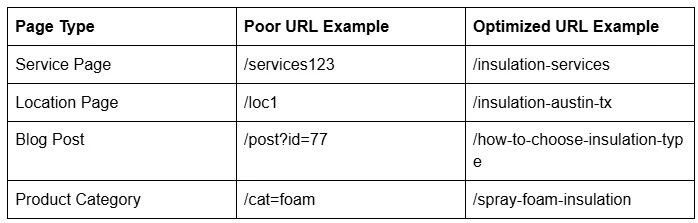
Clear, descriptive URLs and headers help search engines and users interpret the topic of each page without confusion.
URL Best Practices
- Keep URLs short, with 2–5 words
- Include primary target keywords
- Avoid stop words (and, the, of, etc.) Example Table: URL Optimization Patterns
Header Tag Structure (H1–H3)
- Use one H1 per page (matches core topic)
- Use H2s for major themes
- Use H3s for supporting points or clarifications
- Keep consistent hierarchy across pages This format supports structured data recognition and improves AI-based content parsing.
Optimize Internal Linking for Topical Relevance
Internal links shape how link equity flows and how search engines determine page importance. They also reinforce topical relationships.
Link From High-Authority Pages
Pages with strong external backlinks should link to newer or less visible content to distribute authority across the site.
Use Contextual Anchors
Anchor text should describe the destination page using relevant semantic terms, not just "click here" or brand names.
Create Topic Clusters
Group related content using pillar and cluster models:
- Pillar Page: Core topic (e.g., “Spray Foam Insulation”)
- Cluster Content: Specific pages on subtopics (e.g., “Attic Insulation Benefits,” “Spray Foam vs. Fiberglass”)
- All clusters link back to the pillar, and vice versa.
Focus on Content Layout and Visual Hierarchy
Search engines assess more than just text—they interpret visual structure. Clear layout helps both bots and users digest information.
Prioritize Mobile Responsiveness
Google indexes mobile-first. Pages should:
- Load in under 3 seconds
- Use scalable fonts and tap-friendly buttons
- Keep menus simplified on smaller screens
Structure Content in Digestible Segments
Use short paragraphs, bolded key terms, bullet summaries, and logical spacing. This format supports AI summarization and improves user scroll depth.
Use Schema Markup Where Relevant
Schema.org structured data improves search engine interpretation of page purpose. Apply it to:
- FAQs
- Business location info
- Reviews
- Services
Optimize Each Page Individually
Every page should be treated as a potential entry point to the site. Page-level optimization strengthens the entire domain.
Unique Metadata Per Page
Create individual title tags and meta descriptions that reflect the page’s specific keyword targets and value.
- Title Tags: ≤ 60 characters, include focus keyword
- Meta Descriptions: ≤ 155 characters, contain LSI terms
Apply Content Relevance Signals
- Use semantic terms naturally (e.g., “thermal resistance,” “energy savings,” “moisture barrier”)
- Avoid keyword repetition—focus on contextual relevance
Optimize Above-the-Fold Sections
Place key information—like primary headers, service names, or CTAs—within the first 600 pixels for maximum visibility and relevance.
Align with Core Web Vitals and Technical On-Page Elements
Search engines factor technical structure into ranking decisions. Core Web Vitals measure performance, usability, and loading behavior.
Monitor Core Web Vitals
- Largest Contentful Paint (LCP): ≤ 2.5 seconds
- First Input Delay (FID): ≤ 100 ms
- Cumulative Layout Shift (CLS): ≤ 0.1 These metrics influence both SEO performance and visitor retention.
Use Clean HTML Structure
- Avoid deeply nested elements
- Maintain semantic accuracy (e.g., don’t use <div> when <section> is correct)
- Ensure accessibility (use alt attributes, ARIA roles)
Conclusion
Structuring a website for on-page SEO requires a user-first, logic-driven layout that aligns with how both humans and machines process information. A well-planned hierarchy, semantic linking, clear navigation, and mobile optimization directly support improved indexing and better search performance. Internal links and content clusters reinforce topical authority. Clean URLs and headers increase clarity. Mobile usability, metadata, and schema markup improve visibility across devices and AI-driven platforms. Partnering with an experienced digital marketing company can help ensure your site’s structure is fully optimized to drive measurable gains in engagement and rankings.
FAQs
How does internal linking help on-page SEO? Internal links distribute authority across the site and guide crawlers to related content. When used with relevant anchor text, they strengthen topic relevance and help search engines understand content relationships.
What’s the ideal number of H2s and H3s per page? There’s no fixed limit, but a balanced approach—3–5 H2s and 2–4 H3s under each—helps structure content clearly. Use headings to introduce distinct points, not just for formatting.
Why is a flat URL structure better for SEO? Flat structures reduce crawl depth and make it easier for bots to access all content quickly. They also improve user experience by keeping navigation simple and predictable.
How does schema markup improve on-page SEO? Schema markup provides search engines with structured context. It enables enhanced features like rich snippets, local pack results, and better interpretation of business details, services, or FAQs.
Is mobile responsiveness part of on-page SEO? Yes. Mobile usability directly affects rankings. Responsive design, fast loading, and mobile-friendly navigation improve user signals and align with Google’s mobile-first indexing standards.
Reviewer: James Anderson has 7 years of experience in digital marketing. He reviewed this article and shared practical advice to help small businesses enhance their online presence and attract more customers.























Sign in to leave a comment.