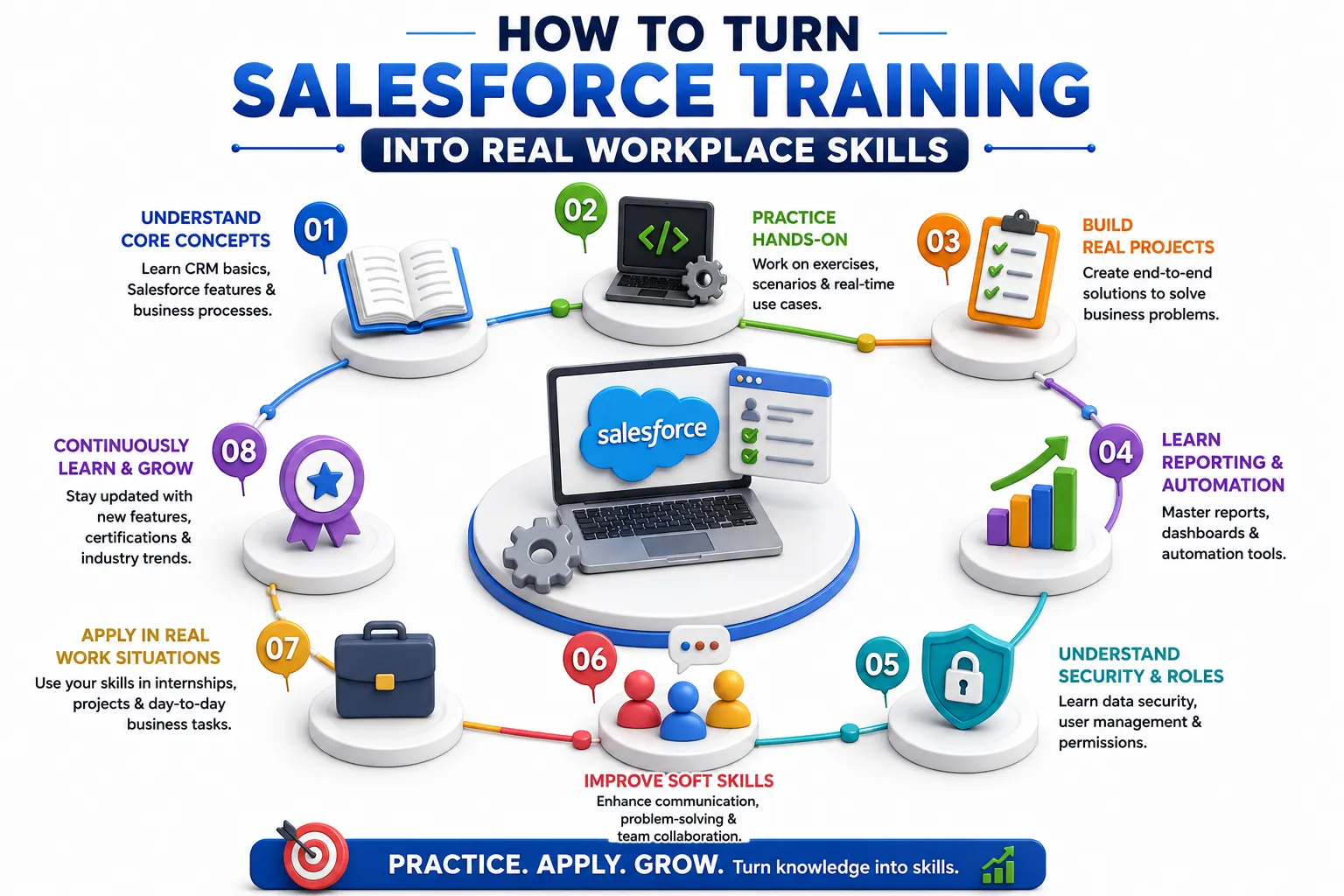

Many people enroll in Salesforce Training with the goal of starting a successful career. They complete lessons, understand CRM concepts, and even finish assignments. However, one question often remains:
"How can I use what I've learned in a real workplace?"
The answer lies in applying your knowledge through practice, understanding business processes, and developing the skills employers actually need. Salesforce isn't just a software platform—it's a tool businesses use to improve customer relationships, automate work, and make better decisions.
In this article, you'll learn how to transform your Salesforce knowledge into practical workplace skills that can help you succeed in professional roles.
Start with CRM Fundamentals
Before learning advanced Salesforce features, make sure you understand the basics of Customer Relationship Management (CRM).
Businesses use CRM systems to:
- Manage customer information
- Track sales opportunities
- Improve customer service
- Build long-term customer relationships
Understanding these fundamentals helps you see how Salesforce supports everyday business operations instead of treating it as just another application.
Practice What You Learn
Reading notes and watching tutorials are useful, but practical experience is what turns knowledge into skill.
During Salesforce Training, make time to practice tasks such as:
- Creating user profiles
- Managing customer records
- Building reports
- Designing dashboards
- Customizing page layouts
- Organizing business data
The more you practice, the more confident you'll become.
Think Like a Business User
One common mistake beginners make is focusing only on platform features.
Instead, ask yourself questions like:
- What problem is this feature solving?
- How will this help a sales team?
- How can customer service benefit from this process?
- Will this save employees time?
Thinking from a business perspective helps you understand why Salesforce is valuable.
Work on Real-World Projects
Hands-on projects bridge the gap between learning and professional work.
Try creating simple projects such as:
- A customer management system
- A sales pipeline dashboard
- A lead tracking application
- A support case management process
These projects help you understand how businesses use Salesforce every day and give you practical examples to discuss during interviews.
Develop Problem-Solving Skills
In the workplace, you'll rarely receive step-by-step instructions.
Instead, you'll be expected to understand business requirements and recommend solutions.
As you continue your Salesforce Training, challenge yourself to solve small business problems using the platform. This habit strengthens your analytical thinking and prepares you for real job responsibilities.
Learn to Communicate Clearly
Technical knowledge is important, but communication is equally valuable.
Whether you're working with clients, managers, or team members, you'll often need to explain your ideas in simple language.
Practice describing:
- The purpose of your project
- The business problem
- Your solution
- The expected outcome
Strong communication skills make collaboration much easier.
Understand Reports and Dashboards
Businesses rely on reports and dashboards to monitor performance and make decisions.
Instead of learning only how to create them, understand:
- Which data matters
- Why managers need reports
- How dashboards support business planning
This knowledge helps you connect technical work with business goals.
Build Good Work Habits
Professional success depends on more than technical ability.
Develop habits such as:
- Meeting deadlines
- Paying attention to detail
- Keeping your work organized
- Taking notes
- Asking thoughtful questions
- Learning from feedback
These habits are valuable in every workplace.
Continue Learning Beyond the Course
Completing Salesforce Training is only the beginning.
Salesforce continues to introduce new features, and businesses constantly look for professionals who are willing to learn and adapt.
Keep improving your skills by:
- Practicing regularly
- Reviewing business scenarios
- Building additional projects
- Learning new platform features
Continuous improvement helps you stay competitive.
Choose Practical Learning
If you're comparing different learning options, look for programs that emphasize practical experience instead of theory alone.
A good Salesforce Training in India program should include assignments, business case studies, and project-based learning that prepares you for workplace situations.
Similarly, if you choose Salesforce Online Training, make sure it offers interactive sessions where you can practice instead of only watching recorded videos.
Build Confidence Before Applying for Jobs
Many beginners hesitate to apply for jobs because they don't feel ready.
Confidence grows when you've practiced regularly and completed meaningful projects.
You don't need to know everything before starting your career. Employers value candidates who understand the basics, demonstrate practical skills, and show a willingness to learn.
Conclusion
Turning Salesforce Training into real workplace skills isn't about memorizing every feature—it's about learning how businesses solve problems using Salesforce. By practicing consistently, working on projects, understanding business processes, and improving your communication skills, you'll be better prepared for real-world responsibilities.
Whether you're learning through classroom sessions or Salesforce Online Training, focus on applying your knowledge instead of simply completing lessons. Practical experience, continuous learning, and the right mindset will help you build the confidence and skills needed for a successful Salesforce career.
Frequently Asked Questions
How can I apply Salesforce Training in a real job?
Practice real-world projects, understand business processes, and learn how Salesforce helps organizations improve customer relationships and automate daily tasks.
Why are practical projects important?
Projects help you apply what you've learned, improve problem-solving skills, and build confidence for interviews and workplace responsibilities.
Can beginners develop workplace skills through Salesforce Training?
Yes. With regular practice, hands-on assignments, and a focus on business scenarios, beginners can build practical skills that employers value.
Is Salesforce Online Training enough to become job-ready?
A quality online training program that includes live sessions, practical exercises, and project work can help learners develop workplace-ready skills.
What should I focus on after completing Salesforce Training?
Continue practicing, build more projects, strengthen your communication skills, and stay updated with new Salesforce features to support long-term career growth.



























Sign in to leave a comment.