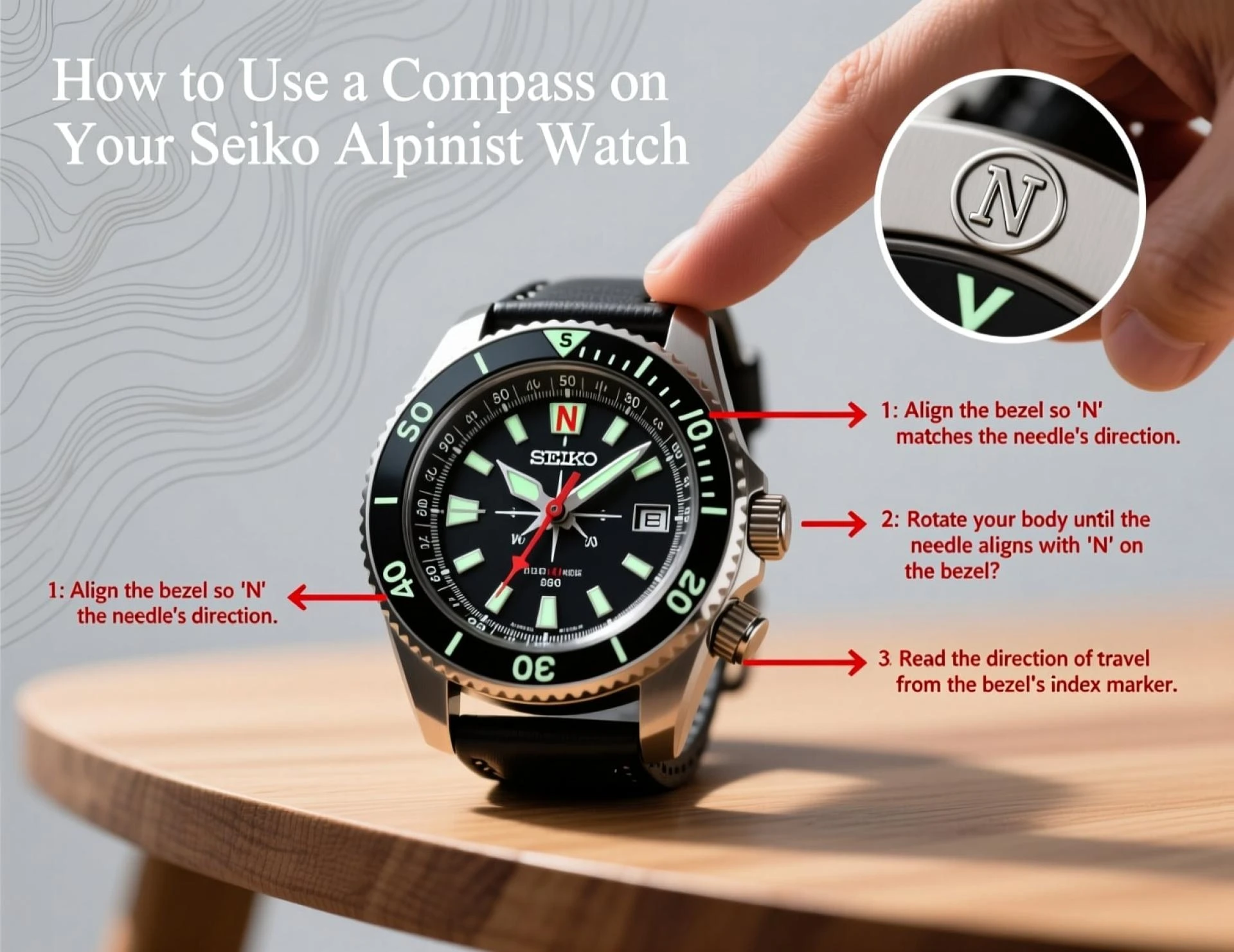

The Alpinist is not just a watch; it is a way of life. To put it mildly, it has filled a unique niche since its introduction in the 1960s—a sturdy, elegant, and highly capable tool watch for mountain thrill-seekers and watch enthusiasts alike. The rotating internal bezel for the compass function is the most distinctive and enchanting characteristic of the Seiko Alpinist. The compass is a mystery to the new owner when it comes to this great complication. How do you go about doing that? How effective are you going to be using it out in the field? This will give you a crash course in everything you need to know about the built-in compass of your Alpinist watch, from a beautiful add-on to a practical navigational tool.
Understanding Your Seiko Alpinist Compass Bezel
As with any compass, its components must be understood in order to be fully operated. The Alpinist's compass does not have an external bezel as diver's watches do, which can be rotated by fingers. It comprises an internal ring, marked from 0 to 360 degrees, or N, E, S, W, which lies in between the main dial and the crystal. This ring is turned by means of a crown positioned at the 4 o'clock position of the case.
This design stands out for several reasons. It first and foremost protects the compass ring from being accidentally knocked out of position. The second advantage is that since it uses a crown to turn, one can control it much finer and precisely. The crown is usually of a screw-down variety, which maintains water resistance. Recognizing that the 4 o'clock crown is the key to the compass is your first step toward becoming a proficient navigator.
Step-by-Step: How to Take a Bearing
Taking a bearing with your Alpinist is an easy process when you know how. The aim is to know what direction you are facing, which is called taking a bearing. Here's how to do it:
- Position the Watch Correctly: Hold the watch level in your hand, much like the traditional baseplate compass. For the most accurate reading, you should take the watch off your wrist and hold it steady.
- Align with the Sun (or a Landmark): This is the most common method. Point the hour hand of your watch directly toward the sun. If you're in the Northern Hemisphere, you'll be using the hour hand. (Note: In the Southern Hemisphere, you would point the 12 o'clock marker at the sun).
- Find South (or North): This is where the little calculation comes in. Draw a mental line bisecting the smaller angle between the hour hand and the 12 o'clock marker. In the Northern Hemisphere, this halfway point indicates south. So if it is 10 in the morning, the hour hand would be at 10 o'clock. This means that the halfway point between 10 and 12 would place South at approximately 11 o'clock on your dial.
- Set the Compass Ring: Rotate the secondary crown at 4 o'clock until the "S" (or 180-degree mark) on the internal bezel aligns with the South point that you just identified. This needs to be done while holding the watch fairly steady.
- Read Your Bearings: With the "S" set to South, the entire compass ring is now oriented relative to the cardinal points. You can now read your bearing directly. "N" will point to North, "E" to East, and so forth. Now you are able to hold your watch steady, and any object you point to will correspondingly have direction indicated on the compass ring.
It is noteworthy that this way of finding direction relies on the position of the sun and the time of the watch. It is not using a magnetic compass and is therefore not disturbed by local magnetic fields from electronics or metal structures, but it needs you to see the sun and have an idea of the time.
Calibration and Best Practices for Accuracy
The sun-and-time method works pretty well; however, some best practices should be followed for maximum accuracy.
- Calibrate with a Known Reference: An excellent way to be sure your compass is set correctly is to calibrate it using a known landmark or reliable compass (such as one on your smartphone). Pick an azimuth you know for sure—stand on a road you know runs perfectly north-south. Point the watch toward that known direction, then rotate the internal bezel to match. Now your Alpinist rests perfectly calibrated for your immediate location.
- Account for Daylight Saving Time: The sun method is based on true local time. If you are on Daylight Saving Time, you must compensate by using the hour one before the current time for your calculation. For instance, if it's 2 PM DST, apply the calculation as if it were 1 PM Standard Time.
- Keep it Level: Like any directional instrument, holding the watch level is key to an accurate reading. Tilting it may disturb the perceived alignment.
- Understand its Limitations: The compass on your Seiko Alpinist is great for general orientation and backup navigation. For serious mountaineering or off-trail navigation in featureless terrain, however, you will want to supplement this with a proper magnetic compass and a critical topographic map. Its true beauty remains in being integrated into a tool you are already wearing, providing continuous reference to the style of your journeys.
Unlocking the internal rotating compass is what really gives this icon its very soul. The compass connects you back to that heritage of the explorers who originally relied upon it and changes your relationship with the timepiece from one of passive admiration to active utility. After a little practice, taking a bearing will be second nature, transforming your Seiko Alpinist from a watch for the mountains to a watch for the thoughtful adventurer in secular daily life.






























Sign in to leave a comment.