
In the admittedly rarefied world of haute horology, where, for the most part, it is tradition that rules, scarcely a few brands will ever consistently dare to challenge the conventions of watchmaking with the kind of boldness and showmanship that Franck Muller brings to the table. Simply this name brings to mind dramatic artistry and technical bravura, and so it prepares one for very much anything but mainstream timepieces. In answer to who could ask, "What differentiates a Franck Muller watch from all others?" The answer is not a single feature but an entire philosophy that thinks of the watch dial as a canvas and the movement as a stage for constant innovation. Thus have been born the brand's rebellious roots from the inception itself—transforming the idea of luxury watches into that of combining complex mechanical ingenuity with bold, unmistakable beauty that continues to captivate collectors and connoisseurs around the globe.
The Iconic Cintrée Curvex: A Blueprint for Avant-Garde Design
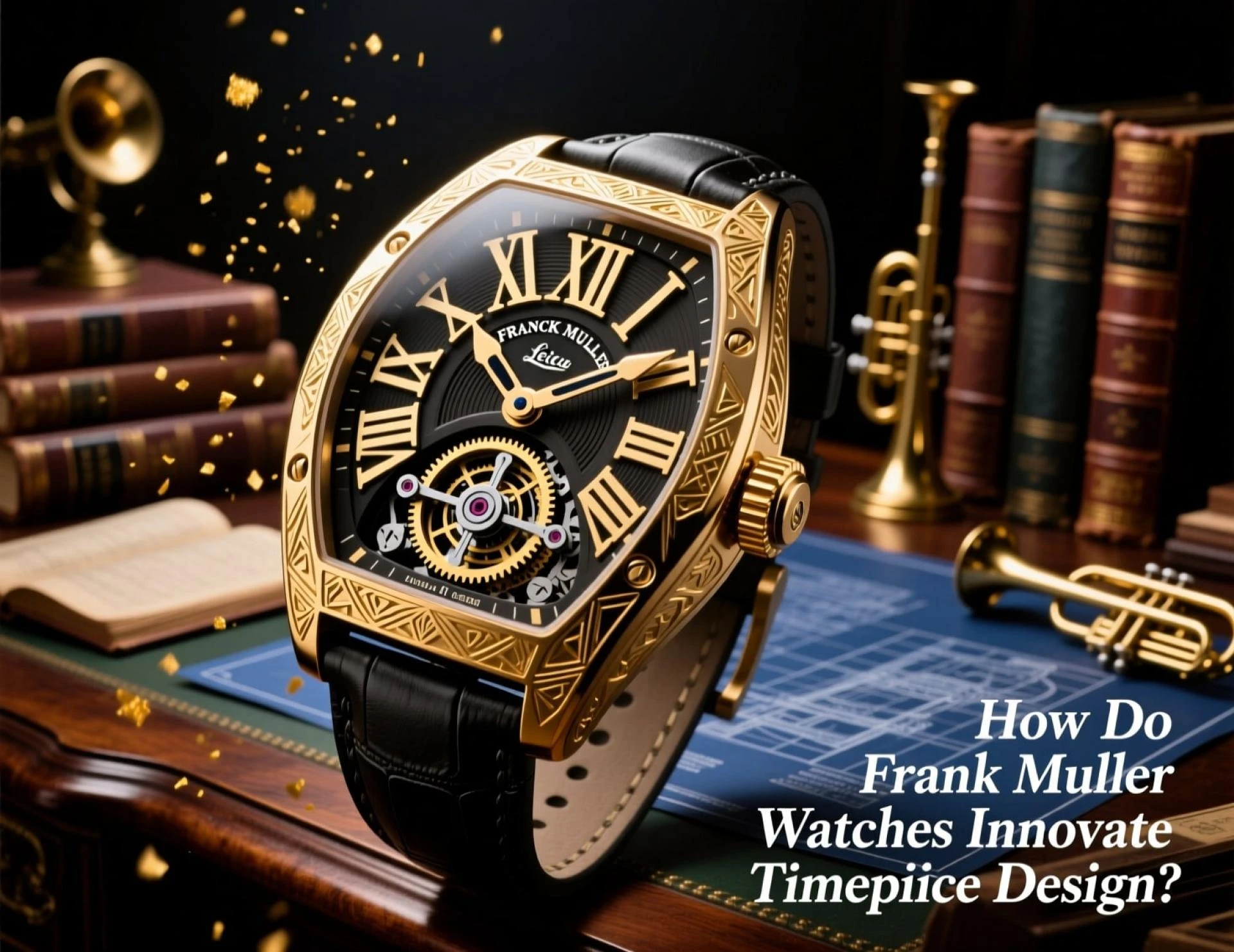
Before going on about the wonderful mechanics, one must first appreciate what forms the bedrock of Franck Muller's design language: the Cintrée Curvex case. In a time of round watches, Muller's introduction of a case that was really out of the ordinary: tonneau-shaped but possessing a pronounced curvature that ergonomically hugs the wrist. This was much more than a stylistic whim; rather, it was a structural revolution. Three dimensions—length, width, and height—define the curve of the case, making it a sculptural form that is both difficult to manufacture and beautiful to behold. This case became the signature "canvas" for the brand: a uniquely signed frame that decisively distinguishes a Franck Muller watch from its peers. It offered a unique identity that was immediately recognizable, proving that innovation could begin with the very silhouette of the timepiece before a single complication is even considered.
The Mastery of a Franck Muller Watch: Grand Complications Reimagined
If the case is a stage, then the complications are lead actors. Franck Muller not only adopted pre-existing complex mechanisms, but he also saw them anew, usually made them even more complex, and always dramatized their presentation. Franck Muller makes most of the grand complications: minute repeater, perpetual calendar, tourbillon, and chronograph, but their trademark lies in the way they make it happen. Take, for example, the very famous "Grande Sonnerie" models, which are used to refer to some of the most complicated striking mechanisms in watchmaking, but, at the same time, they are more complicated, as these sonneries are endowed with other grand complications, yielding crazy complexity and incorporating them into wristwatches. In addition, this particular approach tends to skeletonize intricate movements such that it does not only showcase technical prowess, but it translates mechanics into an art form such that it allows the wearer to see the symphony of gears and levers in motion.
The Art of Dial Design: Numbers as a Signature
It probably is Franck Muller's most visually immediate innovation in the treatment of the dial; this would be the famous numerals echoing Art Deco in numbers. Dubbed "Master of Complications," Muller also proved himself to be a master in legibility and style. Those large, often exaggerated, and boldly stylized numbers became a signature. This was deliberate, a slap on the conservative, often straightforward dials that many other high-end watch manufacturers embraced. This gave personality and flair, turning the watch into more than an instrument of time but an expression of art. This focus on the dial includes guilloché patterns, as well as the use of vibrant colored gemstones and intricate enameling, ensuring that every Franck Muller watch is an entirely unique piece of art from every angle.
Pushing Boundaries with the Crazy Hours
Perhaps the best example of Franck Muller's innovative mindset is the "Crazy Hours" model, remarkable because it is superficially whimsical, giving the impression of being haphazardly scattered—or misordered—on the dial. Yet, this artful surface hides a true mechanical innovation: at a complex module, the hour hand suddenly jumps from, say, 1 to 5, going to 11, and continues on, the minute hand going about its sweep regularly. It misled the most important principle of time telling—patterning the numbers in sequential order. An excellent conceptual breakthrough, in that it proved that a watch could simultaneously be intellectually stimulating, mechanically amazing, and even fun, tearing down some of the stuffiness associated with a luxury watch.
Material and Technical Experimentation
It goes without saying that, besides that which is form and function, the Franck Muller experimenter plays with materials and technical construction. The brand has its own alloys and uses a huge variety of metals for its cases, from high-tech carbon composites to bright-colored ceramics and even precious metals. The Long Island collection evokes a rectangular form, a point in the present reinterpretations of the Art Deco style on a more contemporary level, displaying much versatility in the design language. Further testament to their engineering technicality is the mega-complication "Aeternitas," one of the most convoluted wristwatches ever constructed, endowed with 36 units of complications. The relentless testing against technical limits does not allow the brand to recline on its aesthetic laurels; rather, engines of development keep propelling forward the science of watchmaking itself.
Of the many brands that look to their history to inspire their future, Franck Muller has always had its eyes focused firmly on the present. The legacy of the brand evolves into one where clear-cut design, understanding of horological tradition to be reinterpreted, and an everlasting commitment to the artistic form have been the ingredients. From the ergonomic genius in the concept of the Curvex case to the mind-bending mechanics of the crazy hours to the stunningly complex structure of their grand complications, everything here comes from a philosophy that admires innovation over anything else. For an engineering marvel as well as a declaration of personal style, nothing quite recognizes the permanence and continued evolution of a piece from Franck Muller like that in modern horology.




























Sign in to leave a comment.