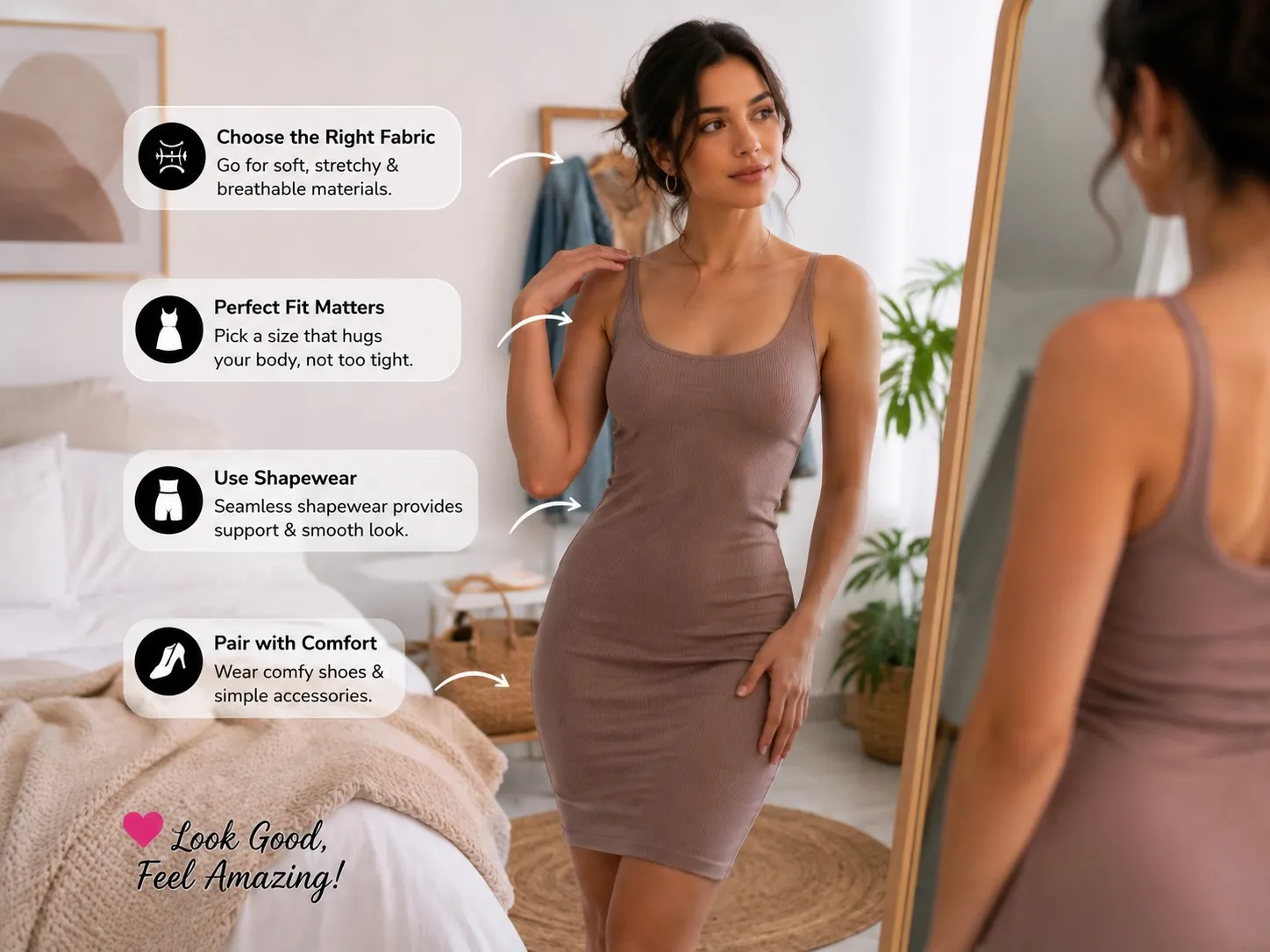

Most people stash their fitted dresses in the back of the closet after one night like that.
Bodycon styling gets a bad reputation because fast fashion relies on cheap, paper-thin synthetic jerseys that cling to every skin fold. Real comfort comes down to fabric density, base layers, and structural balance. You can wear a fitted silhouette all day without feeling pinned down or self-conscious.
Why fabric weight decides your comfort level
Thin fabrics cause 90% of all bodycon discomfort. When a manufacturer uses a 140 GSM (grams per square meter) polyester blend, the fabric has to stretch to its absolute limit just to fit your hips. That tension pulls the fabric upward with every step you take, which is why your hem keeps creeping toward your waist.
Look for fabrics with a weight of at least 280-350 GSM. Heavyweight Ponte de Roma, double-knit ribbed cotton, and thick modal blends have enough structural integrity to hold their own shape against your skin.
Heavier fabrics skim your natural curves rather than sink into every dip. They also provide light, built-in smoothing without squeezing your ribs.
When shopping for women's clothes online, check the fabric breakdown in the product specs. Aim for a blend of around 85% natural fiber or dense rayon with 10% to 15% elastane or spandex. That ratio gives you 4-way stretch with high recovery, meaning the dress snaps back to its original shape after you sit for 2 hours.
Sizing for your widest measurement
Most people buy fitted clothing based on their smallest measurement. If you have a 28-inch waist and 40-inch hips, buying a size small guarantees the fabric across your lower half will overstretch, turn semi-sheer, and ride up continuously.
Always buy the dress to fit your widest point comfortably.
If the waist or shoulders end up slightly loose, spend $15 at a local tailor to take in the side seams or add 2 small waist darts. A properly tailored dress for women looks high-end and lets you move your arms, walk naturally, and eat a full meal without restriction.
If tailoring is not on your schedule, look for dresses with built-in ruching along the side seams. Ruching builds extra fabric slack into the design. That extra slack accommodates sitting down, bending over, and walking up stairs without shifting the placement of the dress.
Build a smarter undergarment system
Extreme compression shapewear often creates more problems than it solves. High-compression shorts push soft tissue up toward your ribs and down toward your thighs, creating noticeable lines at the edges. They can also roll down at the waist, which forces you to visit the restroom just to readjust your layers.
Swap heavy compression gear for lightweight, laser-cut raw-edge smoothing shorts.
Look for styles made of silky microfiber with bonded seams instead of sewn elastic. The flat finish prevents visible lines across your hips. A high-waisted cut that sits directly under your bra line stays in place far better than mid-rise waistbands.
For unlined knits, static cling is another hidden source of physical discomfort. When synthetic knits stick to your legs, the dress bunches around your groin and thighs. Rubbing a dime-sized amount of standard body lotion directly onto your legs before slipping into your base layer kills static instantly.
Strategic layering balances the tight silhouette
A skin-tight cut from collarbone to ankle can feel restrictive, especially in casual daytime settings. Layering changes the proportions and gives you functional pockets, warmth, and visual balance.
Pair your fitted base with an oversized, structured top piece:
- An oversized wool blazer with strong shoulder pads adds clean geometry and lets you unbutton the jacket when you sit down.
- A longline trench coat left open creates 2 vertical lines down your torso, which draws the eye up and down.
- A cropped boxy denim jacket cuts the torso at your natural waist, keeping your proportions balanced without covering your hips.
- A heavy knit cardigan hitting at mid-calf softens the sharpness of the fitted dress while giving you coverage from behind.
Brands like Froute Clothing highlight this layered approach by pairing clean, body-skimming knits with relaxed utility jackets. The contrast between tight and loose pieces makes the outfit practical for all-day wear.
How to style a cocktail dress for women without feeling trapped
Formal events present a bigger challenge because evening fabrics often lack stretch. When you need a cocktail dress for women, prioritize design details that allow freedom of movement.
Look for a midi-length bodycon with a back vent or a side slit. A slit reaching 2 inches above the knee gives your legs a full range of motion so you can climb stairs or get out of an Uber gracefully.
Avoid stiff synthetic satins that have zero horizontal give. If you want a glossy or formal look, choose stretch crepe, lurex-rib knits, or velvet with elastane. Stretch velvet is especially forgiving because the fabric pile catches light at different angles, which conceals undergarment outlines completely.
If you choose a strapless or off-the-shoulder fitted cut, check the inside top hem for silicone grip tape. That thin rubberized strip anchors the neckline directly to your skin, preventing the constant tugging that ruins your posture during an event.
Footwear physics and pelvic tilt
The shoes you pick directly influence how comfortable your fitted dress feels around your lower back and stomach.
High stilettos force your pelvis to tilt forward, which arches your lower spine and pushes your lower abdomen out. In a tight dress, this stance pulls the front fabric taut, creating pressure against your stomach.
If you plan to be on your feet for more than 2 hours, choose footwear that keeps your pelvis in a neutral position:
- Low block heels (1.5 to 2 inches) give you height while keeping your weight evenly distributed across your feet.
- Sleek pointed-toe leather flats lengthen your leg line without altering your spinal posture.
- Chunky lug-sole boots ground a casual cotton bodycon dress for women while allowing you to walk at full stride.
- Clean white leather sneakers turn a ribbed midi dress into an easy weekend outfit.
When your posture stays neutral, the fabric hangs the way the designer intended, eliminating tension points across your midsection.
The texture trick: ribs, patterns, and drape
Flat, solid-colored matte jersey shows every shadow and contour underneath. If you feel exposed in flat fabrics, switch to textured surfaces.
Vertical ribbing is the easiest upgrade for daily wear. The accordion structure of ribbed fabric expands laterally over curves while maintaining vertical tension, which stops the dress from bagging out at the knees or seat.
Dark, small-scale prints like micro-florals, houndstooth, or abstract marl patterns also break up light reflections. They give you the sleek profile of bodycon dresses for women while masking sweat marks, seatbelt wrinkles, and undergarment edges throughout a long day.
Conclusion
Wearing a fitted dress should never mean holding your breath or pulling at your hem all night. Pick heavyweight knits above 280 GSM, buy for your widest point, and rely on raw-edge base layers instead of suffocating shapewear. When you give your body room to move, a fitted dress for women becomes one of the most reliable, easy pieces in your closet.
Frequently asked questions
How do I stop my bodycon dress from riding up when I walk?
A dress rides up because the fabric is too tight across the hips or too lightweight to resist upward friction. Sizing up to fit your hip measurement stops the fabric from pulling upward. You can also use double-sided fashion tape along the inner hem or wear smooth microfiber shorts underneath to eliminate friction against your skin.
What undergarments work best under a tight dress?
Choose high-waisted, laser-cut microfiber briefs or mid-thigh smoothing shorts with bonded, flat edges. Avoid traditional underwear with stitched elastic leg bands, which press into the skin and create visible lines through fitted fabrics.
Can I comfortably wear a bodycon dress after eating a large meal?
Yes. Pick dresses made with double-knit ribbing, side ruching, or 4-way stretch fabrics like modal-spandex blends. Ruching provides extra fabric slack across the midsection, letting the material expand naturally without tightening around your ribs.
How do I style a casual bodycon dress for work?
Add a structured, oversized blazer that hits below your hip line, and wear the dress with flat loafers or low block heels. A midi length paired with high necklines like a mock-neck or crewneck keeps the silhouette balanced and professional.
Which fabric is best for all-day comfort in a fitted dress?
Heavyweight Ponte de Roma or dense ribbed cotton blends containing 10% to 15% elastane are the best options. These fabrics provide structure, recover their shape quickly after sitting, and prevent the dress from turning sheer under direct light.




















Sign in to leave a comment.