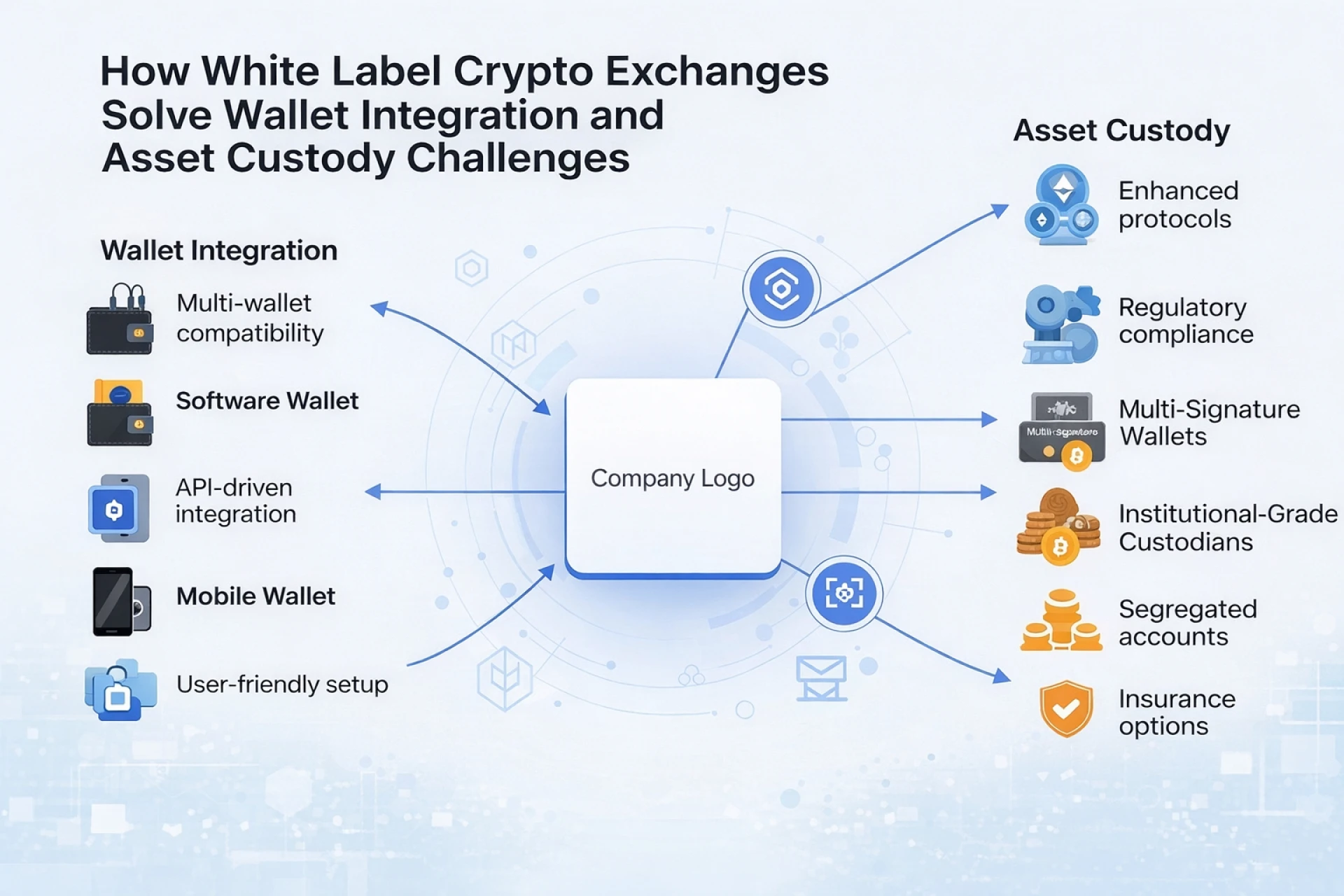

Wallet integration and asset custody are two of the most complex, high-risk components of operating a crypto exchange. While trading interfaces and pricing models often receive the most attention, the real operational backbone of any exchange lies in how digital assets are stored, transferred, secured, and recovered. For businesses entering the crypto market, especially those without deep blockchain infrastructure expertise, wallet mismanagement is one of the most common causes of security breaches, regulatory violations, and customer distrust.
As crypto adoption expands across fintech platforms, payment companies, brokers, and enterprises, the expectation for institutional-grade custody and seamless wallet operations has increased significantly. Users now demand fast deposits, reliable withdrawals, transparent balances, and assurance that their assets are protected under robust security frameworks. Meeting these expectations through custom development is not only expensive but also operationally dangerous for organizations unfamiliar with blockchain custody models.
White label crypto exchanges have emerged as the most effective solution to these challenges. By offering pre-integrated wallet systems, custody frameworks, and security controls developed by specialists, white label platforms allow businesses to operate crypto exchanges confidently without assuming the technical and regulatory risks associated with wallet and asset management.
Why Wallets and Custody Are the Most Difficult Parts of a Crypto Exchange
Why wallet integration is harder than it looks
- Each blockchain has unique wallet standards
- Transaction confirmation behavior varies by network
- Gas fees and congestion must be managed dynamically
- Deposit and withdrawal logic must be fail-safe
Why asset custody creates long-term operational risk
- Private key exposure leads to irreversible losses
- Custody failures undermine regulatory trust
- Manual wallet processes increase human error
- Poor segregation of assets creates legal liability
Why businesses need a proven custody model
- Institutional security expectations
- Regulatory scrutiny is increasing
- Customers demand transparency and safety
- Operational errors directly impact brand credibility
These factors explain why businesses increasingly rely on platforms delivered by a specialized White Label Crypto Exchange Development Company
Understanding Wallet Integration in Crypto Exchanges
Wallet integration is far more than connecting an address to a user account. It requires a deep understanding of blockchain behavior, transaction lifecycles, and security design.
Core wallet functions in an exchange environment
A crypto exchange wallet system must support:
- Address generation per user or per asset
- Real-time balance updates
- Deposit detection and confirmation tracking
- Withdrawal validation and signing
- Fee estimation and optimization
Each of these processes must work reliably across multiple blockchains.
The complexity of multi-asset wallet support
Modern exchanges rarely support a single asset. Wallet systems must handle:
- UTXO-based blockchains
- Account-based blockchains
- Token standards and smart contracts
- Network upgrades and forks
This complexity increases exponentially as asset coverage grows.
Why Asset Custody Is a Major Risk Area for Businesses
Asset custody refers to how private keys are generated, stored, protected, and accessed. In crypto, custody errors are irreversible.
Common custody challenges in custom exchanges
- Single-point key storage
- Hot wallet overexposure
- Manual signing processes
- Poor access control
- Inadequate recovery procedures
These weaknesses have led to some of the most high-profile losses in the industry.
Regulatory implications of poor custody design
Custody failures can trigger:
- Regulatory investigations
- Loss of licenses
- Legal action from users
- Insurance denial
This makes custody a board-level concern rather than a technical detail.
Why Custom Wallet Development Often Fails
Blockchain-specific expertise is required
Each blockchain introduces unique challenges:
- Different transaction formats
- Different fee mechanisms
- Different confirmation logic
Maintaining expertise across multiple networks is resource-intensive.
Security mistakes are costly and permanent
Unlike traditional finance systems, crypto transactions cannot be reversed. Even minor implementation errors can result in permanent asset loss.
Maintenance burden increases over time
Wallet systems require constant updates due to:
- Network upgrades
- New token standards
- Security vulnerabilities
Custom wallet maintenance becomes increasingly expensive.
What Is a White Label Crypto Exchange?
A White Label Crypto Exchange is a ready-made trading platform that includes pre-integrated wallets, custody frameworks, trading engines, and compliance workflows. The provider manages blockchain infrastructure, wallet security, and technical maintenance, allowing businesses to operate under their own brand.
Wallet and custody components typically included
- Multi-asset wallet architecture
- Hot and cold wallet separation
- Automated transaction processing
- Secure key management systems
- Monitoring and alerting tools
White Label Cryptocurrency Exchange platforms remove the need for businesses to build wallet systems from scratch.
How White Label Crypto Exchanges Simplify Wallet Integration
Pre-integrated blockchain support
White label platforms support multiple blockchains out of the box. Providers handle:
- Node setup and maintenance
- Network synchronization
- Protocol upgrades
Clients gain immediate access without blockchain configuration work.
Automated deposit and withdrawal handling
White Label Crypto Exchange software development includes systems that:
- Detect incoming deposits
- Track confirmation thresholds
- Update balances automatically
- Queue and validate withdrawals
This automation reduces human error and operational overhead.
Enterprise-Grade Asset Custody Built In
Hot and cold wallet architecture
White label exchanges use a layered custody model:
- Hot wallets for liquidity
- Cold wallets for long-term storage
- Transfer rules between wallets
This minimizes exposure while maintaining operational efficiency.
Multi-signature authorization
Custody systems require multiple approvals for sensitive actions, reducing insider risk and unauthorized access.
Secure key management
Private keys are protected through:
- Hardware security modules
- Encrypted storage
- Access restrictions
- Regular rotation policies
White Label Crypto Exchange Platform development prioritizes institutional-grade custody standards.
Reducing Operational Risk Through Centralized Custody Management
Role-based access control
White label platforms limit wallet actions based on user roles, ensuring:
- Separation of duties
- Reduced insider risk
- Clear accountability
Monitoring and alerts
Custody systems include real-time monitoring for:
- Unusual withdrawal activity
- Balance discrepancies
- Network anomalies
This allows rapid response to potential threats.
Regulatory Compliance and Custody Alignment
Custody requirements in regulated markets
Regulators increasingly expect:
- Clear asset segregation
- Audit trails
- Access controls
- Incident reporting
White label compliance support
White Label Crypto Exchange Development Services include:
- Custody reporting tools
- Transaction logs
- Audit-ready data structures
This simplifies regulatory interactions.
Multi-Currency Support Without Wallet Complexity
Supporting multiple assets safely
White label exchanges handle:
- Native coins
- Tokens
- Stablecoins
Each asset follows predefined custody rules.
Adding new assets with minimal risk
White label providers test and deploy new wallet integrations centrally, reducing client-side risk.
Liquidity and Custody Coordination
Why liquidity depends on wallet efficiency
Liquidity operations require:
- Fast internal transfers
- Reliable balances
- Controlled hot wallet exposure
Poor wallet design disrupts trading performance.
Integrated liquidity workflows
White Label Crypto Exchange Platform development ensures custody systems align with trading engines and liquidity providers.
Disaster Recovery and Asset Protection
Backup and recovery mechanisms
White label custody systems include:
- Encrypted backups
- Geographic redundancy
- Recovery procedures
Business continuity planning
In case of system failures, providers ensure:
- Asset availability
- Transaction integrity
- Operational continuity
These safeguards are costly to implement independently.
Cost Efficiency of White Label Wallet and Custody Solutions
Avoiding custom wallet development costs
Custom custody systems require:
- Security audits
- Ongoing testing
- Dedicated teams
White label solutions spread these costs across multiple clients.
Predictable operational expenses
White Label Crypto Exchange Development Services provide:
- Fixed licensing models
- Transparent maintenance fees
This improves budgeting accuracy.
Use Cases: Businesses Solving Custody Challenges with White Label Platforms
Fintech startups
Startups avoid building wallets by relying on White Label Cryptocurrency Exchange platforms.
Payment and remittance companies
These firms integrate crypto custody without altering core payment infrastructure.
Enterprises entering digital assets
Large organizations rely on White Label Crypto Exchange Development Company expertise to meet institutional custody standards.
Step-by-Step: Implementing Wallet and Custody Through a White Label Exchange
Step 1: Define asset coverage
- Supported blockchains
- Token standards
Step 2: Select a custody-focused provider
Evaluate wallet security architecture and audit history.
Step 3: Configure operational rules
- Hot wallet limits
- Withdrawal approvals
Step 4: Integrate compliance workflows
- KYC triggers
- Transaction monitoring
Step 5: Launch and monitor
- Review custody metrics
- Adjust exposure thresholds
Choosing the Right White Label Crypto Exchange Development Company
Custody evaluation checklist
When assessing a White Label Crypto Exchange Development Company and its White Label Crypto Exchange Development Services, businesses should review:
- Wallet architecture documentation
- Cold storage strategy
- Multi-signature implementation
- Security audits
- Incident response procedures
- Asset segregation policies
- Ongoing maintenance commitments
A strong custody partner significantly reduces long-term risk.
The Future of Wallet and Custody Management
Custody standards continue to evolve as institutional participation increases. White label providers invest continuously in:
- New custody technologies
- Improved security models
- Regulatory alignment
Clients benefit from these advancements without internal redevelopment.
Conclusion: Secure Wallet Integration Without Custody Risk
Why white label exchanges solve wallet challenges
- Pre-integrated multi-asset wallets
- Enterprise-grade custody frameworks
- Automated transaction workflows
- Centralized security management
Strategic advantages for businesses
- Reduced operational and security risk
- Faster launch without blockchain complexity
- Lower maintenance costs
- Stronger regulatory posture
Long-term value of white label custody solutions
- Sustainable operations enabled by White Label Crypto Exchange Development
- Secure scaling through White Label Crypto Exchange Platform development
- Risk reduction via White Label Crypto Exchange software development
- Ongoing support from White Label Crypto Exchange Development Services
- Institutional confidence delivered by a trusted White Label Crypto Exchange Development Company
For businesses navigating the complexities of wallet integration and asset custody, white label crypto exchanges offer the safest and most efficient path forward. By relying on proven custody frameworks and experienced providers, organizations can protect assets, build trust, and focus on growth without exposing themselves to unnecessary technical and regulatory risk.




























Sign in to leave a comment.