

Every business running workloads on AWS eventually faces the same question: should you build an internal cloud team, or bring in outside help? The answer shapes your budget, your timeline, and how much control you keep over day-to-day decisions. There isn't a single right answer, but there is a right answer for your specific situation.
Whether you're standing up a new cloud platform or scaling an existing one, the decision of how to hire AWS Developers, in-house or outsourced, deserves more thought than it usually gets. This article breaks down both models, compares them side by side, and offers a practical framework for choosing the right fit.

1. What 'In-House' and 'Outsourced' Actually Mean
Before comparing the two, it helps to define them clearly, since the terms get used loosely in practice.
In-House AWS Developers
These are full-time employees on your payroll, dedicated exclusively to your infrastructure and applications. They report directly to your engineering leadership and work as an embedded part of the team.
Outsourced AWS Developers
This covers freelancers, staffing agencies, and specialized consulting firms that provide AWS expertise on a contract or project basis. You direct the work, but they aren't your employees, and the arrangement can be scaled up or down as needed.
2. Side-by-Side Comparison
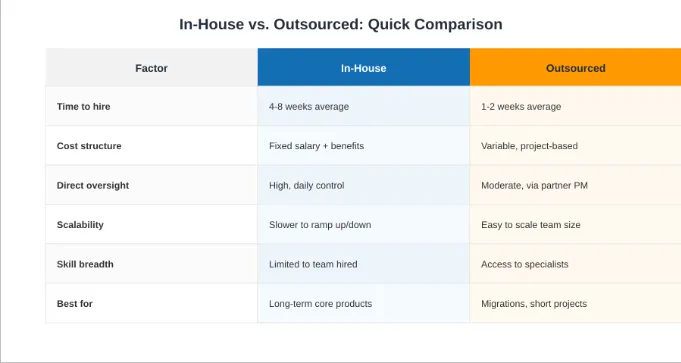
Here's how the two models stack up across the factors that matter most to most hiring decisions:
3. Pros and Cons of Each Model
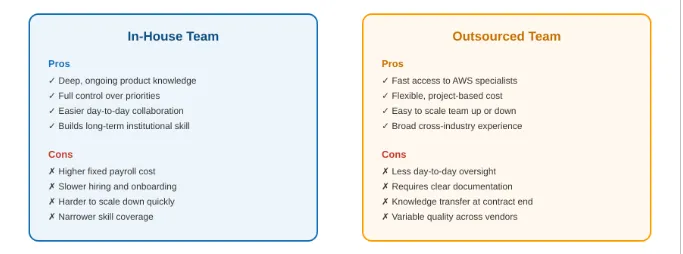
Both approaches have real strengths and real trade-offs. Understanding them clearly is more useful than picking a side in the abstract.
When In-House Makes Sense
- Your AWS infrastructure is core to the product, not a supporting function
- You need daily, hands-on collaboration between cloud and product teams
- You're optimizing for long-term institutional knowledge over short-term speed
- Budget allows for competitive salaries and benefits in a tight talent market
When Outsourcing Makes Sense
- You're running a defined project, like a cloud migration, with a clear end date
- You need specialized skills your current team doesn't have, such as security hardening or cost optimization
- Hiring timelines are tight, and you can't wait 6-8 weeks to fill a role
- You want to test a cloud investment before committing to permanent headcount
4. Cost Considerations Beyond the Hourly Rate
Comparing costs purely on hourly rate or salary misses much of the real picture. A few often-overlooked factors:
- Fully loaded in-house cost: salary plus roughly 25-35% in benefits, payroll tax, and overhead
- Recruiting cost: agency fees or internal recruiter time to fill a specialized AWS role
- Ramp-up time: in-house hires need weeks to become fully productive on your systems
- Outsourced markups: agencies typically charge 10-25% above freelance market rates for vetting and management
- Idle cost: in-house staff are paid even during quieter periods; outsourced teams scale down with demand
For short, well-defined projects, outsourcing usually wins on total cost. For sustained, multi-year cloud operations, in-house often becomes more economical over time.
5. Why the Decision to Hire AWS Developers Matters So Much
AWS misconfigurations are one of the leading causes of cloud security incidents, and cost overruns from poorly architected infrastructure are common even at well-funded companies. Whichever model you choose, the developers behind it need to bring real depth:
- Hands-on experience with core services like EC2, S3, RDS, Lambda, and IAM
- Familiarity with Infrastructure as Code tools such as CloudFormation or Terraform
- A track record of designing for security, high availability, and cost efficiency
- Clear communication, especially important with outsourced or distributed teams
Whether you hire AWS developers as full-time staff or bring in a contracted team, the technical bar shouldn't change. Only the employment structure does.
6. The Hybrid Model: Best of Both Worlds
In practice, many companies don't choose one model exclusively. A hybrid approach is increasingly common and often the most practical:
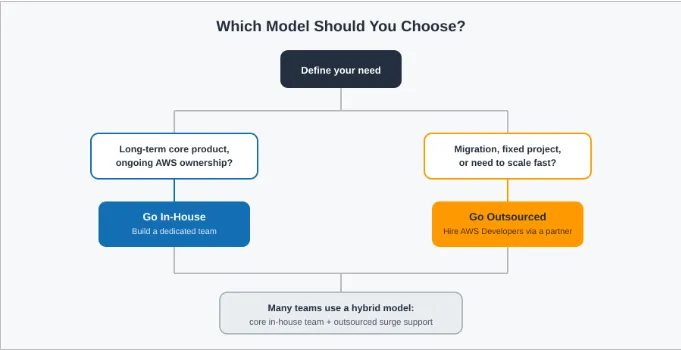
- A small in-house team owns core architecture and long-term roadmap decisions
- Outsourced specialists are brought in for migrations, security audits, or capacity spikes
- Contract developers cover skill gaps the in-house team hasn't built yet
- The in-house team absorbs knowledge from outsourced experts over time, reducing future reliance on outside help
This approach lets businesses keep control over strategic decisions while staying flexible enough to handle projects that don't justify a permanent hire.
7. A Practical Framework for Deciding
Before choosing a model, answer these questions honestly:
- Is this a permanent function or a time-boxed project? Permanent leans in-house; time-boxed leans outsourced
- How fast do you need to start? If it's urgent, outsourcing gets you moving in days, not weeks
- Do you have the budget for full-time salaries plus benefits, or is variable spend a better fit right now?
- How specialized is the work? Niche skills like advanced security or cost optimization are often easier to access through a partner
- How much oversight can your team realistically provide? Outsourced teams still need clear direction and check-ins
| Also read: Cloudflare Vs AWS Cloudfront: A Detailed Comparison
Conclusion
There's no universal right answer to the in-house versus outsourced question. The best choice depends on your timeline, budget, and how central AWS infrastructure is to your core business. Short-term projects and specialized needs often favor outsourcing, while long-term, product-critical infrastructure usually justifies the investment in a dedicated in-house team.
What matters most is being deliberate about the choice rather than defaulting to whatever's fastest or most familiar. Whether you decide to hire AWS developers as permanent staff, bring in an outsourced partner, or blend the two, matching the hiring model to the actual scope of the work is what determines whether the investment pays off.
FAQs
1. What is the difference between in-house and outsourced AWS developers?
In-house AWS developers are full-time employees who work within your organization, while outsourced AWS developers are external professionals or teams hired through a technology partner to deliver AWS development and cloud services.
2. Which hiring model is more cost-effective?
Outsourced AWS developers are generally more cost-effective because businesses avoid expenses related to recruitment, employee benefits, office infrastructure, training, and long-term overhead.
3. When should I hire in-house AWS developers?
An in-house team is a good choice for organizations with continuous cloud development needs, long-term product ownership, and the resources to build and manage an internal engineering team.
4. When is outsourcing AWS development the better option?
Outsourcing is ideal for businesses that need specialized AWS expertise, faster project delivery, flexible team scaling, or support for cloud migration and modernization initiatives.
5. Can outsourced AWS developers work with my internal team?
Yes. Dedicated AWS developers can collaborate seamlessly with your in-house engineers using Agile methodologies, shared project management tools, and regular communication.


























Sign in to leave a comment.