

NetSuite ERP integration plays an important role in helping businesses connect their financial, operational, customer, and supply chain systems. As companies grow, they often need to connect NetSuite with ecommerce platforms, CRM software, banking systems, payment gateways, logistics applications, HR systems, and other business tools.
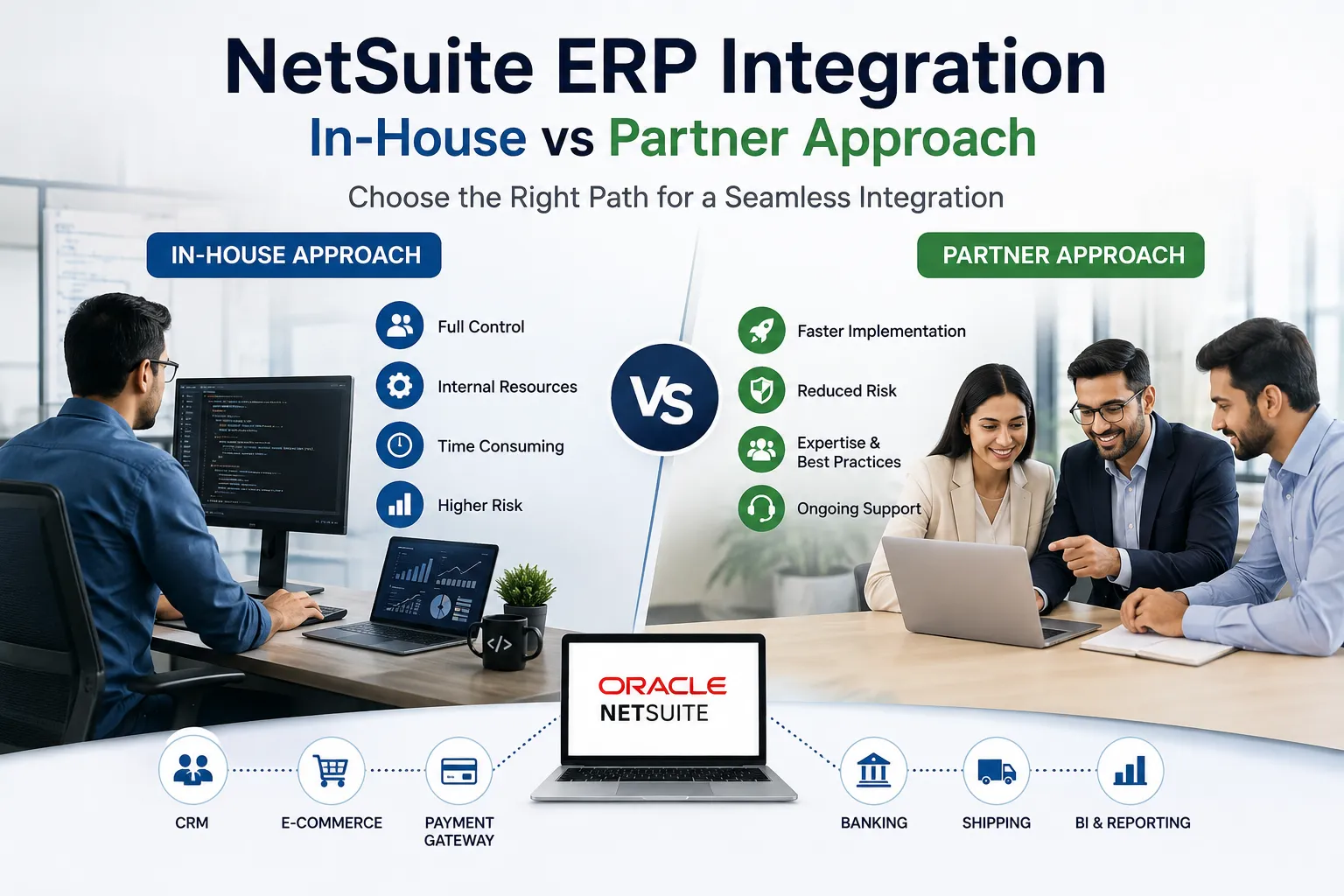
One of the most important decisions businesses face is whether to build these integrations using an internal team or work with a specialized NetSuite integration partner. Both approaches have advantages, but the right choice depends on the company's technical expertise, integration requirements, budget, timeline, and long-term support needs.
What Is NetSuite ERP Integration?
NetSuite ERP integration connects the ERP system with other applications used by a business. The goal is to allow information to move between systems automatically instead of relying on manual data entry.
For example, an ecommerce order can be transferred automatically to NetSuite, inventory information can be updated across systems, and payment information can be synchronized with financial records. CRM integration can also help sales and finance teams access consistent customer and transaction information.
Successful integration requires more than simply connecting two applications. Businesses need proper data mapping, API management, authentication, error handling, testing, monitoring, and security. Companies operating in India may also need to consider GST, e-invoicing, e-way bills, and other local financial requirements.
Building NetSuite Integration In-House
An in-house approach means the company's own IT or development team is responsible for planning, developing, testing, and maintaining NetSuite integrations.
One major advantage of this approach is internal control. Employees already understand the organization's business processes, existing applications, and data structures. This can make communication easier and allow the company to customize integrations according to specific internal requirements.
In-house development can also be useful for businesses that already have experienced NetSuite developers. If the organization has a dedicated technical team with knowledge of SuiteScript, APIs, SuiteFlow, and NetSuite architecture, it may be able to manage smaller integration projects effectively.
However, developing integrations internally can also create challenges. NetSuite-specific development requires specialized knowledge, and employees may need additional training before handling complex integrations. Development can take longer when the team is learning the platform while working on an important business project.
The internal team is also responsible for ongoing maintenance. Changes to NetSuite, connected applications, APIs, or business processes may require updates to existing integrations.
Hiring a NetSuite Integration Partner
A specialized NetSuite integration partner brings technical expertise and experience from working on different integration projects. Instead of building everything from scratch, an experienced partner may use established frameworks, development practices, and testing methods to accelerate the project.
A partner can help integrate NetSuite with ecommerce platforms, CRM applications, banking systems, payment gateways, logistics providers, HR applications, and compliance systems.
For Indian organizations, choosing experienced oracle netsuite partners in india can be particularly valuable when integrations involve GST, e-invoicing, e-way bills, TDS, or other India-specific requirements. These areas require careful planning because errors can affect financial processes and compliance.
A specialist partner can also help businesses design integrations that are easier to maintain when NetSuite or connected systems receive updates.
Cost and Time Considerations
Cost is another important factor when comparing in-house development with a partner approach.
In-house development may appear more affordable because the company uses existing employees. However, businesses should also consider employee salaries, training, development time, testing, maintenance, and the opportunity cost of assigning internal employees to integration work.
Working with a partner involves an external service cost, but it can provide access to specialized professionals without requiring the company to build a large internal NetSuite development team.
For businesses with several integrations and a strict implementation timeline, a partner can also help reduce development delays by providing experienced resources.
Integration Complexity Should Guide the Decision
The complexity of the project should be considered before choosing an approach.
A company with only one or two simple integrations may be able to manage the work internally if it has suitable technical expertise. However, businesses with multiple applications may face considerably more complexity.
For example, ecommerce integration may involve order synchronization, inventory updates, fulfillment, returns, and payment information. Banking integration may involve transaction matching and reconciliation. CRM integration may require synchronization of customers, opportunities, sales orders, and invoices.
When several systems need to communicate with NetSuite, professional integration planning becomes increasingly important.
Importance of Ongoing Support
NetSuite integration should not be treated as a one-time development project. After implementation, businesses need to monitor integrations and respond to changes in connected systems.
NetSuite updates, API changes, new business requirements, and changes in third-party applications can affect existing integrations. Regular testing and maintenance can help prevent unexpected failures.
A reliable netsuite partner in india can provide ongoing monitoring, troubleshooting, upgrade support, documentation, and maintenance services. This allows internal employees to concentrate on core business operations while specialists manage technical integration requirements.
When Is In-House Integration a Good Choice?
In-house development can be suitable when a business already has experienced NetSuite developers, has only a few simple integrations, and has sufficient time for development and testing.
It may also be a good option for organizations that want to establish a long-term internal NetSuite center of excellence and have the resources to maintain their integrations.
However, companies should carefully evaluate their internal capabilities before selecting this approach.
When Should You Choose a NetSuite Partner?
A specialist partner may be the better choice when a business has complex integration requirements, multiple connected systems, limited internal NetSuite expertise, or a strict implementation deadline.
Experienced partners can provide technical knowledge, structured integration planning, testing expertise, documentation, and post-go-live support. They can also help businesses avoid common integration problems related to data mapping, error handling, security, and system upgrades.
Conclusion
The choice between in-house NetSuite ERP integration and hiring a specialist partner depends on the organization's resources, technical capabilities, integration complexity, budget, and business goals.
In-house development can provide greater control for companies with experienced NetSuite professionals and straightforward integration requirements. On the other hand, businesses with complex systems, multiple integrations, compliance requirements, or tight timelines may benefit from working with an experienced integration provider.
By evaluating these factors carefully, businesses can choose an approach that supports reliable data exchange, improved efficiency, easier maintenance, and long-term business growth. Working with experienced oracle netsuite partners in india or a trusted netsuite partner in india can also help organizations build scalable integrations that continue to support their business as it grows.




























Sign in to leave a comment.