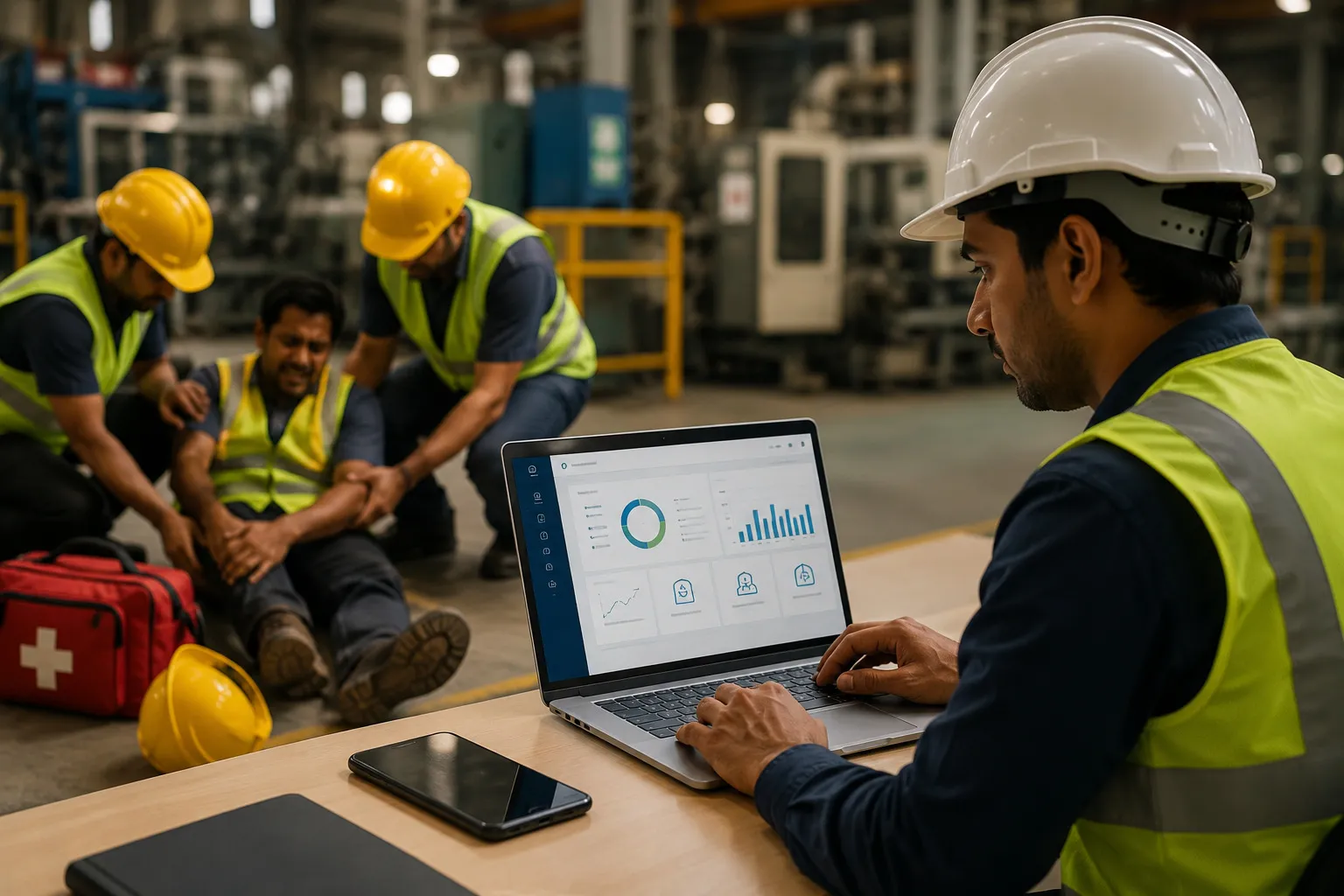

Manufacturing environments are among the most complex workplaces, involving heavy machinery, hazardous chemicals, electrical systems, forklifts, manual material handling, and high-speed production lines. While organizations invest heavily in safety measures, incidents can still occur due to unsafe acts, equipment failures, environmental conditions, or procedural gaps. What truly determines a company's safety maturity is not just how it responds to an incident but how effectively it records, investigates, tracks, and prevents similar events in the future.
An Incident Tracking Report for Manufacturing Industry is a structured record that documents every workplace incident from the moment it occurs until corrective and preventive actions are completed. Rather than simply recording accidents, it provides complete visibility into incident trends, root causes, investigation findings, responsible personnel, corrective actions, and closure status.
Modern manufacturers are moving away from paper-based reporting systems and spreadsheets toward digital incident tracking software that automates reporting, improves accountability, and provides real-time insights for continuous safety improvement.
This guide explains everything manufacturers need to know about incident tracking reports, their importance, key components, benefits, implementation strategies, and how digital solutions transform workplace safety.
What is an Incident Tracking Report?
An Incident Tracking Report is a detailed document that records workplace incidents throughout their entire lifecycle. It captures information about what happened, where it happened, who was involved, why it occurred, what corrective actions were taken, and whether those actions successfully eliminated the risk.
Unlike a simple accident report that only documents an event, an incident tracking report follows the incident until all corrective and preventive actions have been completed. This continuous tracking ensures that incidents are not forgotten after the initial investigation and that lessons learned are applied across the organization.
For manufacturing companies operating multiple production lines or facilities, incident tracking reports provide centralized visibility into workplace safety performance and help management identify recurring hazards before they result in major accidents.
Why Incident Tracking is Important in Manufacturing
Manufacturing operations involve numerous hazards that change throughout the day. Employees interact with machines, tools, chemicals, conveyors, electrical equipment, and automated systems. Without proper incident tracking, organizations may repeatedly experience similar accidents because the underlying causes remain unresolved.
A comprehensive incident tracking process helps organizations understand patterns instead of viewing incidents as isolated events. For example, if multiple employees experience slips in the same production area, the issue may not be employee behavior but inadequate drainage, poor housekeeping, or damaged flooring.
Tracking incidents over time enables organizations to prioritize high-risk areas, allocate safety resources effectively, improve maintenance schedules, revise operating procedures, and strengthen employee training programs.
Most importantly, effective incident tracking transforms reactive safety management into proactive risk prevention.
Key Components of an Incident Tracking Report
A well-designed incident tracking report contains much more than basic incident details. It provides a complete picture of the event and its resolution.
Incident Information
The report begins with essential details including the incident date, time, location, department, shift, production line, and reporting employee. This information establishes the context and supports future analysis.
Description of the Incident
A detailed narrative explains exactly what happened before, during, and immediately after the incident. Accurate descriptions help investigators understand the sequence of events without assumptions.
Individuals Involved
The report records employees, contractors, visitors, witnesses, supervisors, and emergency responders associated with the incident. Maintaining accurate personnel information supports investigations and regulatory compliance.
Injury or Damage Details
If injuries occurred, the report includes injury type, body part affected, medical treatment received, lost workdays, and severity classification. Property damage and production losses are also documented when applicable.
Root Cause Analysis
Rather than focusing solely on immediate causes, the report identifies underlying organizational factors such as inadequate training, equipment malfunction, maintenance failures, insufficient supervision, or ineffective procedures.
Root cause analysis helps prevent similar incidents from occurring again.
Corrective Actions
Every identified cause should have corresponding corrective actions assigned to responsible personnel with defined completion deadlines.
These actions may include equipment repairs, revised procedures, employee training, engineering controls, or process improvements.
Preventive Measures
Preventive actions focus on long-term safety improvements that reduce future risks across multiple departments instead of addressing only a single incident.
Status Tracking
One of the most valuable features of an incident tracking report is monitoring whether corrective actions remain open, are in progress, overdue, or completed.
This ensures accountability throughout the organization.
Benefits of Incident Tracking Reports in Manufacturing
Organizations that maintain effective incident tracking systems experience improvements far beyond regulatory compliance.
The greatest advantage is increased workplace safety. Every reported incident becomes an opportunity to identify hazards before they cause serious injuries. When organizations consistently investigate incidents and implement corrective actions, workplace risks steadily decline.
Incident tracking also supports better decision-making. Instead of relying on assumptions, safety managers use real data to identify departments with higher incident rates, equipment requiring maintenance, recurring unsafe behaviors, and seasonal safety trends.
Another significant benefit is regulatory compliance. Occupational safety authorities often require manufacturers to maintain accurate incident records. Digital reporting simplifies audits by organizing all reports in one secure system with complete investigation histories.
Operational efficiency also improves because recurring equipment failures, process interruptions, and production downtime are identified early. Addressing these issues not only improves safety but also increases productivity.
Finally, incident tracking strengthens organizational safety culture. Employees become more willing to report hazards when they see management taking corrective actions seriously rather than filing reports without follow-up.
Challenges of Manual Incident Tracking
Many manufacturers continue using paper forms, spreadsheets, emails, or disconnected databases to manage incident reports. While these methods may appear simple, they create numerous operational challenges.
Paper reports can be misplaced, damaged, or stored in multiple locations, making historical analysis difficult.
Spreadsheet-based systems often require manual updates, increasing the likelihood of incomplete records and data entry errors.
Without automated reminders, corrective actions frequently remain open long after investigations conclude.
Management also struggles to generate meaningful reports because data exists across separate files and departments.
As organizations grow, manual reporting becomes increasingly inefficient and unable to support enterprise-wide safety initiatives.
Digital Incident Tracking Software for Manufacturing
Digital incident tracking software transforms traditional reporting into a streamlined, automated process.
Employees can report incidents immediately using mobile devices, tablets, or desktop applications. Supervisors receive instant notifications, allowing investigations to begin without delay.
The software automatically assigns corrective actions, tracks completion deadlines, sends reminders, stores supporting photographs and documents, and generates real-time dashboards for management.
Instead of manually compiling monthly reports, safety managers can instantly view incident trends, department comparisons, root cause statistics, and corrective action performance.
Digital systems significantly improve reporting accuracy, response time, and overall safety management.
Best Practices for Effective Incident Tracking
Successful incident tracking depends on consistent organizational practices rather than technology alone.
Organizations should encourage immediate reporting of all incidents, including near misses, because early reporting improves investigation accuracy.
Standardized reporting formats help maintain consistent information across departments while reducing confusion during investigations.
Root cause analysis should focus on identifying systemic issues rather than assigning blame to employees.
Management should regularly review incident trends during safety meetings and ensure corrective actions are completed within established timelines.
Continuous employee training reinforces reporting expectations and encourages active participation in workplace safety initiatives.
Finally, organizations should periodically evaluate incident data to identify opportunities for improving safety programs, maintenance strategies, operational procedures, and employee awareness.
Choosing the Right Incident Tracking Software
When selecting an incident tracking solution, manufacturers should consider software that supports mobile reporting, automated workflows, customizable forms, root cause analysis, corrective action management, dashboard reporting, document management, and regulatory compliance.
The software should integrate with broader Environmental, Health, and Safety (EHS) processes such as inspections, audits, risk assessments, permit-to-work systems, and training management.
Scalability is equally important because manufacturing organizations often expand operations across multiple facilities. A centralized platform ensures consistent safety reporting regardless of plant size or location.
Why Choose SoftDesigners for Incident Tracking in Manufacturing?
SoftDesigners provides an advanced incident tracking solution specifically designed for manufacturing industries seeking to improve workplace safety, compliance, and operational efficiency.
The platform enables employees to report incidents quickly through digital forms while allowing supervisors to investigate events, identify root causes, assign corrective actions, and monitor closure status from a centralized dashboard.
With automated workflows, real-time analytics, customizable reporting, document management, mobile accessibility, and integration with broader EHS management processes, SoftDesigners helps manufacturers reduce workplace risks and build a proactive safety culture.
Whether managing a single manufacturing plant or multiple production facilities, the solution delivers complete visibility into safety performance while ensuring every reported incident leads to meaningful improvement.
Conclusion
An effective Incident Tracking Report for Manufacturing Industry is much more than a record of workplace accidents. It is a powerful management tool that transforms individual incidents into opportunities for continuous improvement. By documenting every event, investigating root causes, tracking corrective actions, and analyzing long-term trends, manufacturers can significantly reduce workplace risks while improving productivity and regulatory compliance.
As manufacturing environments become increasingly automated and data-driven, digital incident tracking software provides the visibility, speed, and accountability needed to create safer workplaces. Organizations that invest in modern incident management systems not only protect their employees but also strengthen operational excellence, reduce costs, and foster a culture where safety becomes an integral part of everyday operations.


























Sign in to leave a comment.