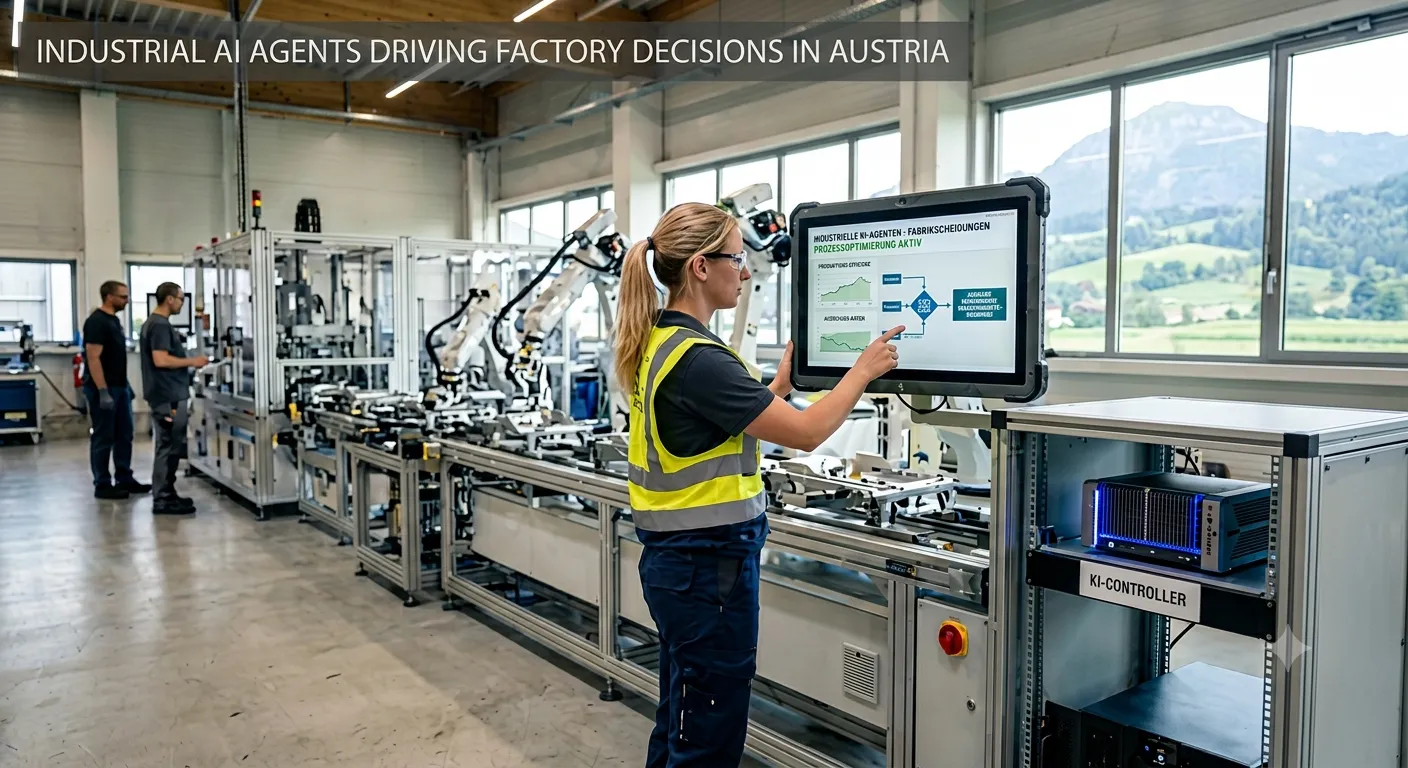

Manufacturing leaders across Austria are facing a new reality. Data is everywhere. Machines generate it. Sensors collect it. Dashboards display it. Yet many critical decisions still depend on human intervention.
The problem is no longer a lack of visibility. It is the inability to come up with quick decisions. The nature of production delays, quality problems, equipment failures and supply chain disturbances require quick actions. The delay while teams review reports, and then determine what to do next, adds up and becomes costly.
This is where Industrial AI Agents are changing the game. Unlike traditional analytics tools, these intelligent systems can observe, analyze, decide, and act autonomously. They move beyond insights and drive outcomes.
For every enterprise software development company in Austria, this shift represents the next evolution of smart manufacturing. The focus is no longer on monitoring operations. It is enabling factories to make decisions in real time.
The Dashboard Dilemma: When Insights Don't Translate into Action
For years dashboards have been the cornerstone of manufacturing. They made it easy for people to see what was going on and helped teams keep track of how things were going at that moment.. Just being able to see what is happening does not fix everything. Someone still has to look at the manufacturing data, figure out what it means, make decisions about digital manufacturing and then do something about it. As digital manufacturing environments get more complicated this way of doing things is not working well as it used to.
Manufacturers Have More Data Than Ever Before
Modern manufacturing facilities generate an unprecedented volume of data every second. Information flows continuously across the organization from multiple sources, including:
- Connected machines and industrial equipment
- IoT sensors and monitoring systems
- ERP platforms managing business operations
- MES solutions overseeing production processes
- Supply chain and logistics networks
While we have access to data now it has become really hard to manage and understand it. Having data doesn't always mean we make better choices.
Why Traditional Analytics Creates Decision Bottlenecks
Most dashboards are designed to inform. They are not designed to act. This creates a critical gap between insight and execution.
Common challenges include:
- Teams manually reviewing reports before taking action
- Delayed responses to production disruptions
- Slow identification of operational inefficiencies
- Dependence on human intervention for routine decisions
- Limited ability to react in real time
Even the most advanced dashboards can only tell teams what is happening. They cannot decide what should happen next. This is where many manufacturers hit a ceiling.
An experienced enterprise software development company in Austria can help bridge this gap by introducing intelligent systems that move beyond reporting and into autonomous decision-making.
The Hidden Cost of Waiting
When we figure something out and do not act on it away the manufacturing process suffers. In factories where everyone is trying to be the best, even a short delay in the manufacturing process can cause problems for the people in charge of operations at the factory. The delay between insight and action in the manufacturing process can be very expensive, for the manufacturing process.
The most common consequences include:
- Increased equipment downtime
- Quality deviations and production defects
- Inventory imbalances and stock inefficiencies
- Higher operational and maintenance costs
- Reduced production agility
The reality is simple. The faster an organization can move from data to action, the greater its competitive advantage. And that is exactly why manufacturers are beginning to look beyond dashboards and toward Industrial AI Agents.
What Are Industrial AI Agents?
Manufacturing intelligence is entering a phase. Traditional analytics tools help enterprise software development companies in Austria understand what is happening now. Predictive models help guess what could happen next. Industrial AI Agents go a step further. They can make decisions. Take action on their own. They do not wait for human input. Of just supporting operations they actively participate in them.
Moving Beyond AI Models and Predictive Analytics
Many manufacturers already use AI for forecasting demand. They use it to predict maintenance needs or identify quality issues. While valuable these systems often stop at providing recommendations.
Industrial AI Agents are fundamentally different.
Traditional Analytics Tools:
* Generate reports and dashboards
* Highlight trends and anomalies
* Depend on human interpretation
* Require execution of decisions
Industrial AI Agents:
* Understand operational goals
* Evaluate situations in time
* Make decisions on their own
* Trigger actions across connected systems
The shift is significant. Organizations are moving from systems that recommend actions. They are moving to systems that can execute them.
How AI Agents Work Inside Manufacturing Environments
Industrial AI Agents operate through a decision-making cycle. They constantly monitor their environment. They respond to changing conditions.
Observe
AI agents collect data from sources. These sources include:
* Machines and equipment
* IoT sensors
* ERP platforms
* MES systems
* Supply chain applications
Analyze
The collected data is processed in time. It identifies:
* Performance deviations
* bottlenecks
* Equipment abnormalities
* Resource constraints
* Emerging risks
Decide
Based on predefined objectives and business rules AI agents determine the most effective course of action.
Examples include:
* Adjusting production schedules
* Reallocating resources
* Triggering maintenance workflows
* Optimizing inventory levels
Execute
Unlike systems, AI agents do not stop at recommendations. They can initiate actions directly. They do this through enterprise systems and industrial platforms.
Learn
Every action generates data. AI agents use these outcomes. They refine decisions and improve accuracy. They adapt to changing conditions.
Key Characteristics of Industrial AI Agents
What makes Industrial AI Agents from conventional automation tools is their ability. They operate intelligently and independently.
Goal-Driven
AI agents work toward business objectives. These objectives include maximizing throughput. They aim to reduce downtime, improve quality or lower costs.
Context-Aware
They evaluate decisions based on real-time conditions. They do not rely on fixed rules. This allows them to adapt as circumstances change.
Autonomous
AI agents can make operational decisions. They do not wait for approval. This enables responses across the production environment.
Collaborative
Multiple agents can work together. They work across departments, systems and processes. They achieve operational goals.
Self-Improving
As new data becomes available AI agents continuously learn. They optimize their performance. They become more effective, over time.
In terms Industrial AI Agents transform manufacturing systems. They change from observers to active decision-makers. They do not just provide intelligence. They operationalize it.
Conclusion:
The future of manufacturing is not about having a lot of data. It is about who can do something with that data the fastest. Industrial AI Agents are really helping manufacturers. They are moving away from looking at numbers and reports and making decisions on their own. Now they are using machines that can work by themselves. Companies in Austria are changing the way they do things with technology. They are not just looking at what's going on, they are taking action. The companies that start using Artificial Intelligence to make decisions now will be better at getting things done efficiently. They will save money. Be able to deal with problems. The manufacturing world is changing fast. These companies will be able to compete. Industrial AI Agents and Artificial Intelligence are important for manufacturers. They need to use these tools to improve and stay competitive.




























Sign in to leave a comment.