

When you put a coating on a product it seems like a thing to do: you get the surface ready you put the coating on you dry it or cure it and then you move on to the next step. In a factory that makes things each of these steps can affect how well the coating sticks what it looks like how well it resists rust how well it works how fast you can make things and how much each finished part costs.
A good industrial coating line is not a bunch of spray guns, tanks, machines that move things and ovens. It is a process were getting the surface ready putting the coating on moving materials around getting rid of air controlling the temperature curing the coating and checking the quality all have to work together.
For people who make things and are planning a coating area or trying to make their current process better, it is really important to understand how all these things work together. If there is a problem in one step, it can cause a problem elsewhere, so it is critical to design the process in a systematic way and to be able to fix problems.
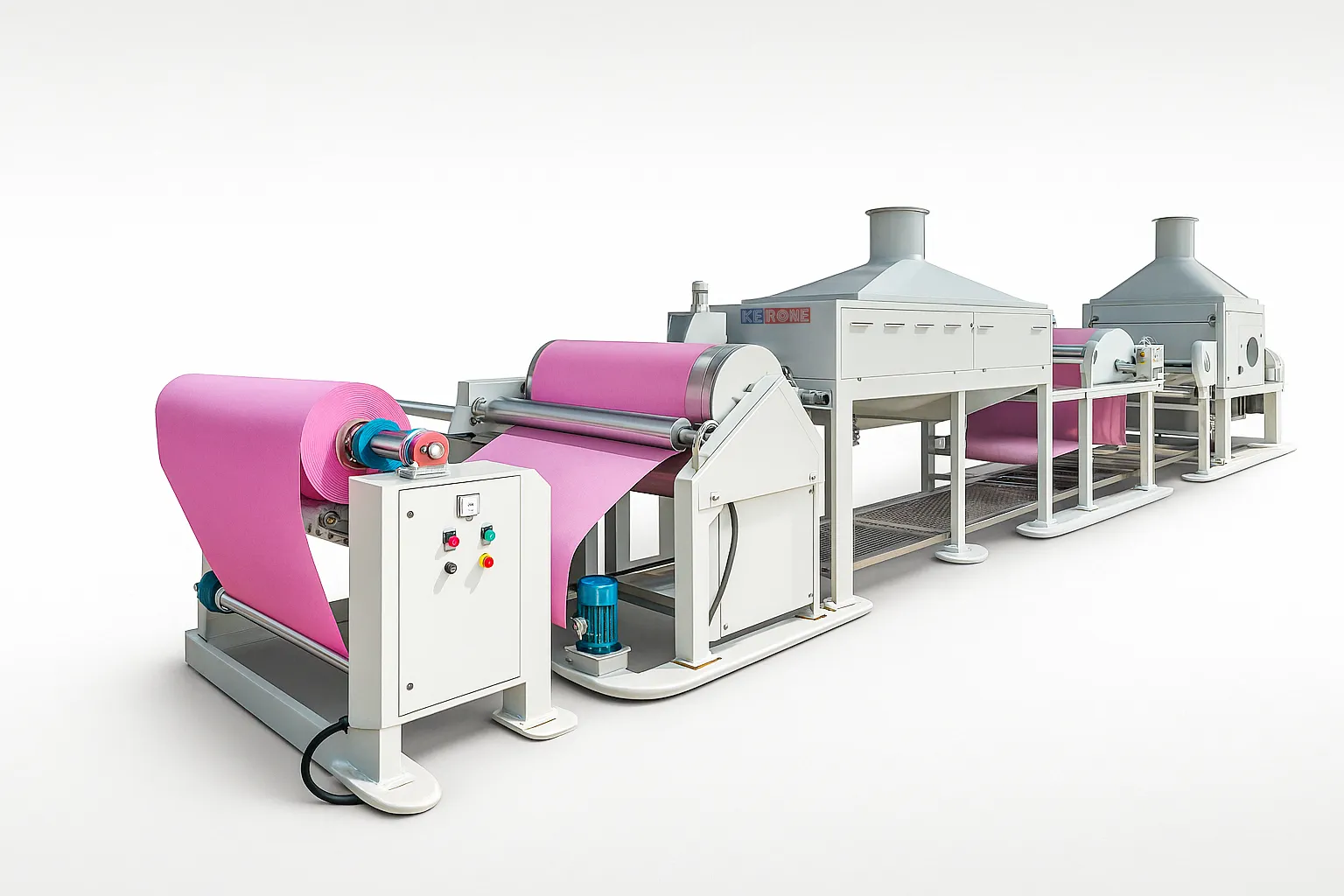
What Is an Industrial Coating Line?
An industrial coating line is an integrated production system used to apply protective, decorative, or functional coatings to manufactured products and components.
Depending on the application, a coating line may include:
- Loading and material handling systems
- Surface cleaning and pretreatment
- Drying after pretreatment
- Coating application equipment
- Spray booths or coating chambers
- Flash-off zones
- Drying or curing ovens
- Cooling sections
- Inspection and quality-control stations
- Unloading and downstream handling
The exact configuration depends on the substrate, coating chemistry, production volume, component geometry, environmental requirements, and desired finish.
For example, a continuous powder coating line for fabricated steel components has very different process requirements from a roll-to-roll coating system used for flexible materials. The engineering principle, however, remains the same: every stage must support stable and repeatable coating quality.
Surface Preparation: Where Coating Performance Really Begins
Many coating failures blamed on the coating material actually begin at the surface preparation stage.
Oil, grease, dust, rust, mill scale, moisture, and other contaminants can interfere with coating adhesion. Even an advanced coating formulation cannot consistently compensate for a poorly prepared substrate.
Industrial pretreatment may involve mechanical cleaning, chemical cleaning, washing, rinsing, conversion treatment, blasting, or combinations of these processes.
The correct method depends largely on the substrate and final performance requirements.
Key factors to evaluate include:
Surface cleanliness: Contaminants must be removed to a level appropriate for the selected coating system.
Surface profile: Some coatings require a controlled surface roughness to achieve effective mechanical adhesion.
Chemical compatibility: Pretreatment chemistry should be compatible with both the substrate and the coating.
Residual moisture: Components generally need to reach the coating stage in the required surface condition, without unwanted water or process residues.
Treating pretreatment as part of the coating process rather than as an isolated cleaning operation can significantly improve process reliability.
Choosing the Right Coating Application Method
There is no universally superior coating technology. The correct choice depends on the product and process.
Liquid Spray Coating
Liquid spray systems are widely used where manufacturers need flexibility in coating chemistry, color, finish, or component geometry. Application may be manual, automatic, robotic, air-assisted, airless, or electrostatic.
Important operating variables include atomization, spray pattern, gun distance, fluid delivery, part orientation, and booth airflow.
Powder Coating
Powder coating is commonly selected for metal components requiring durable finishes. Electrostatic application helps powder particles deposit onto the workpiece before thermal curing.
Successful operation depends on factors such as grounding, powder characteristics, electrostatic settings, component geometry, film thickness, and curing conditions.
Complex shapes can create challenges in recessed areas, particularly due to electrostatic effects, so gun positioning and process settings must be carefully optimized.
Dip and Flow Coating
Dip and flow methods can be effective when products require broad or complete surface coverage. Drainage behaviour, coating viscosity, withdrawal conditions, and component orientation become particularly important in controlling coating uniformity.
Roll and Continuous Web Coating
For sheets, films, foils, textiles, and other continuous materials, roll-based coating technologies can provide controlled coating weights at high production speeds.
Web tension, line speed, coating rheology, drying rate, and temperature uniformity must be coordinated to maintain consistent results.
Drying and Curing Are Not the Same Thing
One of the most important technical distinctions in coating-line design is the difference between drying and curing.
Drying generally involves the removal of water or solvent from a coating. Curing involves chemical or physical changes that develop the coating's final properties. Some processes involve both mechanisms.
This distinction affects equipment design.
A coating may appear dry on the surface while still containing residual solvent or moisture internally. Similarly, exposing a coating to excessive temperature does not necessarily produce better curing. Too much heat can cause discoloration, blistering, degradation, excessive energy consumption, or damage to heat-sensitive substrates.
Engineers therefore need to consider parameters such as:
- Coating chemistry
- Substrate temperature limits
- Required time-temperature profile
- Solvent or moisture removal rate
- Air velocity and circulation
- Exhaust requirements
- Product mass and geometry
- Line speed
For thermally cured coatings, part temperature is often more meaningful than simply looking at the oven's air-temperature setpoint. Heavy components may require significantly more time to reach the required metal temperature than thin parts traveling through the same oven.
Why Airflow and Temperature Uniformity Matter
A curing oven should not be evaluated only by its maximum temperature.
The distribution of heat throughout the working zone can have a major influence on coating quality. Poor air circulation may create hot and cold areas, leading to inconsistent drying or curing across different parts or conveyor positions.
Effective thermal-system design considers how heated air reaches the product, moves around its geometry, transfers energy, and returns through the circulation system.
Airflow also plays an important role in removing evaporated moisture and volatile compounds where applicable. However, excessive air movement can create other problems, particularly with wet coatings or lightweight products.
The goal is controlled heat and mass transfer rather than simply maximizing temperature or airflow.
Designing the Line Around the Product
A common mistake in coating-line projects is selecting equipment first and adapting the product to it later.
A better approach starts with the product and process requirements.
Manufacturers should define component dimensions, weight, production rate, substrate material, coating type, required film properties, quality standards, available floor space, utilities, and expected product variations.
The conveyor system must also be considered early. Conveyor speed directly affects residence time in pretreatment, coating, flash-off, drying, and curing zones. Increasing production speed without considering these relationships can reduce process time below what the coating system requires.
For manufacturers evaluating complete production configurations, reviewing technically engineered industrial coating line solutions can help illustrate how application, material handling, drying, and curing technologies can be integrated around specific process requirements. Companies such as Kerone Engineering Solutions Ltd. work with customized thermal and process systems where line design is developed according to the material, coating chemistry, throughput, and operating conditions rather than relying on a single standard configuration.
Energy Efficiency Should Be Engineered into the Process
Heating and ventilation can represent significant energy demands in an industrial coating operation, particularly in continuous production.
Improving efficiency does not simply mean lowering operating temperatures. If reduced temperature increases curing time, the line may require a longer oven or slower production speed.
A better strategy is to examine the complete energy balance.
Potential improvement areas include:
- Better oven insulation
- Optimized air recirculation
- Reduced unnecessary exhaust
- Heat recovery where technically and safely appropriate
- Improved burner or heater control
- Variable-speed fans
- Better production scheduling
- Reduced idle operation
- Improved temperature zoning
Any changes involving solvent-bearing exhaust streams must also account for applicable fire, explosion, occupational safety, and environmental requirements.
Common Coating-Line Problems and What They Can Reveal
Coating defects often provide useful clues about upstream process conditions.
Poor adhesion may indicate contamination, inadequate pretreatment, incompatible materials, or insufficient curing.
Blistering can be associated with trapped moisture, contamination, excessive film thickness, rapid heating, or substrate-related issues.
Uneven film thickness may result from inconsistent application settings, component positioning, poor grounding in electrostatic processes, or coating-flow characteristics.
Under-cured coatings may point to insufficient residence time or inadequate actual part temperature, while over-curing can affect colour, gloss, flexibility, or other coating properties.
Rather than adjusting a single machine whenever a defect appears, manufacturers should examine the entire process chain.
Building a More Reliable Coating Process
The most effective industrial coating lines are designed as connected systems.
Surface preparation influences adhesion. Application controls film formation. Flash-off conditions affect solvent or water release. Oven design determines the thermal history of the coated product. Conveyor speed determines residence time throughout the process.
When these variables are engineered together, manufacturers gain better control over coating consistency, production capacity, energy use, and reject rates.
The right coating line is therefore not necessarily the fastest or most automated system available. It is the one that provides the required process conditions consistently for the specific product being manufactured.
For companies planning a new line, increasing production capacity, or troubleshooting persistent coating defects, the best starting point is to define the material, coating chemistry, target quality, throughput, and thermal requirements in detail. Once these fundamentals are clear, equipment selection becomes an engineering decision rather than a collection of assumptions and that is what ultimately creates a coating process capable of delivering repeatable results at industrial scale.

























Sign in to leave a comment.