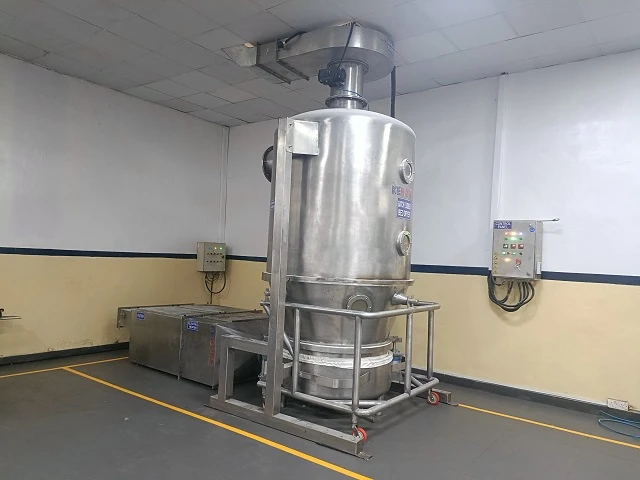
There's something almost magical about the moment a bed of dry particles, resting inert on a distributor plate, suddenly transforms into a churning, boiling mass of suspended solids — all without adding a drop of liquid. This is the phenomenon at the heart of fluidised bed drying: a technology that has quietly become one of the most efficient and versatile drying methods in modern industry.
At its core, the fluidised bed dryer leverages a fundamental principle of fluid dynamics. When a stream of gas — typically heated air — passes upward through a bed of particulate material at the right velocity, the drag forces on the particles exactly balance their weight. The particles are lifted, separated, and begin to move freely, behaving in many ways like a liquid. In this suspended state, each particle is surrounded by hot gas, maximizing the surface area available for heat and mass transfer.
“In fluidised bed drying, every particle becomes its own drying chamber — surrounded on all sides by the thermal medium, with nowhere to hide moisture.”
This simple but profound physics underpins applications across pharmaceuticals, food processing, chemicals, agriculture, and dozens of other industries. Companies like Kerone Engineering Solutions, with over 50 years of experience in industrial thermal processing, have built sophisticated fluidised bed systems that bring this science into demanding production environments with precision and reliability.
Why Fluidised Bed Dryers Outperform Conventional Methods
The popularity of fluidised bed technology across diverse industries is no accident. The design delivers operational and product quality advantages that are difficult to replicate with alternative drying approaches.
- High Drying Efficiency
Exceptional heat and mass transfer coefficients dramatically reduce drying time. - Uniform Drying
Continuous particle mixing ensures consistent moisture levels. - Low Temperature Operation
Preserves heat-sensitive ingredients and flavours. - Gentle on Particles
Minimal attrition compared to mechanical agitation methods. - Flexible Residence Time
Process parameters can be tuned to target moisture levels. - Modular Design
Available in batch or continuous configurations. - Fireproof Construction
Industrial-grade safety features with explosion-resistant options. - Easy Maintenance
Industry Applications
An Extraordinary Range of Materials
Fluidised bed drying is highly versatile and serves multiple industries due to its adjustable temperature, gas velocity, and particle handling capabilities.
Common applications include:
- Pharmaceuticals
- Food & Beverage
- Agrochemicals
- Dyestuffs & Pigments
- Detergents
- Fertilisers
- Polymers & Resins
- Ceramics
- Biomaterials
- Carbohydrates
- Chemical Powders
- Pesticides
- Health-Care Products
- Mineral Processing
- Waste Management
- Calcination
Pharmaceuticals: Precision Matters Most
Fluidised bed dryers are widely used to dry APIs, granulated excipients, and agglomerated powders. They offer uniform temperature control, reproducibility, and containment required by regulatory standards.
Food Processing: Gentle and Fast
Used for cereals, coffee, sugar, salt, and food ingredients, these dryers preserve aroma and nutritional qualities due to lower operating temperatures. Continuous systems support high-throughput operations.
Chemicals and Agrochemicals: Tough Environments
Used for fertilisers, pesticides, and specialty chemicals. Robust construction and high-temperature capability allow use in calcination and combustion processes.
A Technology Built for the Demands of Modern Industry
Fluidised bed drying combines elegant science with practical engineering to create an efficient, versatile, and reliable drying solution. Its ability to dry materials rapidly, uniformly, and gently explains its widespread adoption across industries.
With advancements in AI-driven analytics, IoT connectivity, and real-time monitoring, modern fluidised bed dryers are becoming intelligent systems capable of predictive maintenance and data-driven quality control.
For manufacturers seeking efficiency, product quality, and sustainability, fluidised bed dryers remain an indispensable solution. Experienced partners like Kerone can translate process requirements into systems that deliver precise, reliable performance.






















Sign in to leave a comment.