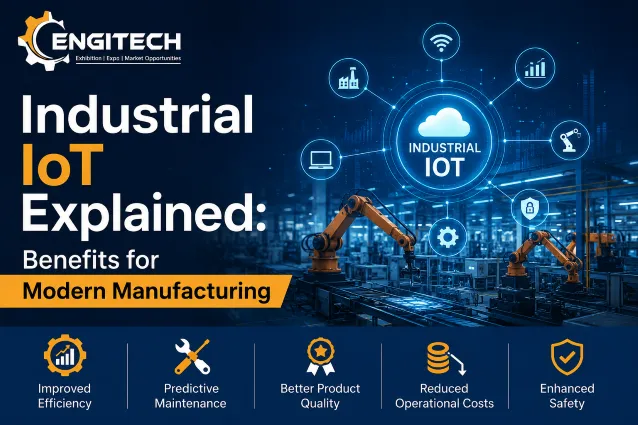

There have been major changes in manufacturing as compared to the traditional assembly line methods. The factories of modern times have also evolved to become smarter and much more efficient because of the use of advanced technologies, which continuously provide information. The modern manufacturing process is dependent on the Industrial Internet of Things, which plays an important role in making it possible for machines to communicate with each other in real-time.
By the use of IIoT, manufacturers can enjoy many benefits, including improvement in their product quality, production efficiency, and reduction in downtime. IIoT makes it possible to observe the performance of various manufacturing procedures and ensure that safety measures are observed within the manufacturing sites.
With the increase in popularity of Industry 4.0, it has become necessary for manufacturers to understand the advantages of the Industrial Internet of Things in order to keep up with the modernization of the field.
What is Industrial IoT (IIoT)?
Industrial IoT is a term that is used to refer to the contemporary technology that involves the use of the latest online-connected sensors, machines, industrial tools, and software systems in the manufacturing and industrial spheres, where these connected instruments collect information from operations, transmit it instantly, and give companies the opportunity to follow up on manufacturing procedures.
The distinctive feature of industrial IoT devices is that they target critical operations critical in production, where reliability and accuracy play important roles in the processes.
An IIoT ecosystem typically includes:
- Smart sensors
- Connected machines
- Cloud or edge computing platforms
- Industrial communication networks
- Data analytics and AI software
- Manufacturing execution systems (MES)
Together, these technologies create intelligent factories capable of making data-driven operational decisions.
How Does Industrial IoT Work?
The concept of Industrial IoT is based on attaching the sensors to the manufacturing machinery. The installed sensors keep on capturing the metrics of the machines such as temperature, vibration, pressure, energy consumption, machine speed, and product quality. The data gets sent through industrial network systems into cloud or edge computing systems.
On the basis of this data, manufacturing facilities may use cloud dashboards, receive alerts in case there is an issue, and even automate the activity before the machine breaks down.
Why Industrial IoT Matters in Modern Manufacturing
Manufacturing is growing in complexity because of heightened consumer expectations, reduced product life span, labor shortages, and international rivalry. Old-fashioned manufacturing systems are inefficient in quickly reacting to the changing demands of consumers.
Wonderful opportunities in resolving the challenges that industrial manufacturing is facing today are provided by industrial IoT. Instead of manual supervision and random inspections, the possibility is opened for factories to have visibility of all operations performed.
The implementation of industrial IoT enables firms to improve performance and increase efficiency while eliminating waste and unpredictable downtime.
Key Benefits of Industrial IoT
1. Enhancing operational efficiency
One of the main advantages of industrial IoT is improved operational efficiency. Connected devices report on performance, allowing managers to detect production problems and optimize processes.
Instead of waiting for a daily report, manufacturers can follow production at every stage. Thus, problems can be solved quickly, and resources are used more rationally.
2. Predictive maintenance
Standard maintenance schedules can lead to unnecessary repairs or equipment failures.
Industrial IoT changes this by monitoring machines continuously. The sensors react to fluctuations of temperature, vibrations, or pressure.
Maintenance specialists can provide repairs even before the shutdown.
3. Improved product quality
The quality of the product is one of the core issues in manufacturing.
Sensors of industrial IoT follow production parameters during the manufacturing process. The moment when the machine starts to work unconventionally, operators are informed, which helps to fix the problem before defective goods are produced. This reduces waste and increases customer satisfaction in the end.
4. Monitoring Production in Real Time
The factory overseer can do away with having to rely on manual inspections. With industrial IoT dashboards, now it is possible to see how a factory performs in real time in terms of its machine operation, productivity, availability of equipment, and supplies in stock. The possibility to monitor all processes in real time ensures faster decision-making and improved transparency in operations.
5. Minimizing Operational Costs
Thanks to the Industrial IoT, companies have a chance to cut their manufacturing costs by using resources more efficiently. Using connected systems enables saving on energy, reducing the amount of downtime, minimizing waste, and making maintenance more efficient. As a result, these efficiencies will lead to considerable savings and higher profits.
6. Better Safety of Employees
The industrial environment is associated with dangerous machinery and processes. By using wearable devices, sensors, and monitoring systems based on IIoT technologies, it is possible to learn about an unsafe situation long before it happens. Factories can check for gas leaks, temperatures, problems with equipment, and if someone enters a restricted area.



























Sign in to leave a comment.