
Introduction
In one of my discussions with the hospital administrator, there was a surprising problem identified. The most significant delays were not related to either the absence of skilled specialists or obsolete medical technology. In fact, it took many hours daily for people to perform all kinds of routine administrative tasks such as moving information from one system to another, verifying claims, reviewing the documentation, and performing manual approvals.
Eventually, the problem affected the whole institution. Bottlenecks in the administration process led to additional delays, costs, and stress on both clinical and non-clinical staff. This is how Intelligent automation in healthcare became something much more important than just another technological trend. It allows automating the process of routine operations and making informed decisions with the help of AI technologies and workflows. It does not replace healthcare professionals but gives them more time for work that demands human skills and experience.
What Makes Intelligent Automation Different From Traditional Healthcare Automation?
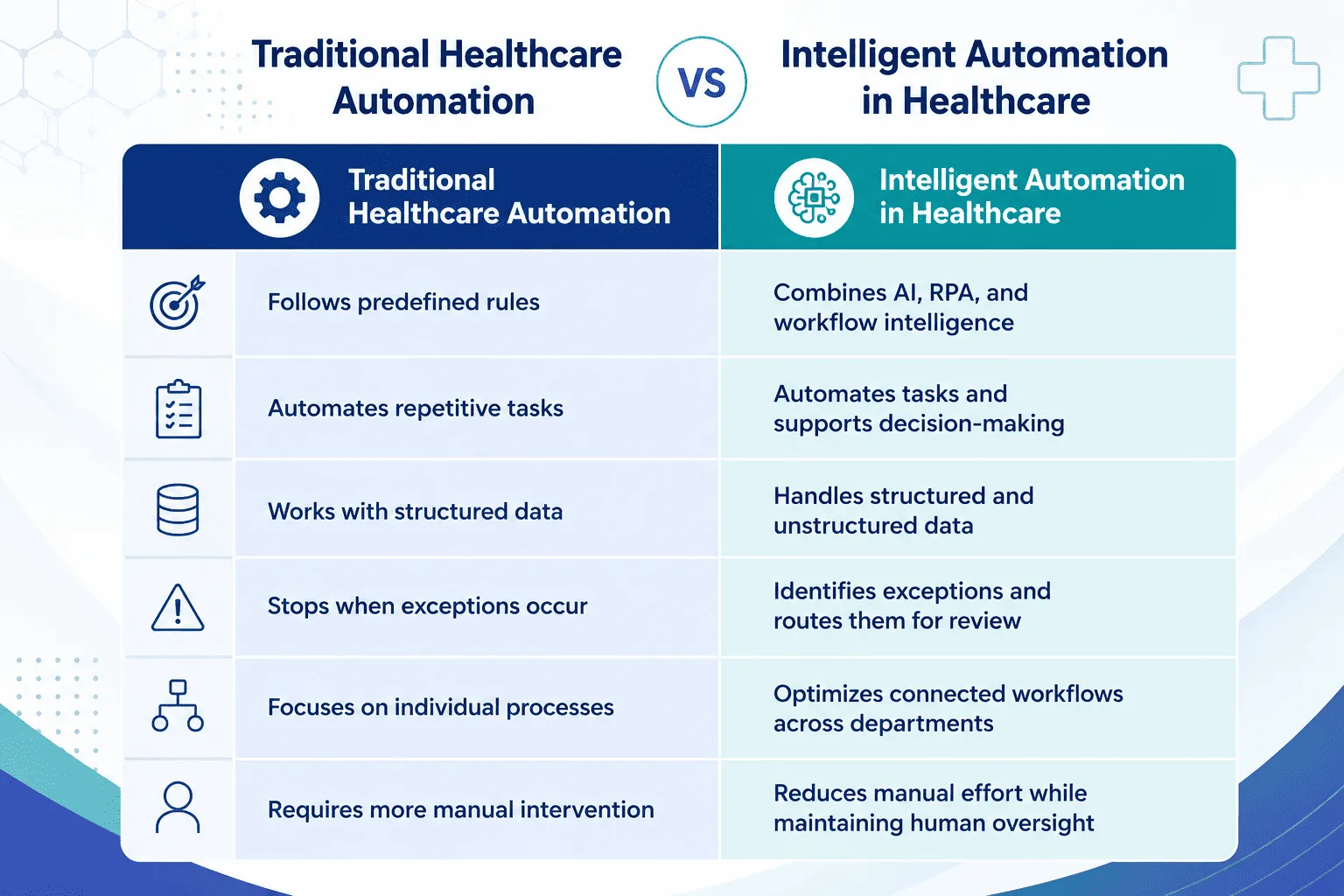
Automation of healthcare through traditional methods makes use of defined rules to perform repetitive tasks, including scheduling appointments, directing insurance claims, and entering data. Intelligent automation in healthcare through intelligent processes involves taking automation to the next level, where advanced technologies such as artificial intelligence (AI) and robotic process automation (RPA) are used in analyzing information, managing exceptions, and decision-making, which were previously done manually. Rather than automating each task separately, intelligent automation makes it possible to automate whole processes. This reflects a broader shift highlighted by McKinsey, which notes that many healthcare organizations fail to achieve the full benefits of automation because they add AI to existing processes instead of redesigning end-to-end workflows around human-AI collaboration.
How Intelligent Automation Changes Daily Work Across Healthcare Teams
Healthcare organizations rarely struggle with a single inefficient process. More often delays happen because information moves across multiple departments, each with its own manual tasks and disconnected systems. This is where Healthcare Automation Services helps organizations build connected workflows that reduce repetitive work without removing human oversight. As intelligent automation in healthcare becomes part of everyday operations, each team spends less time on routine administration and more time on work that directly supports patient care, operational performance, and compliance.
Front Office
Teams in the front office handle patient registration, scheduling appointments, verifying insurance, and referring patients. This involves data entry work and switching between different systems which can delay processes before a patient gets to see a provider. Using intelligent automation in such cases helps streamline processes for validating patients' data, insurance eligibility, and updating their records. This way, staff can deal with issues that require their attention rather than performing routine administrative work.
Example: A patient schedules an appointment for an MRI at a hospital using the hospital’s website. In such a case, the intelligent automation system helps to validate the patient's insurance eligibility, physician referral and schedule appointments before their visit while updating their electronic health record. The front office staff intervene only when there are missing prior authorizations or patient information needs validation.
Clinical Support
The clinical support teams use their valuable time in documenting patient visits, searching for medical records, and exchanging information among departments. Although this process is critical, it consumes time that could otherwise be spent on assisting the patients. The intelligent automation facilitates the process of structuring the clinical information, sending it to the proper system, and presenting the required information about the patients when it is needed.
Example: After the cardiology consult: The information is structured by the intelligent automation using the data obtained from the doctor's note in the EHR. The summary is then reviewed by the clinician rather than being written from scratch.
Revenue Cycle
Revenue cycle teams code, process claims, verify payments, and manage denials. The manual processing of these functions will lead to a slower reimbursement process and higher administrative expenses. Intelligent automation increases efficiency by verifying claims, checking for missing data, and routing exceptions before submitting the claim, thereby avoiding unnecessary delays.
Example: An oncology treatment claim undergoes verification of coding, checks on the needs of the payer, and checks for missing data before submission. Claims meeting all criteria proceed automatically while only exceptions go through the manual process.
Compliance
Compliance in the healthcare industry is responsible for ensuring that the regulatory requirements are adhered to by monitoring and auditing access to sensitive patient information. Manual audit of all activities taking place in the system across various applications is not only difficult but also inefficient. Intelligent Automation can help in continuously monitoring workflow activity, auditing access activity, and detecting any anomalies that might require further investigation.
Example: If the user tries to access patient records from different departments, intelligent automation will log the action and report it for further investigation.
IT Operations
The IT group at healthcare organizations provides technical assistance for electronic medical records, clinical systems, interoperability solutions, and supporting infrastructures, which need to be available 24/7. The smallest issue with the availability of such systems may result in a disruption of clinical workflow and impact patient care. Intelligent automation tracks performance, identifies system failures, and sends the incident to the relevant technical support team.
Example: Communication from the laboratory information system to the EHR via HL7 interface ceases. Intelligent automation notices the problem with the message queue, generates an incident ticket, notifies the integration team, and starts executing a defined procedure before any clinical disruption occurs.
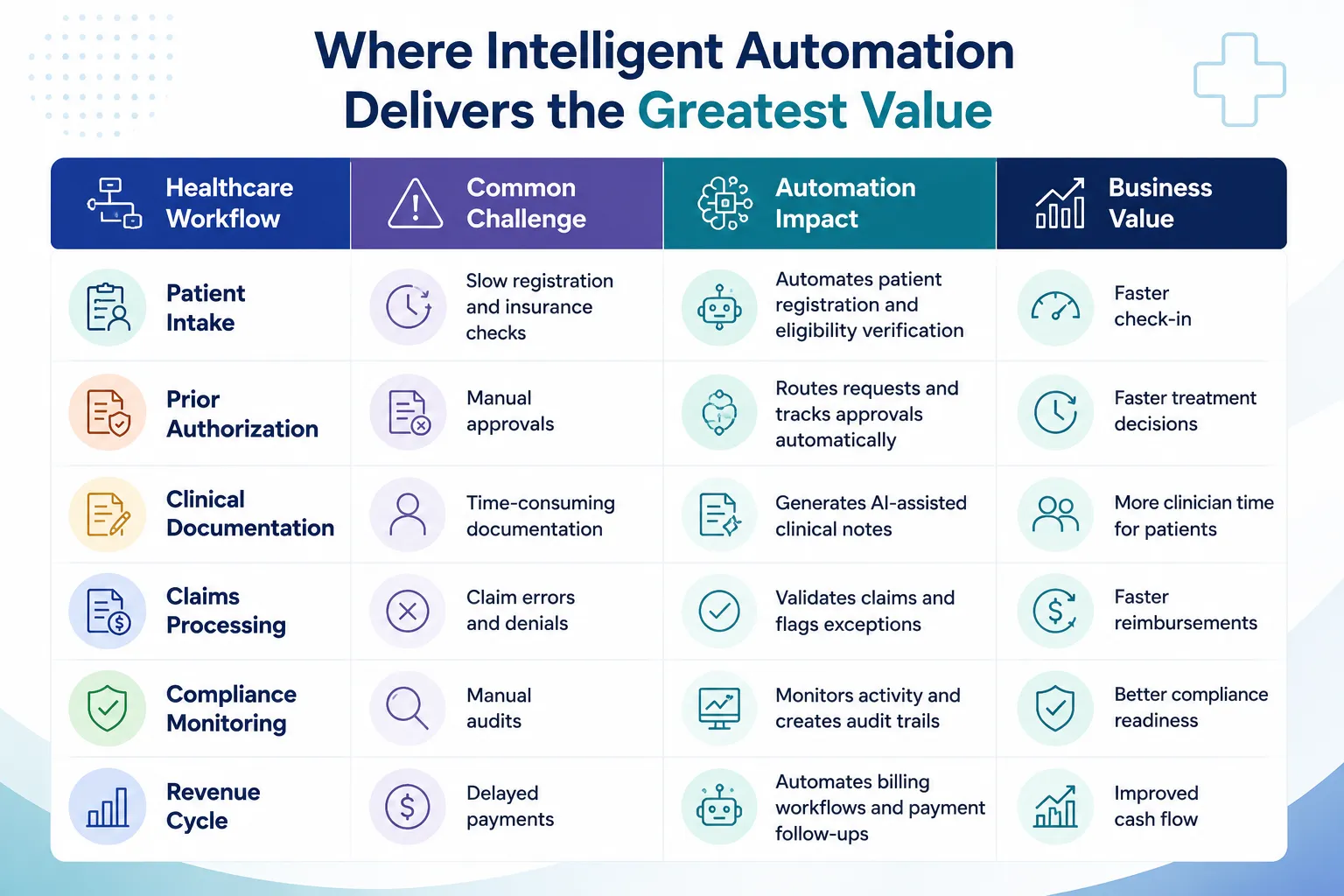
Where Intelligent Automation Delivers the Greatest Value
Not all processes within the healthcare sector yield equal gains through automation. The biggest gains can be made through intelligent automation of processes that are highly repetitive, time-sensitive, and involve multiple systems. Intelligent automation in healthcare enables healthcare workers to concentrate on other critical tasks besides minimizing effort, increasing speed, and ensuring accuracy.
Conclusion
The future of healthcare is not the total automation of everything. It is making people more efficient in their actions. Intelligent automation in healthcare reduces repetitive tasks, improves operational efficiency, and makes decision-making faster without taking away from the important role that health care providers play. Intelligent automation, when used appropriately, will improve cooperation among departments and allow the staff to focus on what really matters.
As healthcare organizations are increasingly facing challenges related to increasing demands from patients, shortage of workforce, and growing number of regulations, intelligent automation will turn into a vital part of the organization's operations rather than just one more technology-related investment.



























Sign in to leave a comment.