

Gate Barrier System technology now sits at the centre of how the UAE plans vehicle movement across new developments, from mixed-use towers and logistics hubs to gated residential communities and free-zone business parks. As the country's infrastructure grows more connected and data-driven, a barrier arm is no longer treated as a standalone piece of hardware but as one node in a wider smart-facility network.
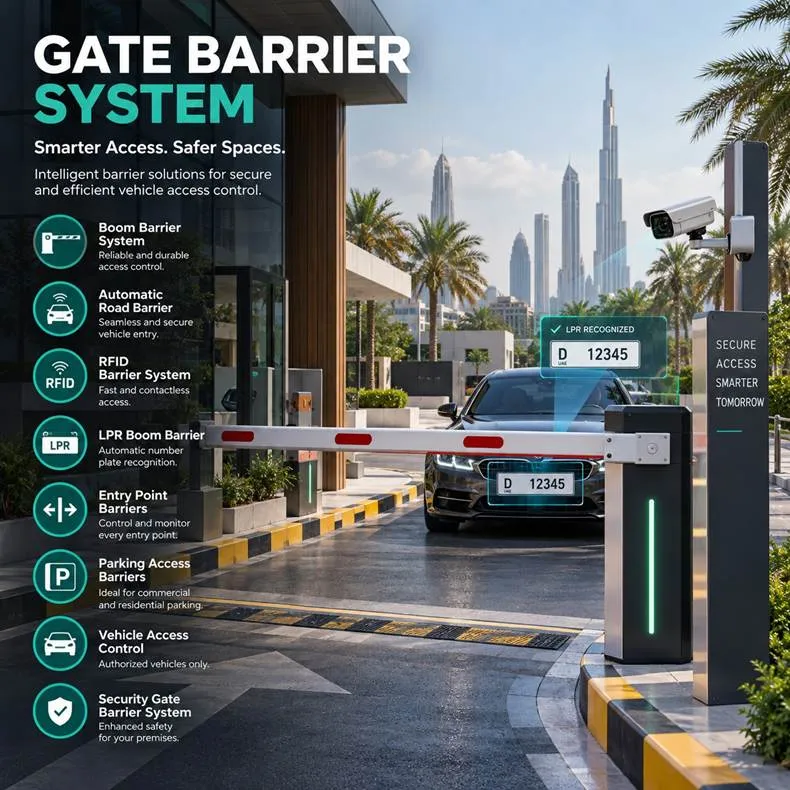
This guide looks at how gate barrier system hardware fits into modern UAE infrastructure planning, the engineering choices behind reliable Vehicle Access Control, and what to consider when specifying a Gate Barrier System UAE solution for a new or upgraded development.
How Vehicle Entrances Fit into Smart Infrastructure Planning
New UAE developments rarely design a vehicle entrance in isolation anymore. Master plans for business parks, residential communities, and logistics zones now treat traffic flow, security, and data collection as connected requirements from the earliest design stage, rather than retrofitting a barrier onto a finished road layout.
This shift matters because a barrier specified early, with proper civil works and power planning built into the site design, performs more reliably and integrates more cleanly with other building systems than one added later as an afterthought.
The Engineering Behind a Reliable Gate Barrier System
A Gate Barrier System is, at its core, a mechanical device operating under demanding conditions: thousands of open-close cycles a month, sustained exposure to heat and dust, and an expectation of near-zero downtime at a facility's main entrance.
Engineering decisions made at the specification stage — motor duty cycle rating, housing material, and arm length — determine how well a barrier holds up under this kind of continuous UAE operating environment, long after installation day has passed.
Boom Barrier System Design for High-Cycle Commercial Use
The workhorse of most vehicle entrances remains the Boom Barrier System, a motorized arm engineered specifically for continuous, high-frequency cycling rather than occasional residential use.
Commercial-grade units are rated for a duty cycle that assumes constant daily operation, which matters enormously at a busy staff entrance or logistics gate where the barrier may cycle several hundred times before the working day even ends.
Automatic Road Barrier Infrastructure for Higher-Capacity Roads
Larger developments with wider, faster approach roads need a heavier engineering solution than a standard boom arm. An Automatic Road Barrier is built for exactly this: longer arm spans, reinforced mechanisms, and faster cycle times suited to multi-lane entrances at business parks and industrial zones.
Specifying this hardware correctly at the planning stage avoids a common and costly mistake: installing a lighter-duty barrier that cannot keep pace once a development reaches full occupancy and traffic volume climbs toward its planned capacity.
Connecting Hardware to Software: RFID Barrier System and LPR Boom Barrier Integration
Modern infrastructure planning treats the barrier arm and its credentialing software as one integrated system, not two separately procured components bolted together after the fact.
RFID Barrier System for Known, Recurring Traffic
An RFID Barrier System handles the bulk of predictable, repeat traffic — staff, residents, and fleet vehicles — reading a windshield tag automatically and opening the barrier without manual intervention at any point.
LPR Boom Barrier for Unregistered and Visitor Traffic
An LPR Boom Barrier extends coverage to vehicles that were never issued a physical credential, reading the license plate directly and checking it against an approved list, which suits visitor lanes, deliveries, and short-term contractor access.
Designing both technologies into the site's network architecture from the start, rather than adding them later, gives infrastructure planners a single data-integrated barrier platform rather than two disconnected systems reporting to different places.
Zoning a Development with Entry Point Barriers and Parking Access Barriers
Large-scale UAE developments benefit from treating vehicle access as a layered zoning problem, rather than a single gate protecting an entire site.
Entry Point Barriers Define the Outer Boundary
Entry Point Barriers establish the perimeter layer, typically pairing an automatic road barrier with credential readers and camera coverage at the point where public roads meet private development land.
Parking Access Barriers Manage Internal Zones
Moving further into a site, Parking Access Barriers divide internal traffic into resident, staff, and visitor zones, each with its own access rules layered on top of the outer perimeter's broader screening.
This zoning approach mirrors how modern master-planned communities and business parks are designed overall: broad access control at the edge, progressively tighter control the closer a vehicle gets to sensitive or reserved areas.
Specifying a Security Gate Barrier System for Long-Term Infrastructure Value
Developers and facility planners specifying a Security Gate Barrier System for a new UAE project generally need to plan beyond opening day, since infrastructure decisions made now shape maintenance costs and upgrade paths for years afterward.
- Open integration standards that allow the barrier to connect with future building-management or smart-city platforms, not just today's software.
- Fail-safe power design that keeps emergency egress compliant even during a grid interruption.
- Modular hardware that can be upgraded, such as adding LPR cameras later, without replacing the entire barrier assembly.
- Data logging built to export cleanly into whatever reporting or audit system the facility adopts down the line.
Infrastructure specified with this kind of forward compatibility in mind tends to age far better than hardware chosen purely on today's lowest upfront cost.
Selecting a Gate Barrier System UAE and Gate Barrier System Dubai Engineering Partner
Sourcing a Gate Barrier System UAE partner for an infrastructure-scale project involves evaluating engineering capability, not just product catalogues. A provider who understands civil works, power planning, and network integration delivers a fundamentally different outcome than one who simply drops in pre-boxed hardware.
For projects specifically located in the Emirate, a Gate Barrier System Dubai partner familiar with the city's mix of free-zone regulations, high-density towers, and master-planned communities brings practical site knowledge that a generic international supplier often lacks.
- Demonstrated experience on comparable infrastructure-scale UAE projects, not only small single-gate installations.
- In-house or closely partnered civil and electrical engineering capability for proper site integration.
- A support model built around the full asset lifecycle, not just the initial installation.
Involving the barrier provider during the design phase, rather than after civil works are finalized, consistently produces a smoother and less costly integration.
From Commissioning to Long-Term Asset Management
Treating a barrier system as long-term infrastructure, rather than a one-time purchase, changes how commissioning and maintenance get planned from day one.
- Commissioning includes full testing of every credential pathway, from RFID to plate recognition, under real site conditions before handover.
- Preventive maintenance schedules are built around actual cycle counts rather than a generic calendar interval.
- Spare-parts availability and technician response times are agreed contractually as part of the infrastructure's operating budget.
Developments that build this kind of asset-management thinking into their barrier specification from the outset consistently report lower total cost of ownership over the system's working life.
Conclusion
Modern UAE infrastructure demands a Gate Barrier System engineered as part of the site plan from day one, with a high-cycle Boom Barrier System or heavier Automatic Road Barrier matched to actual traffic capacity, an RFID Barrier System and LPR Boom Barrier integrated as one credentialing layer rather than separate add-ons, and zoned Entry Point Barriers alongside Parking Access Barriers extending consistent Vehicle Access Control across every layer of the development, which is why a properly specified Security Gate Barrier System sourced through an experienced Gate Barrier System UAE or Gate Barrier System Dubai engineering partner delivers far greater long-term infrastructure value than hardware chosen on price alone.






























Sign in to leave a comment.