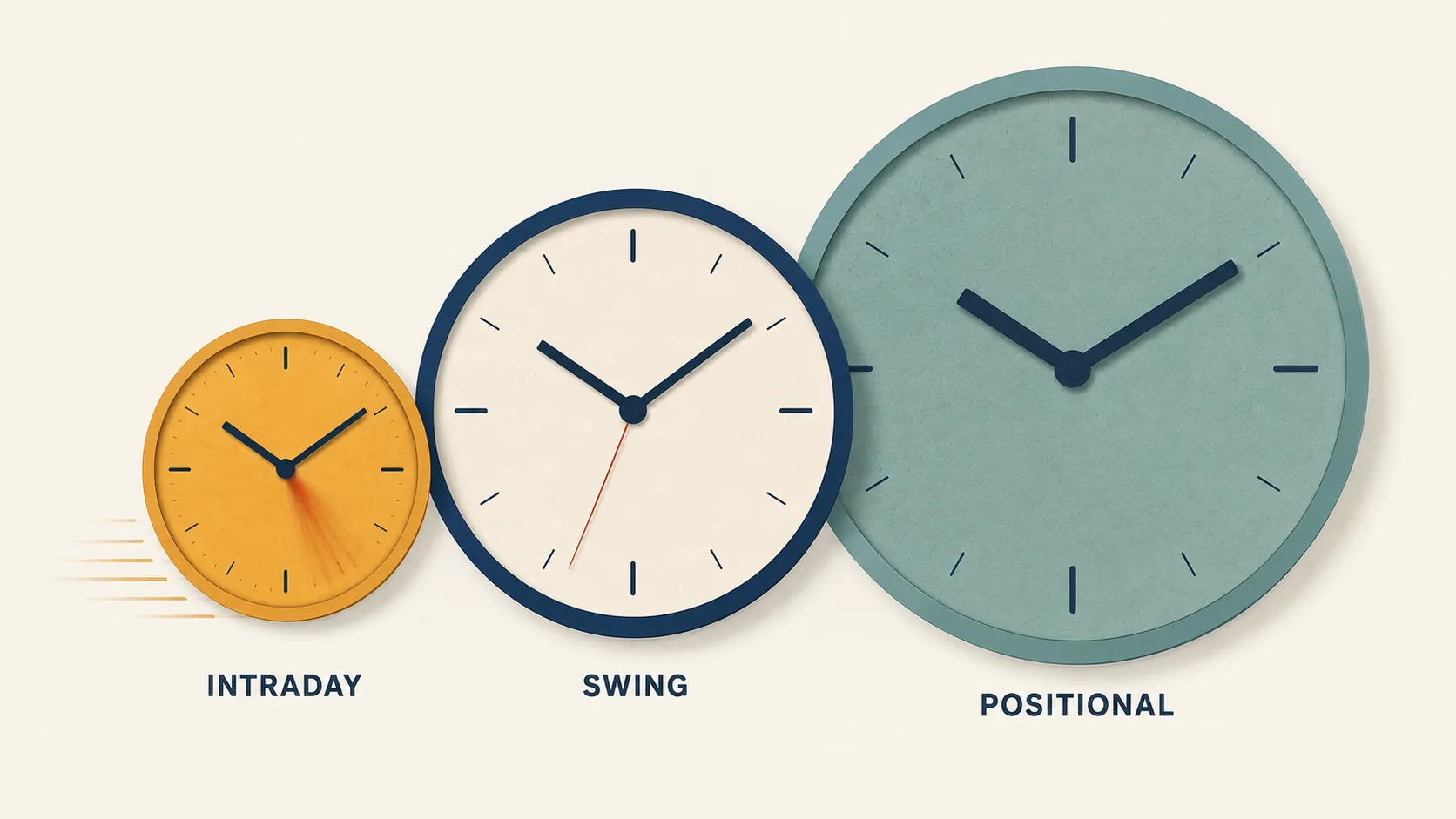


Ask a beginner what they want to learn about trading, and you'll get answers like "candlestick patterns" or "how to read charts" or "which indicators actually work." Almost nobody says "I need to figure out what kind of trader I'm going to be." That question gets treated as a footnote, something you'll figure out along the way, when it's actually the decision everything else depends on.
This is literally a line item in Module 1 of most structured beginner courses, sitting right after the basics of market structure. It gets skimmed past constantly because it doesn't feel like "real" learning yet. Real learning, in most beginners' heads, is charts and indicators and strategies. Picking a trading style feels like paperwork before the actual class starts.
That's backwards. Skipping this step is one of the more common reasons people finish a trading education and still fail at trading. Not because they didn't learn the technical content, but because they learned it for a style of trading that was never going to fit their actual life.
It's Not a Preference. It's a Constraint.
Most beginners approach the intraday-vs-swing-vs-positional question the way they'd approach picking a Netflix genre: whatever sounds most appealing in the moment. Intraday sounds the most exciting, so that's usually the default. Fast trades, quick profits, constant action. It's also what gets the most airtime on YouTube and Instagram, because fast and exciting makes for better content than "I bought a stock in March and I'm still holding it."
But trading style isn't a taste. It's a function of constraints you already have, whether you've thought about them or not.
Intraday trading requires you to be present and watching the market during trading hours, 9:15 AM to 3:30 PM, five days a week. Not glancing at your phone during a lunch break. Actively watching, ready to enter and exit within minutes or hours, because every position gets closed before the market shuts for the day. If you have a job, or you're in college with a class schedule, this constraint alone disqualifies intraday for most of your week, regardless of how good you get at reading charts.
Swing trading asks something different. Positions are held for days to a couple of weeks, based on short-to-medium-term price moves. You don't need to watch the market every minute, but you do need the patience to let a trade play out without checking it forty times a day, and the discipline to not panic-exit the moment it dips before eventually working in your favor.
Positional trading stretches further still, weeks to months, sometimes longer. This is closer to investing with a trading lens. You're relying on a broader trend playing out over time, and you need capital that can sit through interim volatility without you needing to touch it for rent money next month.
None of these is objectively better. They're better or worse for you, based on constraints most beginners never actually sit down and check against.
Why Almost Everyone Defaults to the Wrong One
Here's the uncomfortable part. If trading style were purely a rational match against personal constraints, you'd expect people with day jobs to gravitate toward swing or positional trading almost automatically, since intraday is the one style that structurally competes with a 9-to-5. But that's not what happens. A huge number of first-time traders start with intraday anyway.
The reason isn't a mystery. Intraday is what gets talked about. It's the style behind most "I made ₹15,000 in one trade" screenshots, most fast-cut trading reels, most of the finfluencer content that pulls people into markets in the first place. It looks like the version of trading that matches the energy of everything that got you interested. Swing and positional trading don't produce the same content. "I'm still holding this position from three weeks ago, nothing much has happened" doesn't go viral.
So beginners pick intraday not because it fits their life, but because it's the version of trading they've seen the most of. Then they try to squeeze active, full-attention trading into the gaps of a workday: a five-minute glance during a meeting, a quick check during lunch, a rushed decision right before a call. This isn't a skill problem, it's a structural mismatch. You could have a flawless understanding of candlestick patterns and support-resistance levels and still lose consistently, purely because the style you're trading doesn't fit the hours you actually have available to trade it.
This is worth sitting with, because it reframes a lot of "I'm just not good at trading" self-assessments. Sometimes that's true. But a lot of the time, the actual diagnosis is simpler: wrong style, wrong constraints, never checked.
A Blunter Way to Ask the Question
Instead of "which style sounds most interesting," here are the questions worth answering honestly before picking one.
How much of your actual trading-hours time can you give the market, not after work, during it? Not "I'll check when I get a chance." Actual, dedicated, uninterrupted screen time between 9:15 and 3:30. If the honest answer is "basically none on weekdays," intraday is off the table regardless of interest level. This isn't a discipline failure, it's math. You can't day-trade with zero available hours during the day.
Can you watch an open position lose money for days without closing it out of anxiety? This sounds like a simple yes/no, but it's really a question about your relationship with uncertainty. Swing and positional trades will go against you before they go in your favor more often than beginners expect. If every red number in your portfolio makes you want to exit immediately, you'll cut winning trades short before they've had time to work, which defeats the entire premise of holding for days or weeks.
Are you trying to replace income or grow savings? This one gets skipped constantly, and it matters more than people think. If you need consistent, near-term cash flow, positional trading's multi-month time horizon isn't going to meet that need, no matter how sound the strategy is. If you're trying to build wealth over years and can afford volatility along the way, treating every trade like an intraday sprint will just add stress and fees without adding returns.
There's no scoring system here, no personality quiz turning your answers into a neat label. But answer these three honestly, and the mismatch, if there is one, usually becomes obvious fast.
What This Actually Determines
Here's why this isn't a preliminary formality before the "real" learning starts. Every module that comes after this decision, charting, indicators, strategy, gets filtered through whichever style you're actually trading. A support and resistance level that matters on a 5-minute intraday chart is a completely different tool than a support level on a weekly chart used for a positional trade. An indicator tuned for swing entries behaves differently than the same indicator used for scalping intraday moves. Risk management rules, how much of your capital you risk per trade, where your stop-loss sits, shift based on your holding period too.
If you pick your style honestly first, everything you learn afterward becomes directly usable, because you're filtering every new concept through the lens of how you're actually going to trade. If you skip this step, you end up learning a generic version of technical analysis that technically applies to all three styles and specifically fits none of them, and you find out the mismatch only after you've already lost money finding it.
This is the actual reason so many people can complete a trading course, understand the material, and still fail at trading. It was never a knowledge problem. It was a fit problem, and it was decided by default, without anyone noticing, on day one.
The question "what kind of trader am I" isn't paperwork before the real class starts. It's the first real decision of the entire process. Everything else is just execution.
Frequently Asked Questions
Why is it important to determine my trading style as a beginner?
Determining your trading style is crucial because it shapes how you learn and apply trading concepts. If you choose a style that doesn't align with your available time and emotional capacity, you may struggle to succeed, regardless of your technical knowledge.
What are the different types of trading styles I should consider?
The main trading styles are intraday, swing, and positional trading. Intraday trading requires active market engagement during trading hours, swing trading holds positions for several days, and positional trading takes a longer-term approach, often weeks or months.
How do personal constraints affect my trading style choice?
Personal constraints, such as your work schedule and emotional tolerance for market fluctuations, play a significant role in determining which trading style is suitable for you. If you can't dedicate uninterrupted time to monitor trades, intraday trading may not be a viable option.
What questions should I ask myself to choose the right trading style?
Consider how much time you can realistically dedicate to trading during market hours, your ability to handle losing positions without panicking, and whether you need immediate income or can afford to invest for the long term. Honest answers to these questions can help identify the best fit for your situation.
Can I learn trading concepts without knowing my style first?
While you can learn technical concepts without a defined trading style, the knowledge may not be effectively applicable. Each concept, such as indicators or risk management, is influenced by your chosen style; learning generically may lead to mismatches and potential losses.
What are the common mistakes beginners make when choosing a trading style?
Many beginners default to intraday trading because it's more popular and exciting, neglecting to consider their actual availability and emotional resilience. This mismatch often leads to frustration and losses, as their style doesn't align with their constraints.
How does my trading style affect my learning process?
Your trading style dictates how you interpret market data and apply strategies. By knowing your style first, you can tailor your learning to focus on relevant concepts, making your education more effective and applicable to your trading experience.
























Sign in to leave a comment.