

“Intraday trading vs Swing trading, which is more profitable?” This is one of the most common questions asked by traders new to stock trading dynamics. However, there is no straightforward answer to this question.
Both approaches aim to capitalise on short-term price movements, but they are executed differently and suit different types of traders. Basically, you need to figure out the best approach for you and the one in which you make fewer losing trades.
In this blog, you will learn the critical difference between swing trading and intraday trading and which one is best for you.
What is Day Trading?
Day trading or intraday trading can be a trading approach that involves taking multiple trades in a single day. These types of traders are heavily reliant on technical indicators like Charts, Relative Strength Index (RSI), and more.
The key point in intraday trading vs swing trading is that the primary aim of day trading is to profit from small price fluctuations using high volumes and rapid execution.
Key Characteristics of intraday trading:
● Trades can last anywhere from a few seconds to several hours within the same day.
● You must be glued to the screen, continuously monitoring charts, patterns, and technical indicators.
● Leverages are often used to increase potential returns (and risks).
Pros & Cons of Day Trading
Here are some of the crucial advantages and disadvantages of intraday trading:
Pros
● There is no overnight risk.
● You can work independently and from anywhere.
● Intraday trading gives you the thrill of an adrenaline rush.
● Gives you the opportunity to earn from the volatile market.
Cons
● Time-consuming and requires constant monitoring
● Intraday trading can be emotionally taxing, especially when you are a beginner.
● It may lead to high brokerage charges because you are executing trades continuously.
What is Swing Trading?
Swing trading, as the name suggests, involves identifying and capitalising on the dynamic prices of shares and commodities over a period of time. In swing trading, you hold up the stock for a few days to months, then square off your position once the stock hits your desired price point.
The difference between intraday trading vs swing trading is that, unlike day trading, you don’t make trades on the daily price movement of stocks; rather, you capitalise on short to medium-term movements.
Key characteristics of swing trading:
● It is best for part-time traders, professionals and more.
● Positions are held for days, weeks and sometimes months.
● Traders rely on both technical and fundamental analysis of the stocks.
● Swing trading stress levels are generally lower as compared to intraday trading.
Pros & Cons
Here are a few advantages and disadvantages of swing trading that you need to keep in mind:
Pros:
● It has lower transaction costs.
● Easier to analyse and plan trades using charts and news.
● Swing trading is less time-consuming and is ideal for people with commitments.
Cons:
● Exposure to overnight market risks.
● Market gaps can lead to unexpected losses.
● Requires patience and discipline to wait for price movements.
Intraday vs Swing Trading: A Side-by-Side Comparison
Here is the side-by-side difference between swing trading and intraday trading:
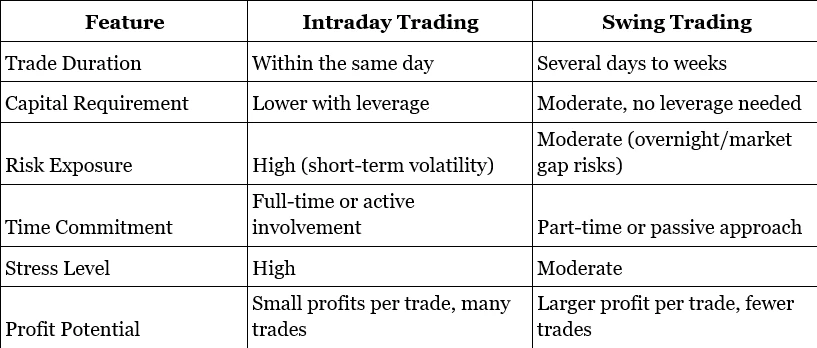
Intraday vs Swing Trading: Which is Best For You?
The answer to intraday trading vs swing trading, which is a better option for you, depends on your trading style, experience level, and risk tolerance.
Intraday might give you faster results but may increase your stress levels and be emotionally taxing. Profit margins are usually thin, requiring higher volume to be meaningful. You can choose intraday trading only if:
● You are incredible at handling pressure.
● You are proficient at making quick decisions.
● You are willing to pursue it as a full-time profession.
On the other hand, swing trading can yield more substantial gains per trade with lower effort, but trades take longer to materialise. You should choose swing trading only if:
● You have a day job or limited time for active trading.
● You are willing to hold positions for days or weeks.
● You prefer analysing trends over a longer period.
Final Thought
Understanding intraday trading vs swing trading is essential for any investor looking to navigate short-term trading opportunities. While intraday trading suits those seeking fast-paced action and instant results, swing trading is more relaxed and ideal for those who prefer a longer view.
Each has its pros and cons, and the difference between swing trading and intraday trading lies mainly in the timeframe, risk, and trader personality. Evaluate your goals, lifestyle, and risk appetite to choose the one that fits best.























Sign in to leave a comment.