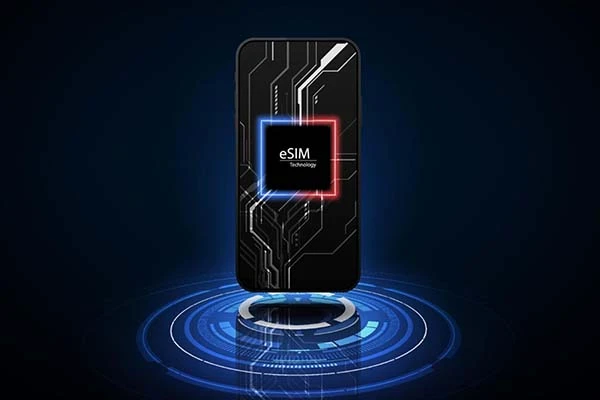

By 2030, eSIM is expected to account for 71% of cellular IoT connections. Until then, the removable SIM card remains the primary way enterprises provide cellular network connectivity to their IoT devices. Right now, telcos must work with an eSIM provider to offer eSIM connectivity support while continuing to provide traditional SIM connectivity for legacy clients.
The physical SIM card and eSIM each have pros and cons. As long as telcos can help clarify the benefits of one approach over the other for their enterprise clients, the sale will be made.
Here’s how telcos can present the two options to clients and help them choose which cellular connectivity option best suits their situation and use cases.
eSIM in IoT Deployments
eSIM is excellent for IoT because it enables remote SIM provisioning. Enterprises, from their centralised control centres, can change their IoT devices’ mobile networks without needing to physically change SIM cards. Everything can be done over the air.
The GSMA SGP.32 eSIM standard, in particular, makes implementing eSIM easier for enterprises. The earlier machine-to-machine (M2M) eSIM specification required custom integrations for every operator. eSIM doesn’t, so not only can enterprises switch operators on the fly, but they can also get online faster.
Remote SIM provisioning also improves SIM lifecycle management. Are the devices being moved somewhere the current operator does not serve? Change the provider. Profiles can also be updated, deleted and created as needed.
Finally, eSIM simplifies logistics. Enterprises can ship out their IoT devices without needing to install physical SIM cards. They can send their sensors and trackers almost anywhere in the world, and these devices can be set up with a profile from an eSIM connectivity mobile network operator upon their arrival at their destination. Alternatively, the control centre may download profiles before shipment and activate these when the IoT devices reach their destination.
When to Recommend the eSIM
Recommend the eSIM to companies that deploy asset trackers, intelligent cars and smart meters. These IoT devices are largely mobile, so they benefit from the remote SIM provisioning attribute of eSIMs.
Enterprises with a global footprint and presence are also perfect for eSIM. They can use eSIM with their IoT devices that are to be shipped internationally and, thus, require operator flexibility.
Finally, organisations that use hard-to-access or sealed IoT devices (these make physical SIM card swaps impractical if not impossible) would love eSIM. They can switch operator profiles without changing SIM cards.
IoT Use Cases
Telcos can make a case for eSIM to whichever company deploys the following IoT devices and systems:
- Automotive & fleet tracking (OEM-preloaded carrier profiles)
- eHealth wearables
- Smart meters (electricity, water)
- Remote industrial sensors
- Smart agriculture systems
Physical SIM Cards for IoT Applications
Conventional physical SIM cards continue to play a role in IoT, particularly in cost-sensitive or infrastructure-limited environments. For many enterprises, deploying IoT devices with removable SIMs remains a dependable, proven approach, especially when their network requirements are stable and unlikely to change in the foreseeable future.
It’s the age-old wisdom that dictates, ‘If it’s working, leave it alone. Don’t mess with success.’ You get the drift.
Physical SIM cards have also evolved and now offer more advanced features. Some, like the Java/Native Monte Rosa SIM from Trasna, can support a wide range of applications and applet customisation. The higher memory also allows for applet storage plus data retention for up to 10 years and erase/program cycles of up to 100,000.
Many modern SIM cards are capable of some over-the-air management. Updates to applications or configurations can be pushed remotely to IoT devices, reducing the need for onsite SIM card servicing and making it practical even for semi-remote deployments.
Physical SIM cards come in various sizes and form factors. These options help device makers and enterprises match form to function more precisely.
Conventional physical SIM cards are particularly suitable for deployment where mobile network infrastructure is older or unlikely to change soon. There’s no need to overhaul connectivity setups, so they’re ideal for static deployments or use in rural and legacy environments. They are also suitable for IoT deployments in stable network environments. Where devices are largely stationary and operator switching is not anticipated, physical SIMs offer a reliable, low-touch connectivity solution.
When to Recommend Physical SIMs
Traditional SIM cards are a good match for deployments in low-churn, fixed environments. These include use cases where the network operator is unlikely to change throughout the device’s lifecycle.
Physical SIM cards also suit deployments in markets where 2G or 3G still dominates. For example, smart city devices in rural areas or industrial IoT in regions with legacy networks benefit from this approach.
If the device is accessible and doesn’t require operator-switching flexibility, conventional SIM cards can be simpler and more cost-effective than eSIM. They’re also well-suited to large-scale, budget-constrained projects since physical SIM cards can keep the bill of materials (BOM) low.
IoT Use Cases
Telcos can advocate for physical SIM cards to organisations deploying IoT systems such as:
• Vending machines with localised deployments
• Parking meters and kiosks in static locations
• Industrial trackers that remain with assets long-term
• Utility meters for areas with consistent cellular coverage
• Legacy infrastructure upgrades in developing or rural regions
It’s All the “SIM” to Telcos
eSIM or physical SIM card—it’s all the same to telcos. Either could win enterprise clients. They just need to master the art of matching the correct type of SIM to the right kind of client.



























Sign in to leave a comment.