IoT PoC vs Prototype: Key Differences and How to Choose

An IoT product idea can look promising during business planning but encounter unexpected problems when engineers begin implementing it. A sensor may produce inconsistent readings, a wireless connection may fail in industrial environments, or the cloud platform may struggle with incoming device data.
These risks explain why businesses should validate important assumptions before committing to full-scale development.
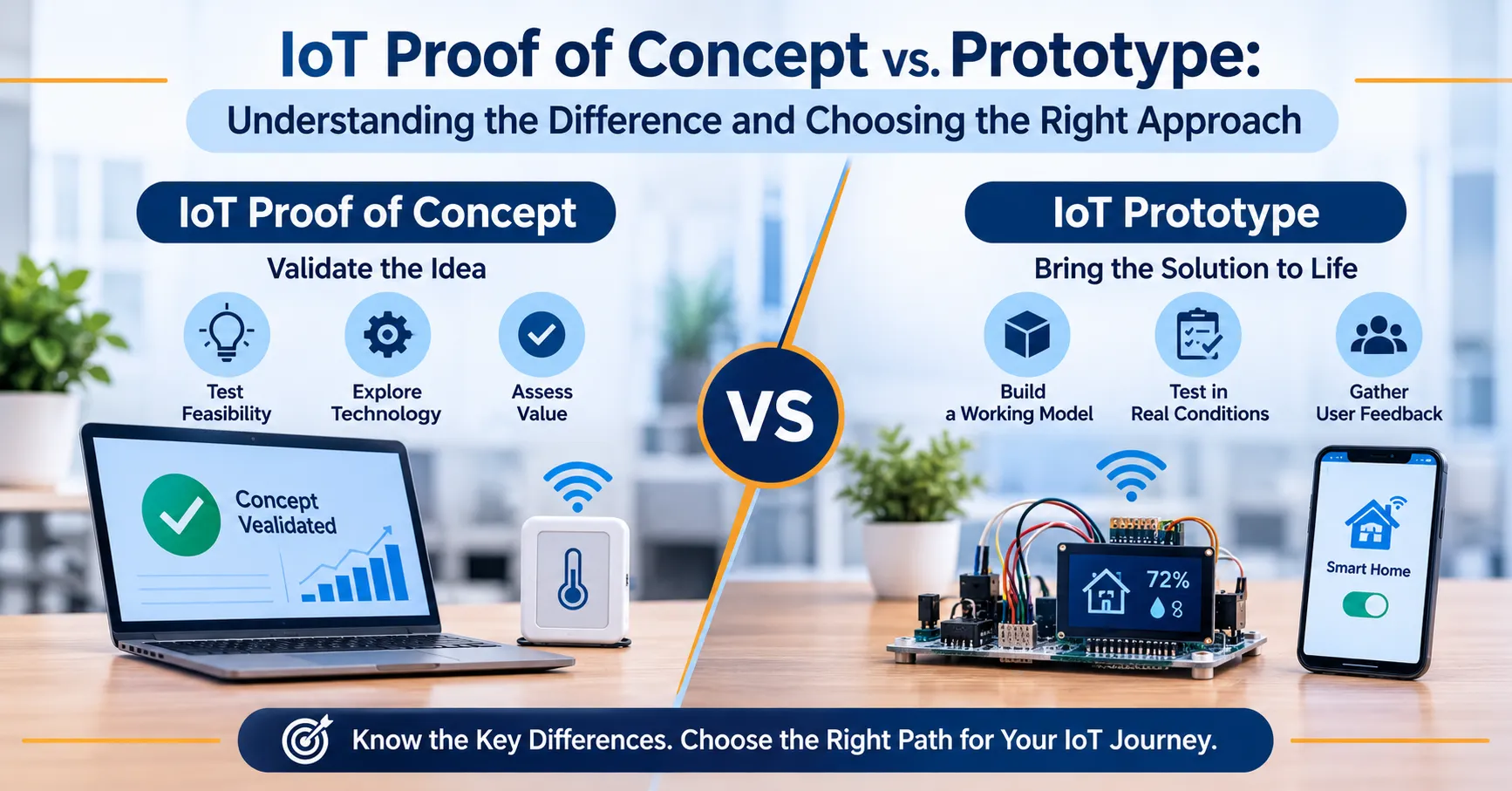
Two approaches commonly support this early validation process: a Proof of Concept (PoC) and a prototype. Although people sometimes use these terms interchangeably, they serve different purposes. A PoC investigates whether a proposed technical idea can work, while a prototype demonstrates how a potential product or system could function.
The importance of early validation becomes clearer as manufacturers invest in connected technologies. Deloitte's 2025 Smart Manufacturing Survey found that 23% of surveyed manufacturers were piloting AI and machine learning at the facility or network level, while 38% were piloting generative AI. The survey also reported that 65% ranked operational risk among their first or second priorities for mitigation when pursuing smart manufacturing initiatives.
These findings highlight an important development principle: organizations need evidence before scaling complex technology investments.
Understanding IoT PoC vs prototype helps businesses select the right validation method, control development risks, and make better investment decisions.
What Is an IoT Proof of Concept?
An IoT Proof of Concept is a small technical experiment designed to verify whether a specific concept or technical assumption is feasible.
It focuses on answering a defined question rather than delivering a complete product.
For example, a logistics company may want to monitor refrigerated containers using wireless temperature sensors. Before developing a complete tracking platform, engineers can build a PoC to determine whether the selected sensors can transmit reliable readings from inside refrigerated containers.
The experiment may examine:
- Sensor measurement accuracy.
- Wireless communication reliability.
- Gateway compatibility.
- Cloud message ingestion.
- Battery consumption.
- Basic alert generation.
A successful PoC demonstrates that the selected technical approach deserves further development. It does not automatically establish that the final product will be commercially viable, user-friendly, or ready for production.
What Is an IoT Prototype?
An IoT prototype is an early working representation of a proposed product or system.
Unlike a PoC, which focuses on a specific feasibility question, a prototype helps stakeholders evaluate how multiple components work together.
A prototype may contain:
- Selected sensors and embedded hardware.
- A development board or custom PCB.
- Firmware for data collection.
- Wireless communication.
- A basic cloud backend.
- A web or mobile interface.
- Device configuration and monitoring features.
For example, the refrigerated container project could progress from a sensor connectivity PoC to a working prototype.
The prototype might include a physical sensor enclosure, a battery-powered embedded controller, a cellular communication module, and a dashboard displaying temperature readings from a simulated or controlled operating environment.
Stakeholders can evaluate installation, usability, device behavior, and system integration before approving production engineering.
IoT PoC vs Prototype: The Important Differences
| Evaluation factor | IoT Proof of Concept | IoT Prototype |
| Primary purpose | Verify technical feasibility | Demonstrate product functionality |
| Main question | Can this technology work? | How will the solution work? |
| Scope | Narrow and experimental | Broader and feature-oriented |
| Hardware | Development boards or existing components | Representative hardware or early custom design |
| Software | Minimal test code | Integrated firmware and application components |
| User interface | Usually unnecessary | Often includes a basic interface |
| Testing | Technical feasibility | Functional behavior and usability |
| Main outcome | Evidence supporting a technical decision | Feedback supporting product development |
A PoC may require only a few sensors and a test gateway. A prototype generally requires greater integration between hardware, firmware, networking, and software.
Neither approach replaces the other. They can form consecutive stages in an IoT product development process.
When Should a Business Choose an IoT PoC?
A PoC is appropriate when technical uncertainty represents the biggest project risk.
Consider these situations:
- Unproven connectivity: A company wants to determine whether LoRaWAN provides sufficient coverage across a large agricultural property.
- Sensor compatibility: An engineering team needs to verify whether a particular sensor communicates correctly with an existing industrial controller.
- Edge computing feasibility: A manufacturer wants to test whether local anomaly detection can reduce cloud communication requirements.
- Cloud integration: An enterprise needs to determine whether its existing cloud infrastructure can process messages from thousands of connected devices.
- Power consumption: A product team wants to estimate whether a battery-powered sensor can meet its intended operating lifetime.
In each case, the team should define one or more measurable acceptance criteria before running the experiment.
For instance, a connectivity PoC might require successful transmission from 95% of test locations under specified operating conditions. This would be a project-specific acceptance target, not a universal IoT performance standard.
When Does a Prototype Make More Sense?
A prototype becomes useful when the business has sufficient technical confidence to explore the complete user and system experience.
It helps answer questions that a narrow PoC cannot address.
- Can technicians install the device without specialist assistance?
- Does the enclosure withstand expected environmental conditions?
- Can users configure the sensor through a mobile application?
- Does the dashboard display information clearly?
- Can the firmware recover after a communication failure?
- Does the complete solution support the intended operating workflow?
A prototype also provides something tangible for demonstrations, stakeholder reviews, and early customer feedback.
However, businesses should not confuse a working prototype with a production-ready product. Prototype hardware may lack manufacturing optimization, formal certification, comprehensive cybersecurity controls, and long-term reliability testing.
A Decision Framework for IoT Projects
Choosing between a PoC and prototype becomes easier when organizations evaluate the maturity of their technical assumptions.
Step 1: Identify the Main Uncertainty
List the questions that could prevent successful implementation.
These may involve sensor accuracy, wireless coverage, data processing, hardware compatibility, or application usability.
Separate technical uncertainties from product-design questions.
Step 2: Rank Risks by Business Impact
Not every unknown requires an experiment.
A minor interface adjustment may not justify a dedicated PoC, but an uncertain communication technology that determines whether the product can function deserves early validation.
Prioritize risks according to their potential impact on project cost, performance, and delivery.
Step 3: Define Measurable Acceptance Criteria
Avoid vague objectives such as proving that the system works.
Instead, specify measurable requirements:
- Maximum acceptable sensor measurement error.
- Minimum communication success rate.
- Target battery operating life.
- Maximum data-processing latency.
- Supported operating temperature.
- Required application response time.
These criteria help engineering teams produce meaningful results.
Step 4: Select the Validation Approach
Choose a PoC when a narrow technical question remains unresolved.
Choose a prototype when the primary objective involves integrated functionality, user interaction, or physical product evaluation.
Some projects require both stages, while others can move directly to prototyping because their underlying technologies are already proven.
Step 5: Document Results and Decide What Comes Next
Record test conditions, component versions, observed failures, performance measurements, and unresolved risks.
Use the findings to decide whether to continue, modify the design, investigate another technology, or stop the project.
Practical Example: Smart Energy Monitoring for Commercial Buildings
Consider a hypothetical property management company planning an IoT solution for monitoring electricity consumption across 25 commercial buildings.
The company wants to install smart meters, collect energy readings, identify unusual consumption patterns, and provide facility managers with centralized reporting.
Initially, the engineering team is uncertain about communication reliability in buildings with multiple floors and electrical distribution rooms.
Instead of building the entire platform immediately, the company starts with a PoC.
Engineers test selected energy meters, communication gateways, and MQTT-based data transmission. They evaluate message delivery, measurement accuracy, and connectivity across representative building locations.
After successful testing, the company develops a prototype containing:
- Several connected energy meters.
- An embedded communication gateway.
- A cloud-based ingestion service.
- A database for historical readings.
- A web dashboard for facility managers.
- Basic energy consumption alerts.
The prototype allows stakeholders to review the complete monitoring workflow and identify installation or usability issues.
The company can then make informed decisions about hardware selection, network architecture, dashboard functionality, and deployment costs.
This staged process avoids investing heavily in a complete system before validating important assumptions.
How Specialized Development Support Improves Validation
Early-stage IoT engineering involves several disciplines, including embedded development, sensor integration, networking, cloud architecture, and application design.
A technically focused development partner can help businesses select suitable components, define test scenarios, and evaluate results objectively.
For organizations planning structured validation, IoT PoC development services can support early feasibility testing, hardware-software integration, communication experiments, and initial technical validation.
The key is to establish clear deliverables. A PoC should produce measurable technical evidence, while a prototype should demonstrate an integrated product concept.
ROI: Why Early Validation Can Reduce Development Risk
The financial value of early validation comes primarily from identifying expensive problems before large-scale implementation.
Consider an illustrative project with a planned development budget of ₹40 lakh.
Suppose an early PoC costs ₹3 lakh and identifies a connectivity limitation that would otherwise require ₹12 lakh in additional redesign and deployment work.
If the alternative architecture resolves the issue without that additional expenditure, the company avoids a potential ₹12 lakh cost against a ₹3 lakh validation investment.
This represents a potential four-to-one gross cost-avoidance ratio, assuming the estimated redesign expense is accurate and the PoC successfully prevents it.
Actual savings depend on project complexity, technical uncertainty, and the accuracy of early cost estimates.
Final Thoughts
A PoC and a prototype serve different but complementary roles in IoT product development. A PoC establishes whether a technical approach is feasible, while a prototype demonstrates how the broader solution may function.
Businesses should select their approach according to the uncertainties they need to resolve. Starting with the right validation method helps teams avoid premature investment, gather meaningful technical evidence, and make more informed product development decisions.
The objective is not to build something quickly at any cost. It is to establish enough confidence to move into the next development stage with a clear understanding of technical limitations and business requirements.






Sign in to leave a comment.