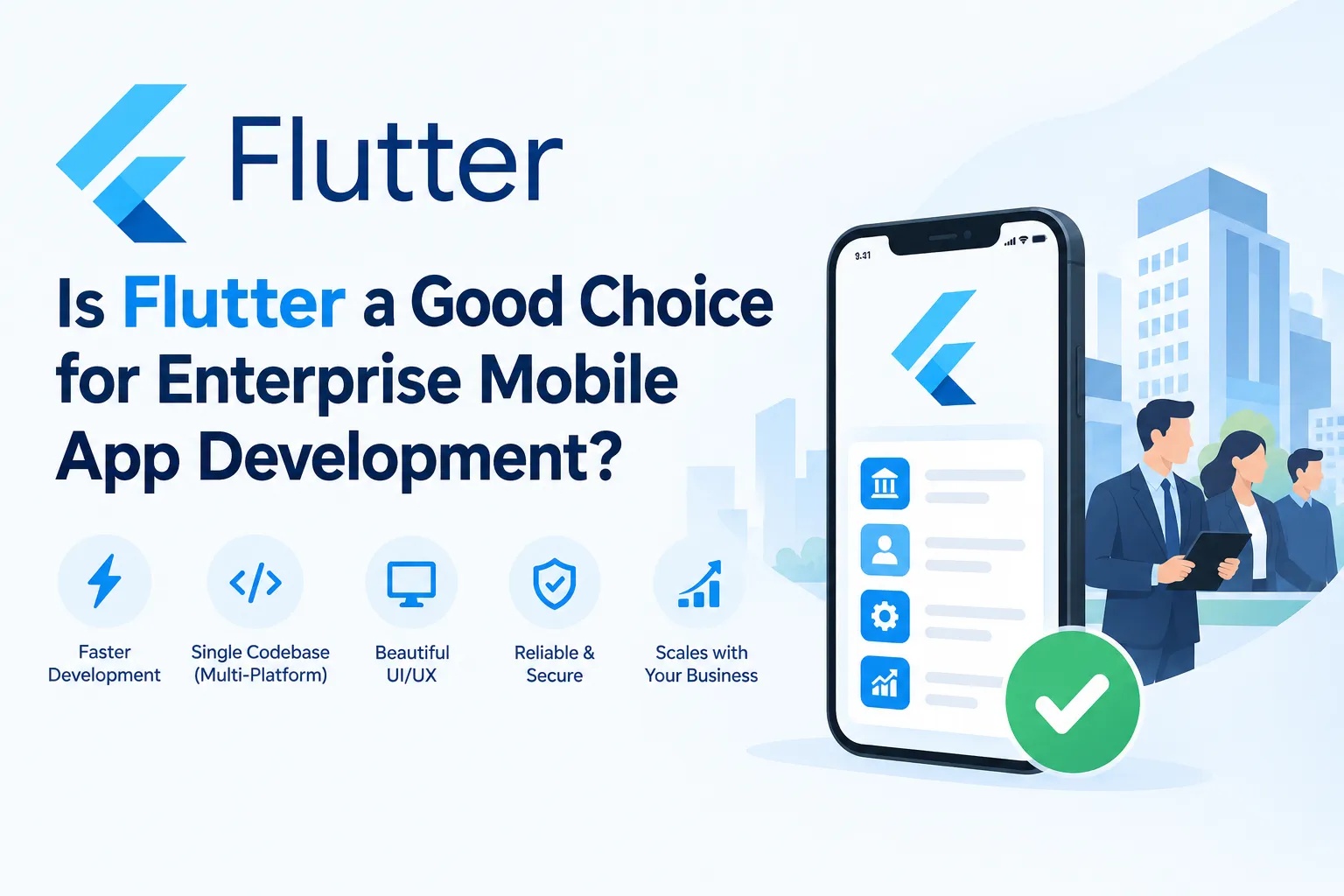

Enterprise mobile applications need more than attractive interfaces. They must support complex workflows, integrate with existing systems, protect sensitive data, and remain maintainable as business requirements evolve. Choosing the right technology therefore has a direct impact on development speed, performance, scalability, and long-term maintenance.
Flutter has become a strong option for businesses looking to build applications for multiple platforms from a shared codebase. With its single development approach, customizable UI, and growing ecosystem, Flutter can help organizations reduce duplicated development work while maintaining a consistent experience across Android and iOS. Businesses evaluating Flutter app development services should still consider their application's complexity, integration requirements, security needs, and long-term roadmap before making a decision.
What Makes Flutter Relevant for Enterprise Apps?
Flutter is Google's open-source UI framework for building applications from a shared codebase. Instead of maintaining separate application interfaces for different platforms, development teams can use Dart and Flutter's widget-based architecture to create experiences for Android and iOS.
This approach is particularly relevant for enterprises managing multiple products, departments, and release cycles. A shared codebase can simplify development and reduce the effort involved in implementing the same functionality across platforms.
Flutter also provides extensive control over the application's interface. Its widget-based architecture allows teams to create consistent design systems while adapting screens to different business workflows. For enterprises, however, the question is not simply whether Flutter can build an application. The more important question is whether it fits the application's technical and business requirements.
Key Benefits of Flutter for Enterprise Mobile Development
1. Shared Codebase Across Platforms
One of Flutter's biggest advantages is the ability to build Android and iOS applications from a largely shared codebase. For enterprises, this can reduce duplicated development efforts. Teams do not necessarily need to implement the same business logic separately for each platform. Updates can also be managed more consistently across applications. This is useful for organizations that want to launch applications on multiple platforms without maintaining completely separate development projects.
2. Faster Development Cycles
Flutter's reusable widgets and hot reload capabilities can support faster development and testing. Developers can make changes to the application and quickly review the results during development. Reusable components can also help teams establish consistent patterns across different screens and features. For enterprise applications with numerous workflows, reusable components can make development more structured and efficient.
3. Consistent User Experience
Enterprise applications often need to maintain consistent branding and interaction patterns across platforms. Flutter provides extensive UI customization capabilities, allowing teams to create shared design components and application patterns. This can help organizations maintain visual consistency across Android and iOS while still supporting platform-specific requirements where necessary. A consistent experience can be particularly valuable for employee-facing applications, customer portals, field-service applications, and business management tools.
4. Strong Support for Complex Interfaces
Enterprise applications can include dashboards, reporting interfaces, forms, charts, approval workflows, and role-based screens. Flutter's widget architecture provides flexibility for creating these interfaces. Teams can build reusable UI components for frequently used enterprise elements such as navigation structures, data cards, forms, and dashboards. This makes Flutter suitable for applications where the user interface plays an important role in productivity.
5. Easier Maintenance
Maintaining two completely separate mobile codebases can increase the effort required for updates and bug fixes. With Flutter, businesses can centralize much of their application logic in a shared codebase. When a feature or business rule changes, developers can often implement the change once and apply it across platforms. This does not eliminate platform-specific maintenance, but it can simplify the overall development structure.
Where Flutter Fits Into Enterprise Development
Flutter can be used across several enterprise scenarios. Internal workforce applications can use it to provide employees with access to workflows, approvals, reports, and operational information.
Customer-facing applications can use Flutter for account management, bookings, payments, service requests, and other digital experiences. Enterprises can also use it for field-service applications where employees need mobile access to business systems while working outside the office.
The suitability depends on how the application interacts with the organization's broader technology environment. For example, an application that needs to connect with CRM platforms, ERP systems, cloud services, payment infrastructure, analytics platforms, or custom backend APIs requires careful architecture. Flutter handles the mobile application layer, while backend services and APIs remain responsible for business logic, data processing, authentication, and other server-side operations.
Flutter and Enterprise Integration Requirements
Enterprise applications rarely operate independently. They commonly need to communicate with existing business systems. Flutter can integrate with REST APIs, databases through backend services, authentication systems, cloud platforms, analytics tools, and other external services. Native platform capabilities can also be accessed when an application requires functionality beyond Flutter's standard framework.
However, integration architecture should be planned before development begins. A custom app development company can evaluate the existing technology stack, APIs, authentication mechanisms, data flows, and security requirements before deciding how Flutter should fit into the overall architecture.
This is important because the mobile framework is only one component of an enterprise application. A well-designed backend, secure API layer, monitoring infrastructure, and deployment process are equally important.
Security Considerations for Enterprise Flutter Apps
Security is a major consideration for enterprise mobile applications, particularly when applications handle customer information, financial data, employee records, or proprietary business information.
Flutter itself should not be treated as a complete security solution. Enterprises need a broader security architecture covering authentication, authorization, encrypted communication, secure data storage, API security, session management, logging, and vulnerability management.
Applications can also require platform-specific security features. In such cases, Flutter can work alongside native Android and iOS capabilities through platform integrations. Security requirements should therefore be defined during architecture planning rather than addressed only after development.
Is Flutter Scalable for Enterprise Applications?
Flutter can support applications that grow in functionality and user adoption, but scalability depends on the entire system architecture. For example, a mobile application may serve thousands or millions of users, but its ability to handle that demand will depend heavily on backend infrastructure, database architecture, API performance, caching, monitoring, and cloud deployment.
Flutter can provide a scalable mobile application layer when developers follow appropriate architectural patterns and maintain a modular codebase. Enterprises should also establish coding standards, testing practices, CI/CD pipelines, and documentation to keep the project manageable as development teams grow.
When Should Enterprises Consider Flutter?
Flutter is particularly attractive when an organization needs:
- Android and iOS applications from a shared codebase
- Consistent UI and branding across platforms
- Faster development cycles
- Reusable application components
- Integration with existing APIs and business systems
- A maintainable cross-platform architecture
- Custom interfaces for complex business workflows
It may be less suitable when an application depends extensively on highly specialized native platform functionality or requires deep platform-specific optimization. In those situations, native development or a hybrid architecture may provide a better fit. The decision should therefore be based on application requirements rather than simply choosing the most popular framework.
Final Verdict: Is Flutter Good for Enterprise Mobile Apps?
Yes, Flutter can be a strong choice for enterprise mobile app development, particularly for organizations that need cross-platform applications, consistent user experiences, and efficient development from a shared codebase.
Its benefits extend beyond development speed. A well-architected Flutter application can support complex interfaces, integrations, reusable components, and long-term maintenance. However, enterprise success depends on more than the framework itself. Security, backend architecture, testing, deployment, monitoring, and integration strategy must all be considered.
Businesses evaluating Flutter should begin with their application requirements and technical environment before selecting the development approach. Working with experienced teams offering enterprise application development services can help organizations evaluate these factors and build a mobile solution aligned with their long-term business goals.
























Sign in to leave a comment.