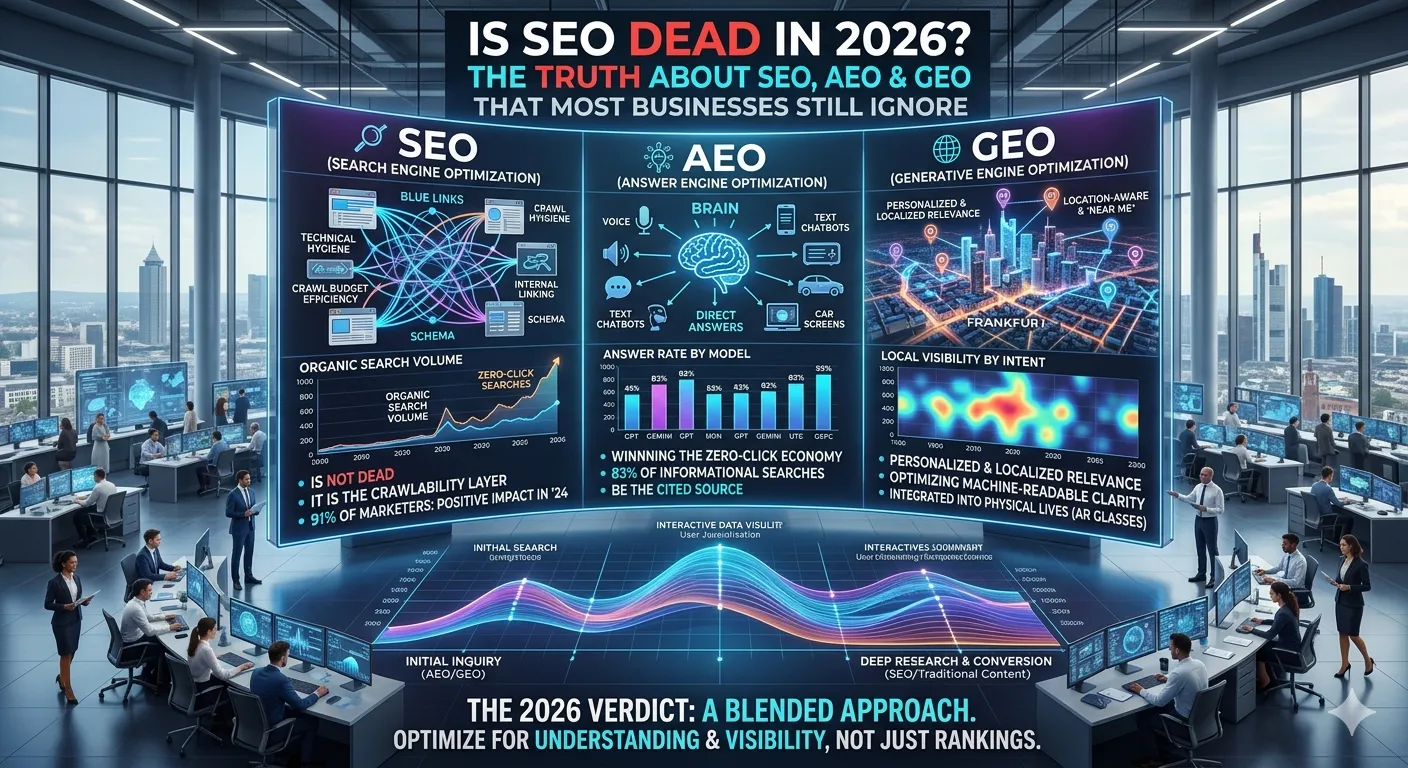

Search is changing fast.
People are no longer searching only on Google. They now ask questions directly to AI tools like ChatGPT, browse answers on social platforms, and trust AI-generated summaries more than traditional blue links.
So the real question is not:
“Is SEO dead?”
The real question is:
“Is your website adapting to how people search today?”
The answer is simple:
SEO is not dead.
Old SEO is dead.
Businesses still using outdated tactics like keyword stuffing, spam backlinks, and thin content are losing rankings every day. Meanwhile, brands using SEO + AEO + GEO strategies are dominating search visibility in 2026.
What Is SEO in 2026?
Search Engine Optimization is no longer just about ranking webpages.
Modern SEO focuses on:
- User intent
- Helpful content
- Experience optimization
- Entity authority
- Semantic relevance
- AI-friendly content structure
Google’s algorithms have become smarter. Search engines now understand context, meaning, and expertise instead of just keywords.
If your website only targets keywords without solving real problems, rankings will continue dropping.
What Is AEO (Answer Engine Optimization)?
Answer Engine Optimization is the process of optimizing your content so AI systems can directly use your answers.
Today users ask:
- “Best SEO strategy for local business”
- “How does GEO optimization work?”
- “What is the future of SEO?”
AI tools scan millions of pages and choose the clearest, most trusted answers.
If your content is not structured properly, AI tools will ignore it.
Best AEO Practices
1. Write Direct Answers
Answer the user’s question in the first 2–3 lines.
2. Use Question-Based Headings
Examples:
- What is SEO?
- Why is GEO important?
- How does AEO work?
3. Add FAQ Sections
FAQs improve visibility in both Google and AI-generated answers.
4. Use Simple Language
AI systems prefer clarity over complexity.
5. Build Topical Authority
Publish multiple articles around one niche instead of random topics.
What Is GEO (Generative Engine Optimization)?
Generative Engine Optimization is the next evolution of digital visibility.
GEO focuses on optimizing content for generative AI platforms that create answers instead of simply listing websites.
Platforms like:
…are changing how users discover businesses online.
Instead of searching:
“best SEO agency”
Users now ask:
“Recommend a trusted SEO expert for AEO and GEO optimization.”
AI gives direct recommendations.
If your brand is not visible in AI systems, you lose future traffic.
Why Most Websites Are Losing Rankings
Here are the biggest reasons websites fail in modern SEO:
1. AI-Generated Spam Content
Publishing hundreds of low-quality AI articles no longer works.
2. Weak Topical Authority
Random content creates confusion for search engines.
3. No E-E-A-T Signals
Google values:
- Experience
- Expertise
- Authority
- Trust
4. Poor Content Structure
Large paragraphs and unclear formatting reduce readability.
5. Ignoring User Intent
Ranking today depends on solving user problems better than competitors.
The Best SEO + AEO + GEO Strategy for 2026
Here’s the exact strategy businesses should follow now.
Step 1: Build Topic Clusters
Instead of writing random articles, create content hubs.
Example:
If your niche is SEO:
- Technical SEO
- Local SEO
- AEO
- GEO
- Link Building
- Content Optimization
- AI SEO
This builds authority.
Step 2: Optimize for Human Readers First
Search engines reward websites users trust.
Focus on:
- Readability
- Useful insights
- Fast loading speed
- Mobile optimization
- Clear navigation
Step 3: Use Semantic SEO
Search engines understand relationships between concepts.
Instead of repeating one keyword 50 times, naturally include related terms like:
- Search visibility
- Organic traffic
- SERP rankings
- AI search optimization
- Digital authority
Step 4: Create AI-Friendly Content
Your content should include:
- Short paragraphs
- Bullet points
- FAQs
- Clear headings
- Definitions
- Step-by-step explanations
This increases your chances of being featured in AI-generated responses.
Step 5: Build Authority Backlinks
Quality backlinks still matter.
But modern link building focuses on:
- Relevance
- Authority
- Brand trust
- Editorial placements
Spam backlinks can destroy rankings.
Is SEO Still Worth It in 2026?
Absolutely.
Organic traffic remains one of the highest ROI marketing channels.
Businesses ranking organically receive:
- Long-term traffic
- Brand authority
- Consistent leads
- Lower advertising costs
- Higher trust
But the strategy must evolve.
The future belongs to businesses combining:
- SEO
- AEO
- GEO
- Content authority
- AI visibility
Final Thoughts
SEO is not dying.
Search behavior is evolving.
Businesses that adapt to AI-driven search will grow faster than ever before. Those relying on outdated SEO tactics will continue losing traffic.
The future of digital marketing belongs to brands that:
- Answer questions clearly
- Build authority
- Optimize for AI systems
- Create genuinely useful content
If your website is not optimized for SEO, AEO, and GEO together, you are already behind competitors.
About the Author
Ramish Rajput
SEO, AEO & GEO Content Strategist
Email: [email protected]
LinkedIn:
Rise Grower Online LinkedIn
Portfolio:
Rise Grower Online
























Sign in to leave a comment.