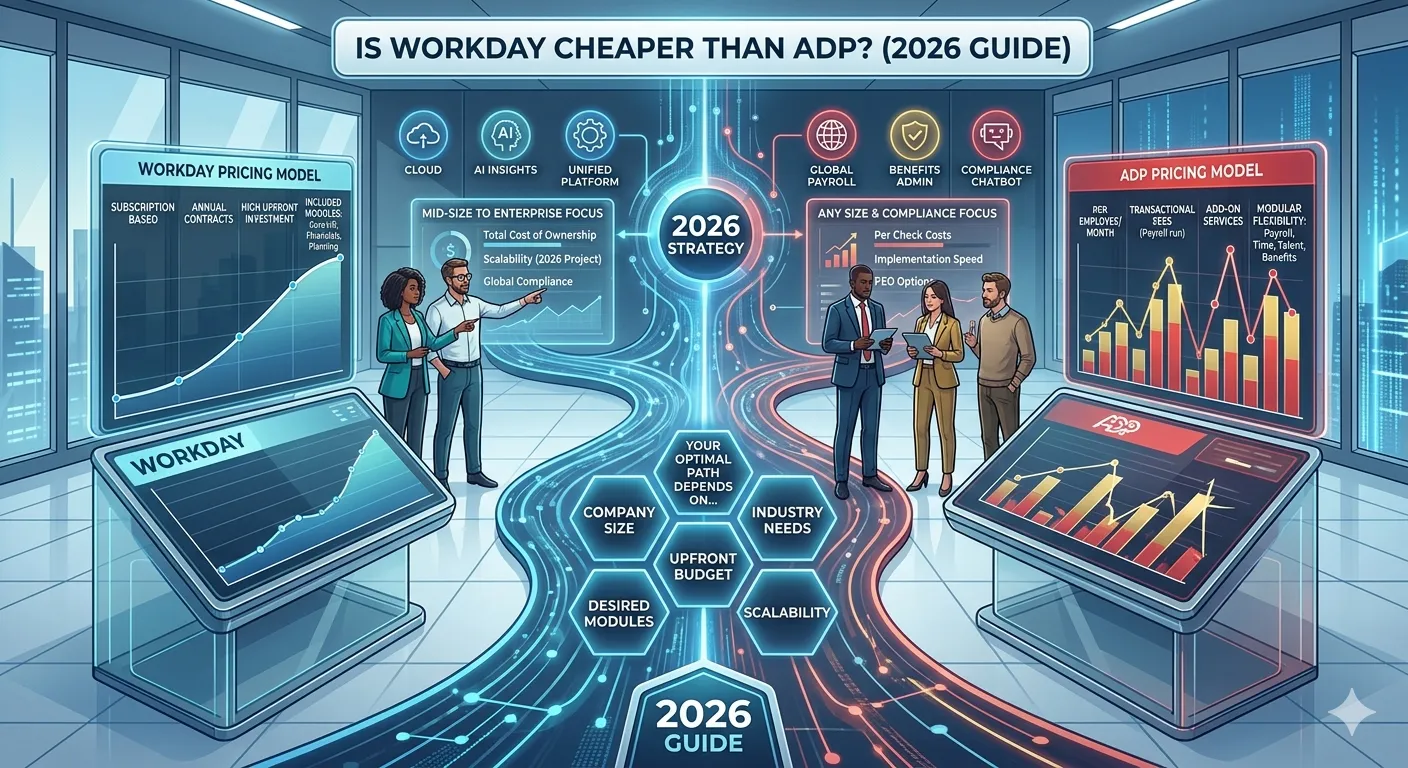

When comparing Workday vs ADP, one of the most common questions businesses ask is: Which one is cheaper? The honest answer is — it depends on your company size, needs, and customization level. However, based on industry data and pricing benchmarks, we can break it down clearly.
💰 Pricing Overview: Workday vs ADP
Both Workday and ADP use custom pricing models, meaning they don’t publish fixed prices. Instead, you must contact their sales teams for a quote.
However, real-world estimates give us a clearer picture:
- ADP: Typically more flexible with modular pricing (pay only for features you need)
- Workday: Usually sold as a full-suite enterprise solution (less modular, more bundled)
👉 Example enterprise pricing comparison:
- ADP: ~$8–$15 per employee/month
- Workday: ~$12–$25 per employee/month
👉 Implementation costs:
- ADP: ~$10,000–$50,000
- Workday: ~$50,000–$250,000+
👉 Annual contracts (large enterprises):
- ADP: ~$300K–$450K
- Workday: ~$450K–$750K
📊 So, Is Workday Cheaper?
No — in most cases, Workday is NOT cheaper than ADP.
Here’s why:
1. Workday Targets Enterprise Clients
Workday is designed for large organizations with complex HR needs, which drives up pricing due to:
- Advanced analytics
- Global workforce management
- Full HCM suite
This makes it a premium product.
2. ADP Offers More Flexible Pricing
ADP provides:
- Multiple plans and add-ons
- Scalable pricing for small to large businesses
- Pay-as-you-grow approach
This flexibility often makes ADP more cost-effective, especially for small and mid-sized companies.
3. Implementation Costs Are Higher for Workday
Workday implementations are:
- Longer
- More complex
- More expensive
ADP, on the other hand, is generally faster and cheaper to deploy.
4. Feature Depth vs Cost
- Workday = High cost, high functionality (analytics, finance + HR integration)
- ADP = Lower cost, strong payroll + HR focus
So, you're paying more for capability and scalability with Workday.
🧠 When Workday Might Be Worth the Cost
Even though Workday is more expensive, it can be worth it if you:
- Run a large enterprise (1000+ employees)
- Need advanced HR analytics and automation
- Want a single unified system for HR + finance
💡 When ADP Is the Better Choice
ADP is usually better if you:
- Have a small or mid-sized business
- Want lower upfront and ongoing costs
- Prefer modular pricing and flexibility
📌 Final Verdict
- ✔ ADP is generally cheaper than Workday
- ✔ Workday is a premium, enterprise-grade solution
- ✔ ADP offers better affordability and flexibility
👉 In simple terms:
- Choose Workday for power and scalability
- Choose ADP for cost-efficiency
🎓 Conclusion (with Keywords)
If you're planning a career in HR tech, understanding tools like Workday and ADP is essential. Enrolling in workday hcm training or exploring workday courses online can help you gain in-demand skills and better understand why enterprises invest in such powerful platforms.



























Sign in to leave a comment.