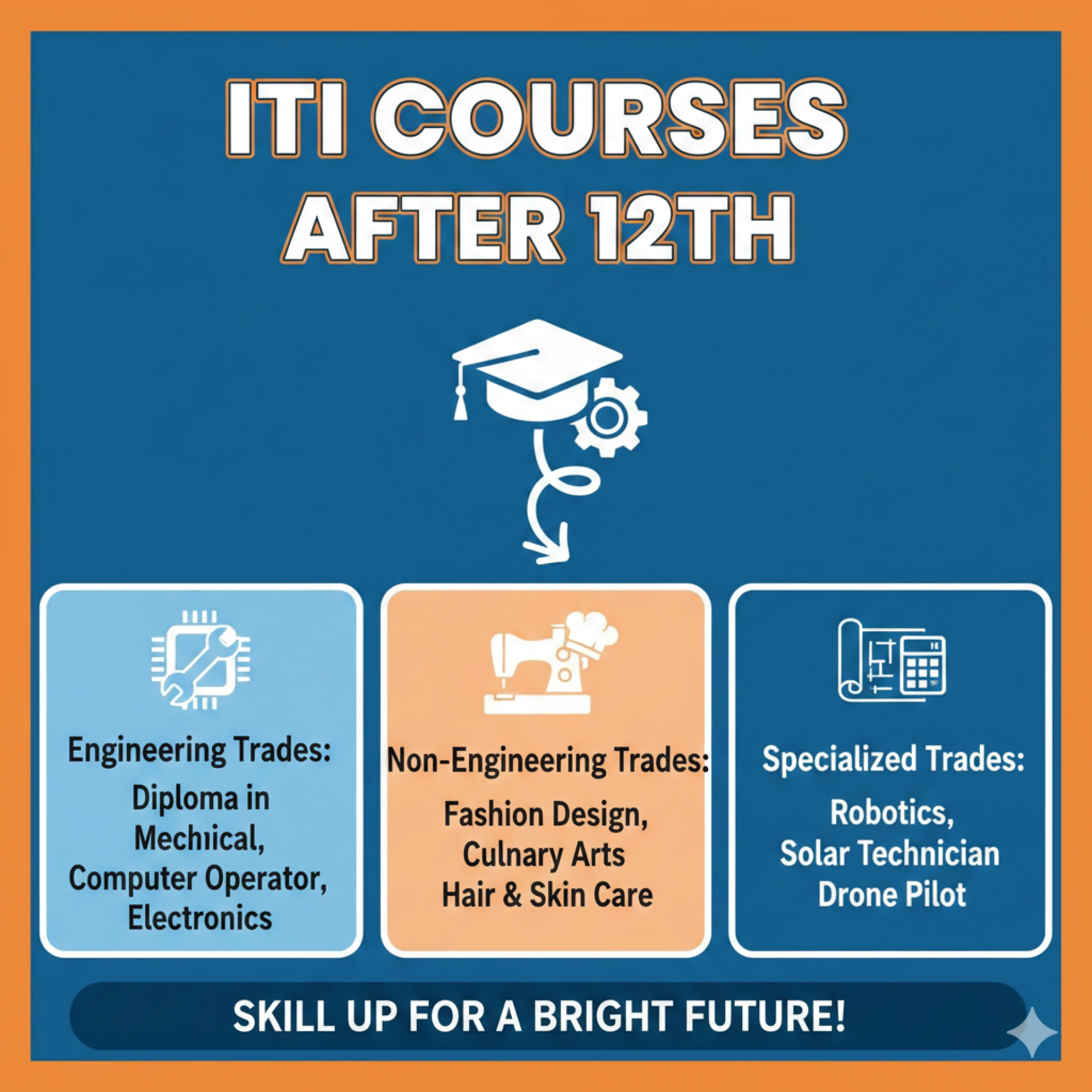

After completing 12th grade, many students look for career options that are practical, job-oriented, and affordable. Not everyone wants to spend three to four years in a traditional degree program. If you prefer hands-on training and want to start earning early, ITI courses can be a smart choice.
ITI stands for Industrial Training Institute. These institutes are designed to provide technical skills and vocational training to students so they can work in industries or start their own businesses. ITI courses focus more on practical knowledge than theory, which makes them ideal for students who enjoy working with tools, machines, or technical systems.
Let’s understand everything about ITI courses after 12th, including types of courses, eligibility, duration, career scope, and salary expectations.
What Are ITI Courses?
ITI courses are short-term technical and non-technical training programs offered by government and private institutes across India. These programs are regulated by the Directorate General of Training, which works under the Ministry of Skill Development and Entrepreneurship.
The main goal of ITI is to prepare skilled workers for industries such as manufacturing, construction, electrical, automotive, and service sectors.
Can You Do ITI After 12th?
Yes, absolutely. While many ITI courses are available after 10th, students who complete 12th can also enroll in advanced or specialized trades. In fact, 12th pass students often have better career growth opportunities because they meet eligibility requirements for more technical trades and government jobs.
Popular ITI Courses After 12th
Here are some of the most popular ITI trades you can choose after completing 12th:
1. Electrician
This is one of the most in-demand ITI trades. Students learn about wiring systems, electrical equipment, maintenance, and safety. After completion, you can work in industries, construction companies, or even start your own electrical services business.
2. Fitter
The fitter trade focuses on assembling, fitting, and maintaining machinery parts. It is highly valued in manufacturing industries.
3. Mechanic Diesel
If you are interested in vehicles and engines, this course teaches repair and maintenance of diesel engines used in trucks, buses, and heavy vehicles.
4. Electronics Mechanic
This trade deals with repairing electronic devices, circuit boards, and communication equipment.
5. Computer Operator and Programming Assistant (COPA)
This is ideal for students interested in computers. It covers basic programming, data entry, and office software skills.
6. Draughtsman (Civil/Mechanical)
Students learn technical drawing and design using engineering tools and software. This course is suitable for those interested in construction or mechanical industries.
7. Stenographer
This is a non-technical trade where students learn shorthand typing and office administration skills.
Duration of ITI Courses
ITI course duration generally ranges from 6 months to 2 years depending on the trade. Technical trades like electrician and fitter usually take 2 years, while computer and office-related courses may take 1 year.
Eligibility Criteria
For ITI after 12th:
- You must have passed 12th from a recognized board.
- Some technical trades may require science or mathematics in 12th.
- Minimum age is usually 14 years.
- Admission may be based on merit or state-level entrance procedures.
Admission Process
Admission to ITI courses is usually conducted through state-level online counseling. Government ITIs are more affordable, while private ITIs may charge higher fees.
Students can apply through their respective state ITI admission portals. After document verification and seat allotment, students can confirm admission by paying the required fee.
Career Opportunities After ITI
One of the biggest advantages of ITI courses is early job opportunities. After completing ITI, you can:
- Work in private companies
- Join government departments
- Apply for apprenticeships
- Start your own small business
- Work in railways, defense, or public sector units
Many ITI graduates apply for jobs in organizations like Indian Railways, Bharat Heavy Electricals Limited, and other public sector companies.
You can also pursue further studies like diploma engineering or advanced skill courses to improve your career growth.
Salary After ITI
The starting salary after ITI depends on the trade and company. On average:
- Freshers can earn between ₹10,000 to ₹18,000 per month.
- Skilled workers with experience can earn ₹20,000 to ₹35,000 per month or more.
- Self-employed professionals can earn even higher depending on demand.
Technical trades like electrician, fitter, and mechanic often offer better long-term income growth.
Benefits of Doing ITI After 12th
Here are some key benefits:
- Short duration courses
- Low course fees
- Practical skill-based learning
- Quick job opportunities
- Government job eligibility
- Option to start own business
ITI courses are especially beneficial for students who want financial independence at an early age.
ITI vs Diploma After 12th
Many students get confused between ITI and diploma courses.
- ITI focuses more on practical training and specific trades.
- Diploma courses are more theory-based and take 3 years.
- ITI helps you enter the job market quickly.
- Diploma is better if you want to pursue engineering later.
Choose based on your career goals and interests.
Is ITI a Good Career Option?
Yes, ITI is a good career option for students who prefer skill-based education over academic degrees. With increasing demand for skilled workers in India, ITI graduates have strong employment opportunities.
Government initiatives promoting skill development are also creating more job openings in technical fields.
If you are someone who wants to build a stable career without spending many years in college, ITI courses after 12th can be a smart and practical decision.
Final Thoughts
ITI courses after 12th offer a strong foundation for technical careers. They are affordable, job-oriented, and industry-focused. Whether you choose electrician, mechanic, computer operator, or draughtsman, each trade provides valuable practical skills.
Before selecting a trade, understand your interests, job demand, and long-term career goals. With proper training and dedication, ITI can open doors to stable jobs, government opportunities, and even entrepreneurship.





























Sign in to leave a comment.