

In today's fast-paced industrial world, material performance plays a very important role in product safety, reliability, and long life. All industries, automotive or aerospace, rely on the ability to measure the toughness of materials for their manufacturing process. The best way to measure it is, through impact testing and the Izod Charpy Impact Tester. These testers provide valuable insights into how a material can behave while resisting sudden impacts or shocks, which is an important factor in determining durability.
Let’s read about the functionality and meaning of how Izod testing machines and Charpy testing machines work, discussing, their technical specification, and how they ensure material durability and safety. We'll also review some important maintenance tips, dos, and don'ts, and FAQs to ensure you are getting every ounce of use out of your Izod testing machine.
This izod tester measures the resistance of a material to fracture under specific impact conditions. Even though the Izod and Charpy tests measure the same properties, they are carried out in different ways, and therefore a proper understanding of a material's toughness cannot be furnished using just one tester.
Charpy Impact Test: This is the type of test in which, the specimen is held horizontally and hit by the impact hammer at its center of span. They are primarily used to determine the material's response in shock loading across its thickness.
Izod Impact Test: In this, the test specimen is held vertically and with the hammer striking at one end, proving what happens in case of material with the incident of impacting at a point. For materials like plastic, more effectively, the setup of Izod's test simulates the real conditions.
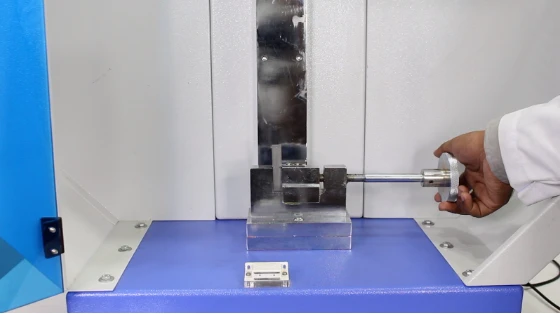
How a Charpy Tester Works
Other major constituent parts of an Charpy Tester are the impact hammer (pendulum), specimen holder and scale or gauge for measuring the energy absorbed by the sample during the impact test.
Impact Hammer: The hammer is dropped from a given height. It strikes the test specimen, and depending upon the drop height and amount of deflection at the time of impact, the energy required to fracture the material is measured.
Specimen Holder: The specimen is placed here in either a vertical position for Izod or a horizontal position for the Charpy test. The specimen holder is made with a firm and consistent setting in each of the tests.
Technical Specifications of the Izod tester
The Izod Charpy Impact Tester is a high-precision tool for delivering reliable and accurate results across a wide range of materials. The following are the key specifications you should look for in any quality impact testing equipment:
Impact Capacity:
Up to 21.68 Joules
Range of Scales:
The machine has multiple scales for precise measurements:
2.71 J
5.42 J
10.84 J
21.68 J
These scales allow you to test materials with varying toughness levels.
Display:
LED (Digital) 7 Segment
The results are displayed clearly on a digital 7-segment LED display for easy reading of the test values.
Accuracy:
± 2% at full range
The tester ensures high accuracy within a tolerance of ±2% across the full energy measurement range.
Resolution:
Different levels of resolution are available for precise measurements:
R1: 0.02 Joules
R2: 0.05 Joules
R3: 0.1 Joules
R4: 0.2 Joules
This allows you to measure small changes in energy for highly accurate results.
Power Supply:
220V, Single Phase, 50 Hz
The tester operates on a standard 220V power supply, compatible with most industrial settings.
Pendulum Release Angle:
150º
The pendulum is released from an angle of 150º, ensuring a consistent impact force for reliable results.
Hammer Radius:
Izod Hammer Radius: 0.79 ± 0.12 mm
Charpy Hammer Radius: 3.17 ± 0.12 mm
These dimensions refer to the radius of the hammer, which is critical for consistent impact testing.
Computer Connectivity:
USB Port
The tester features USB connectivity, enabling easy data transfer to a computer for analysis and record-keeping.
Pendulum Release Mechanism:
Electromagnetic
The release mechanism is electromagnetic, providing precise control over the pendulum’s motion.
Material & Finish:
Material: Mild Steel
Finish: Powder-coated Havel Gray & Blue combination finish and bright chrome/zinc plating for corrosion resistance
This durable construction and finish ensure long-lasting performance and protection from wear and tear.
Dimensions:
855 x 521 x 753 mm
The compact size of the tester makes it suitable for various laboratory and industrial settings while still offering robust functionality.
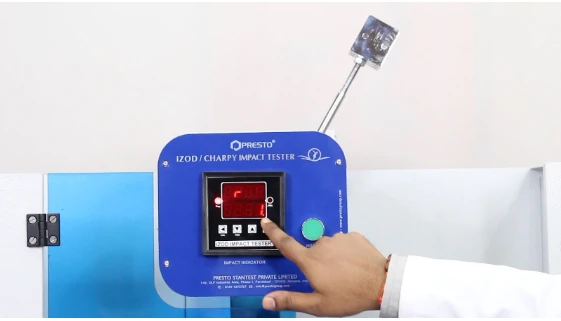
Do's and Don'ts for Operating the Izod Charpy Impact Tester
To get the most out of your Izod testing machine, a few do's and don'ts will be important for operation:
- Do Calibrate Regularly: Your tester must be calibrated at regular intervals. Inaccurate readings and wrong results might occur, and this can be caused by an incorrectly calibrated machine.
- Do Follow Standardized Procedures: Impact tests shall be performed according to ASTM or ISO standards. Thus, the result will always compare correctly.
- Do Check the Specimen: Always check the specimen before testing. This will make sure that the same is properly prepared. Discrepancies on a specimen would skew results.
- Do Record Results: Always store test results for traceability. This helps to identify trends, understand material behaviour over time, and meet regulatory requirements.
- Do Maintain the Machine: Regular maintenance in the form of lubrication of moving parts and cleaning of impact hammers is crucial for longevity and reliability.
Don'ts:
- Dont Overload the Tester: Avoid use of materials which exceed the energy capacity of the tester as this may damage the machine
- Don't Neglect Safety Measures: Wear safety equipment correctly when using the tester. Fast movement of the pendulum may be dangerous in case precautions are not taken
- Don't Neglect Regular Checks: Failure to check the wear and tear in parts will affect the functionality of the machine and the results obtained.
- Do Not Use Wet or Tainted Specimens: Moisture or other debris in the material may change its toughness reading and produce inaccurate tests.
FAQs
Q: How is the Izod test different from the Charpy impact tests?
A: The fundamental difference between the two tests is that, for the Izod test, the specimen is vertical and struck at one end. For the Charpy test, the specimen is kept horizontally and struck at its center,
Q: Is the Izod Charpy Impact Tester used for polymers?
A: Both the Izod and Charpy tests are commonly used on polymers that are impact-sensitive and must be tested for toughness at low temperatures.
Q: When do I know when my Izod testing machine needs maintenance?
A: Regular inspections should be monitored. Irregular readings, unusual noises, or physical wear on moving parts usually indicate that some amount of maintenance is required.
An Izod Charpy Impact Tester is a requirement in any business which uses the material's strength and toughness for its application. Because it permits an accurate measure of how much shock load a material can absorb, this equipment ensures that the products for usage do not hesitate through the shocks of real-life applications. With suitable application and periodic maintenance, your Izod testing machine will continue to deliver accurate results maintaining high levels of quality and safety for your products.
Understand the technical specs, follow best practices, and regularly perform maintenance upkeep to ensure that your tester is always able to work at its best so that you are in full confidence of meeting your material testing requirements.
Phone: +91 9210903903
Mail: info@prestogroup.com






Sign in to leave a comment.