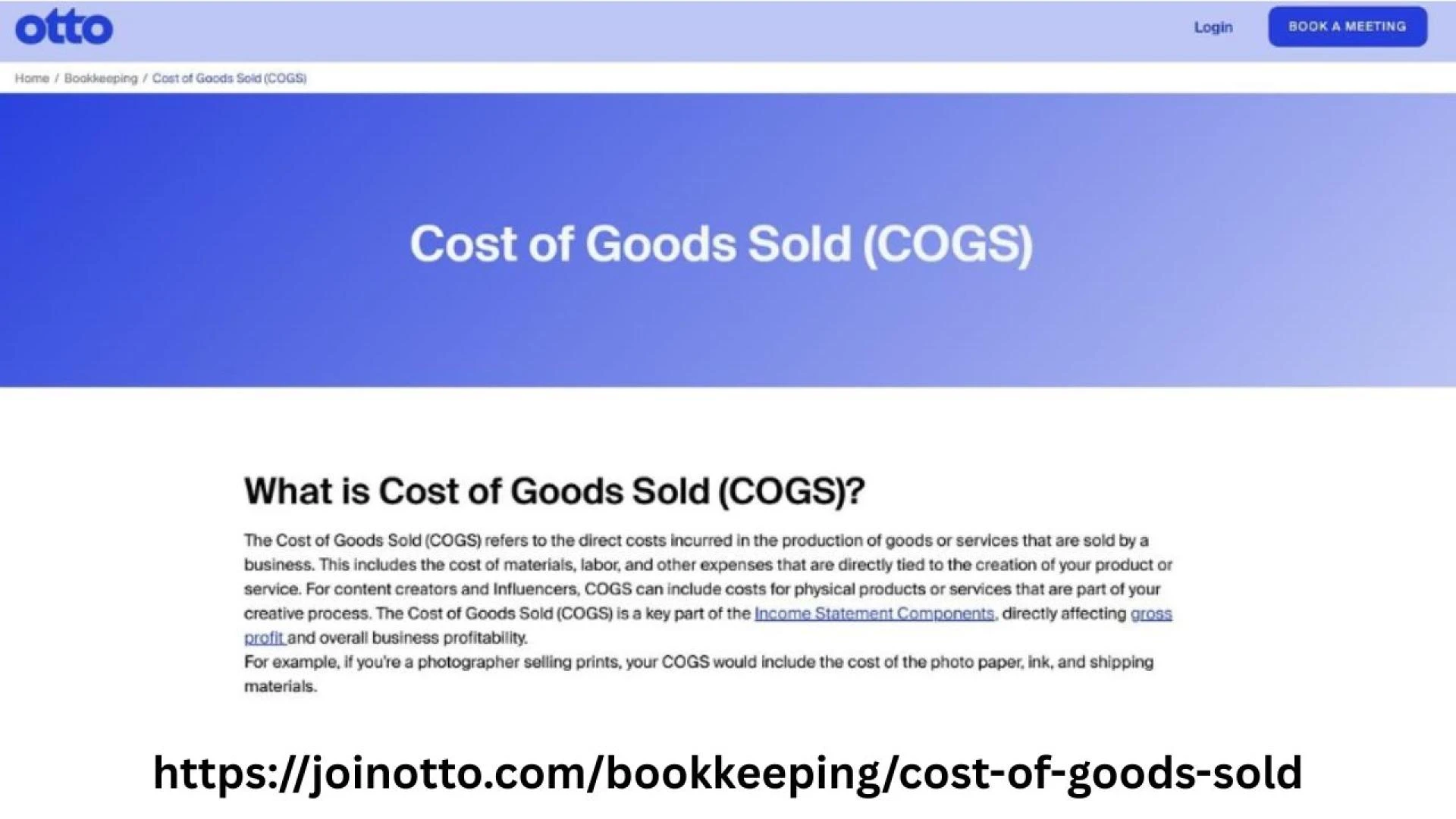

For small businesses and self-employed entrepreneurs, understanding the Cost of Goods Sold (COGS) is essential for accurately tracking profits, managing inventory, and filing taxes. Many small business owners are unsure about what is included in cost of goods sold, which can lead to misreporting financials or mispricing products. This informational guide, brought to you by Otto AI, is designed to clear that confusion and help you confidently manage your business finances.
What Is Cost of Goods Sold (COGS)?
Cost of Goods Sold (COGS) refers to the direct costs associated with producing or acquiring the products a business sells during a specific time period. It plays a major role in determining a business’s gross profit, which is calculated by subtracting COGS from total revenue.
In simple terms, COGS includes everything it takes to make or buy the products you sell — from materials to labor — but it excludes indirect expenses like marketing, shipping to customers, and administrative costs.
Why Understanding COGS Matters
Before diving into what is included in cost of goods sold, it's important to understand why this concept matters:
- Financial Planning: It helps you calculate the true profit margin on your products or services.
- Pricing Strategy: Knowing your COGS ensures your pricing covers costs and contributes to profit.
- Tax Deductions: COGS is tax-deductible, which can reduce your taxable income.
- Inventory Management: Accurate COGS helps track inventory use and waste.
With Otto AI’s intelligent reporting and finance tools, entrepreneurs can easily track and analyze their COGS without the hassle of manual calculation.
What Is Included in Cost of Goods Sold?
Understanding what to include in your COGS calculation is crucial. Here's a breakdown of the main components:
1. Raw Materials and Supplies
These are the basic materials used to create your products. For example:
- A jewelry maker includes silver, gold, or gemstones.
- A coffee shop includes coffee beans, milk, sugar, and cups.
Otto AI helps you categorize these expenses automatically, reducing errors and saving time.
2. Direct Labor Costs
These are wages paid to employees or contractors who directly work on the product or service. This includes:
- Assembly line workers
- Tailors in a clothing business
- Baristas in a coffee shop (if labor is tracked per product)
Note: General employee wages, like administrative assistants or salespeople, are not included.
3. Manufacturing Supplies
Any materials consumed during the manufacturing process but not necessarily part of the final product — such as glue, lubricants, or protective gear.
Otto AI can tag these expenses during upload or sync with inventory management software to allocate them correctly.
4. Shipping and Freight (Inbound Only)
The cost of getting raw materials or products to your place of business is included. For example:
- Freight fees to import leather for making bags.
- Shipping costs from a wholesaler.
Outbound shipping (to your customers) is not included in COGS.
5. Storage and Warehousing
The cost of storing inventory before it’s sold can be included — especially if it is necessary for production or part of the supply chain.
6. Packaging Costs
Packaging that is part of the product (like the box for a perfume bottle) is included. However, promotional or decorative packaging is not.
7. Utilities for Production
If you use utilities like electricity or water directly in your production process (e.g., to power machinery or clean materials), these can be proportionally included in COGS.
8. Factory or Workshop Rent (in some cases)
When a specific space is used solely for production, a portion of the rent may be included as part of the production cost. This is more common in manufacturing-based businesses.
What Is Not Included in Cost of Goods Sold?
Understanding what not to include is just as important:
- Sales and marketing expenses
- Office rent and utilities not tied to production
- Administrative salaries
- Outbound shipping or delivery to customers
- Interest on loans
- Depreciation on non-production equipment
Otto AI clearly distinguishes between these categories during expense tracking, ensuring you don’t mistakenly include non-COGS items in your tax or profit reports.
COGS for Different Types of Businesses
COGS calculations vary depending on the type of business you run:
1. Retail Businesses
COGS = Opening Inventory + Purchases – Closing Inventory
Example: A clothing boutique buys $5,000 worth of clothes, sells $3,500 worth, and ends the year with $1,500 in unsold inventory. Their COGS is $5,000 – $1,500 = $3,500.
2. Manufacturing Businesses
COGS = Raw Materials + Direct Labor + Factory Overhead – Ending Inventory
Example: A candle maker adds up all the wax, wicks, jars, labor hours, and workspace rent involved in producing the inventory.
3. Service-Based Businesses
COGS is not always applicable unless the service includes tangible goods. For example, a web designer may not have COGS, but a bakery offering catering services will.
Otto AI helps tailor your expense categories based on your business model so you can apply COGS accurately.
How Otto AI Simplifies COGS Management
Managing the cost of goods sold manually can be time-consuming and prone to error, especially for small business owners with limited accounting knowledge. Otto AI offers smart automation to:
- Track direct expenses in real time
- Auto-categorize materials, labor, and freight
- Integrate with POS and inventory systems
- Generate easy-to-understand COGS reports
- Offer tax-season-ready documentation
Final Thoughts
Understanding what is included in cost of goods sold is a foundational step in managing a successful business. It affects your profits, pricing, and taxes — all of which are critical for sustainability and growth. Whether you're crafting handmade items, running an online shop, or offering product-based services, accurately calculating and tracking COGS ensures you’re making informed decisions.
With Otto AI by your side, you don’t have to do it alone. From inventory tracking to COGS reporting, Otto AI empowers small business owners and self-employed professionals to run leaner, smarter, and more profitable operations.
























Sign in to leave a comment.