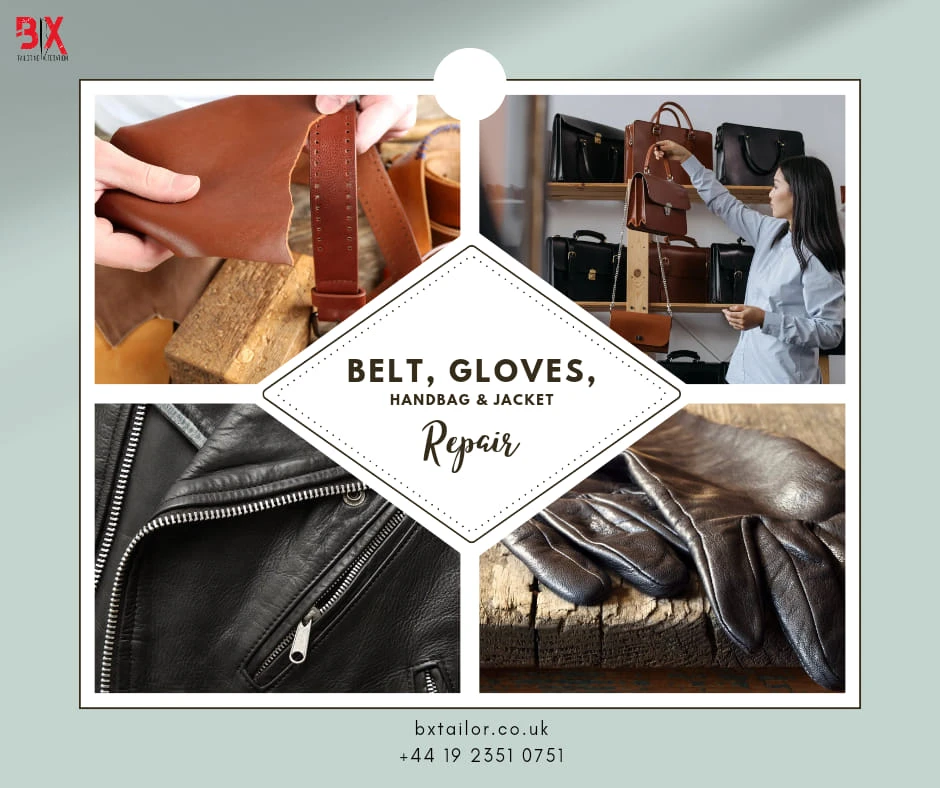
This gives information about the complex world of Leather Glove Repair and the delicate technical process of Glove Lining Replacement.
Why Glove Repair is a Specialist Craft
To understand why Leather Glove Repair is considered one of the most difficult disciplines in tailoring, one must look at the construction of the garment. A glove is a marvel of complex geometry. It consists of the "trank" (the main body), the "fourchettes" (the narrow strips of leather between the fingers), and the "quirks" (small diamond-shaped gussets at the base of the fingers that allow for maximum dexterity).
Because the leather used for gloves is typically much thinner and suppler than that used for jackets or shoes—often sourced from lambskin, goatskin, or peccary—it requires an incredibly steady hand. Standard sewing machines are often too aggressive for these delicate materials. At BX Tailor, much of our repair work is done by hand or using specialized "pique" or "prixseam" machinery that mimics traditional hand-stitching. This ensures that the repair doesn't just hold, but maintains the flexibility and "stretch" that makes a leather glove comfortable to wear.
Common Interventions in Leather Glove Repair
The most frequent issues brought to our studio involve structural failures caused by friction and tension. Because we use our hands for almost every daily task, the seams of a glove are under constant pressure.
Burst Seams and Fourchette Repair
The seams between the fingers are often the first to fail. If a thread snaps, the "fourchette" (the side panel of the finger) can begin to peel away. A professional Leather Glove Repair involves unpicking the compromised thread and restitching the panel using the original needle holes. This "hole-for-hole" technique is vital; creating new holes in thin leather can weaken the material, leading to a "perforation" effect where the leather tears like paper.
Elastic and Wrist Closure Restoration
For many winter or driving gloves, the elastication at the wrist eventually loses its "snap," causing the glove to slip. We can carefully open the wrist hem to replace the internal elastic or repair the snap-fasteners and buckles, ensuring the glove once again provides a secure, draft-proof fit.
The Hidden Luxury: The Necessity of Glove Lining Replacement
While the exterior leather provides the style and protection, the lining provides the comfort. The lining is the interface between your skin and the leather, responsible for moisture wicking, insulation, and the luxurious "hand-feel" of the garment. Unfortunately, linings are usually made from delicate materials like silk, cashmere, or wool, which wear out much faster than the leather shell.
Why Opt for Glove Lining Replacement?
Over time, the friction of your fingernails and the natural oils from your skin cause the lining to thin, develop holes, or become unhygienic soiled. A worn lining makes a glove difficult to put on and can cause the leather to stretch unevenly. Glove Lining Replacement is a transformative service that can make a decade-old pair of gloves feel brand new.
The Technical Process
Replacing a lining is a surgical procedure. It involves:
- Deconstruction: The original lining is carefully detached from the leather shell at the cuff.
- Pattern Creation: Because every glove has stretched differently over time, we use the original lining as a template but adjust the measurements to ensure the new lining fits the current "evolved" shape of the leather.
- Material Selection: At BX Tailor, we offer a range of premium replacement materials. For dress gloves, a 100% pure silk lining offers a sleek, friction-free fit. For winter warmth, high-grade Scottish cashmere provides unparalleled insulation.
Insertion and Finishing: The new lining is inserted and "blind-stitched" to the leather at the fingertips and the wrist, ensuring it stays perfectly in place without any visible external stitches.
Now for the best Leather Glove Repair, please visit https://bxtailor.co.uk/.



























Sign in to leave a comment.