
Many job seekers treat their LinkedIn profile as a copy-paste version of their resume — same bullet points, same phrasing, same structure, just online. It's an understandable shortcut, but it misses what LinkedIn is actually built for, which is exactly the gap a linkedIn profile optimization service is designed to close.
Two Different Jobs, One Document Mistake
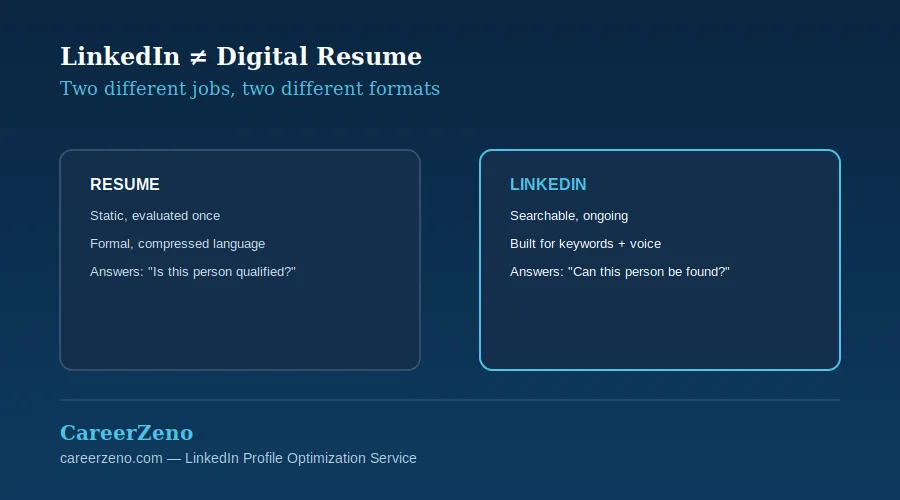
A resume is a static document evaluated once, usually after a candidate applies. LinkedIn is a searchable, ongoing profile that recruiters browse, filter, and revisit — often before an application even exists. Treating both the same way ignores that LinkedIn's primary function is discoverability, not just documentation. A resume answers "is this person qualified." LinkedIn answers "can this person even be found in the first place."
Where the Copy-Paste Approach Falls Apart
Resume bullet points are often written in a compressed, formal register that doesn't translate well to a platform built around searchability and tone. A resume line like "managed cross-functional stakeholder alignment" might read fine in a document a recruiter is actively evaluating, but on LinkedIn, where the same recruiter might be skimming dozens of profiles quickly, it does nothing to signal expertise or personality. LinkedIn rewards clarity and searchable keywords over formal density.
There's also a structural mismatch. A resume's "About" equivalent doesn't really exist — LinkedIn's summary section is a chance to establish voice and direction that a resume format doesn't have room for. Leaving it blank, or filling it with a copy-pasted objective statement, wastes one of the platform's most valuable pieces of real estate.
What Optimization Actually Means Here
Done properly, LinkedIn optimization isn't about rewriting a resume into a slightly different format. It's about rebuilding the profile around what the platform actually rewards: a headline built for search rather than title accuracy, a summary that adds context a resume doesn't have room for, and a skills section aligned specifically with what recruiters are filtering by.
Why This Distinction Matters More Now
As more hiring starts with a recruiter search rather than a job posting, profiles that function purely as resume clones increasingly underperform — not because the underlying experience is weak, but because the platform's actual mechanics were never accounted for.
This shift has been gradual but consistent. Recruiters increasingly rely on LinkedIn's own search and filtering tools to build shortlists before a single application arrives, which means visibility on the platform has become a prerequisite for many hiring conversations rather than a supplementary detail. A profile that was never optimized for search — because it was built to mirror a resume instead — simply doesn't surface in these early-stage searches, regardless of how strong the underlying experience is.
The Engagement Layer a Resume Doesn't Have
Beyond searchability, LinkedIn also rewards a kind of ongoing presence that a static resume was never designed to support — recent posts, comments, endorsements, and recommendations all contribute to how current and credible a profile appears. A resume is judged once, in isolation. A LinkedIn profile is judged continuously, often alongside signals of activity and engagement that a resume simply can't replicate. Ignoring this layer means leaving part of the platform's value entirely untapped.
CareerZeno treats LinkedIn as its own platform with its own rules, rather than a resume that happens to live online.


























Sign in to leave a comment.