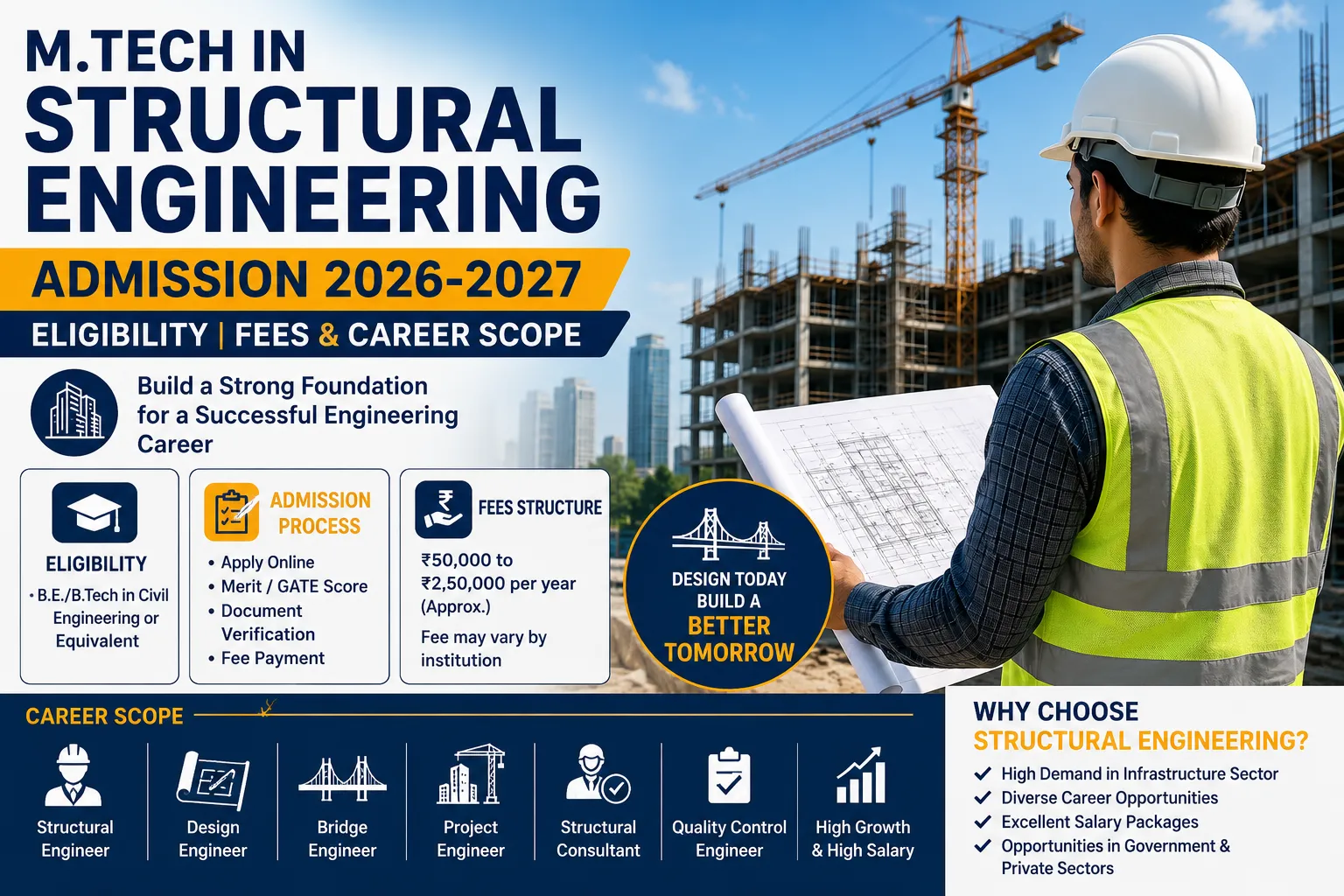

The construction and infrastructure sector is one of the fastest-growing industries in India. With increasing investments in smart cities, highways, metro projects, bridges, and high-rise buildings, the demand for qualified structural engineers is rising significantly. For civil engineering graduates looking to specialize in advanced design and structural analysis, M.Tech in Structural Engineering is an excellent postgraduate program.
If you are planning to pursue M.Tech Structural Engineering Admission 2026-2027, understanding the eligibility criteria, fee structure, admission process, and career prospects can help you make an informed decision.
What is M.Tech in Structural Engineering?
M.Tech in Structural Engineering is a two-year postgraduate degree that focuses on the design, analysis, planning, and construction of safe and durable structures. The program equips students with advanced technical knowledge related to concrete structures, steel structures, earthquake-resistant design, bridge engineering, and structural dynamics.
This structural engineering postgraduate course is designed to help students develop expertise in solving complex engineering challenges while ensuring the safety and stability of buildings and infrastructure projects.
M.Tech in Structural Engineering Course Details
The course is divided into four semesters and includes classroom learning, laboratory work, software training, research activities, and project work.
Major subjects covered in the program include:
- Advanced Structural Analysis
- Reinforced Concrete Design
- Steel Structure Design
- Prestressed Concrete
- Earthquake Engineering
- Structural Dynamics
- Finite Element Analysis
- Bridge Engineering
- Foundation Engineering
- Construction Materials Technology
Students also gain practical exposure through research projects and case studies, making them industry-ready professionals.
Eligibility for M.Tech in Structural Engineering Admission 2026-2027
To apply for Admission for M.Tech in Structural Engineering, candidates generally need to fulfill the following eligibility requirements:
- Bachelor's degree in Civil Engineering or an equivalent discipline.
- Minimum qualifying marks as prescribed by the university.
- Valid GATE score may be preferred in some institutions.
- Final-year engineering students may also apply subject to eligibility conditions.
Applicants should verify the specific eligibility criteria of their chosen institution before applying.
M.Tech in Structural Engineering Admission Process
The M.Tech in Structural Engineering admission process generally includes the following steps:
Application Form Submission
Candidates must complete the online or offline application form and provide accurate academic details.
Document Verification
Required documents such as mark sheets, degree certificates, identity proof, and photographs are verified by the institution.
Selection Process
Admission may be granted based on:
- Merit in qualifying examinations
- GATE score
- University-level entrance examination
Fee Payment and Confirmation
Selected candidates must pay the admission fee to secure their seat in the program.
Students interested in M.Tech Structural Engineering Admission 2026-2027 should apply early to avoid missing important deadlines.
M.Tech in Structural Engineering Fees
M.Tech in Structural Engineering fees vary from one institution to another. Factors such as infrastructure, laboratory facilities, faculty expertise, and industry collaborations influence the fee structure.
In India, the average annual fee generally ranges from ₹50,000 to ₹2,50,000. Additional expenses may include hostel charges, examination fees, and project-related costs.
Students are advised to review the complete fee structure before finalizing admission.
Career Scope After M.Tech in Structural Engineering
The career opportunities after completing M.Tech in Structural Engineering are vast. As infrastructure development continues to grow, qualified structural engineers are required across public and private sectors.
Popular job roles include:
- Structural Engineer
- Design Engineer
- Bridge Engineer
- Construction Manager
- Project Engineer
- Structural Consultant
- Site Engineer
- Research Engineer
- BIM Structural Engineer
- Quality Control Engineer
Graduates can work with construction companies, engineering consultancies, infrastructure firms, research organizations, and government departments.
Government Job Opportunities
Students completing this civil engineering specialization can explore opportunities in:
- Public Works Department (PWD)
- Central Public Works Department (CPWD)
- National Highways Authority of India (NHAI)
- Railways
- Metro Rail Corporations
- State Engineering Services
- Municipal Development Authorities
Government positions often provide excellent career stability, benefits, and growth opportunities.
Salary Prospects
The salary after completing M.Tech in Structural Engineering depends on skills, experience, and employer.
Average salary ranges include:
- Freshers: ₹4–8 LPA
- Experienced Professionals: ₹8–15 LPA
- Senior Structural Engineers and Consultants: ₹15 LPA and above
Professionals with expertise in advanced structural design software and large infrastructure projects can earn significantly higher salaries.
Apply Now for M.Tech in Structural Engineering
📞 Call Us: +91-9870200541
📧 Email: [email protected]
🌐 Apply Online: MUIT Lucknow Admission Portal
🏫 Visit Website: MUIT Lucknow Official Website
FAQs
1. What is the duration of M.Tech in Structural Engineering?
The course duration is generally 2 years, consisting of 4 semesters.
2. Who can apply for M.Tech in Structural Engineering?
Candidates with a Bachelor's degree in Civil Engineering or a related field can apply.
3. What are the main subjects in M.Tech Structural Engineering?
Subjects include Structural Analysis, Earthquake Engineering, Steel Structures, Concrete Technology, and Bridge Engineering.
4. What is the average fee for M.Tech in Structural Engineering?
The fee generally ranges between ₹50,000 and ₹2,50,000 per year depending on the institution.
5. Is GATE compulsory for admission?
No. Many universities offer admission based on merit or their own entrance examinations.
6. What jobs are available after M.Tech in Structural Engineering?
Graduates can work as Structural Engineers, Design Engineers, Consultants, Project Engineers, and Construction Managers.
7. Are government jobs available after completing this course?
Yes. Opportunities are available in PWD, CPWD, NHAI, Railways, Metro Projects, and other government organizations.
8. What is the salary after M.Tech in Structural Engineering?
Fresh graduates can earn between ₹4 LPA and ₹8 LPA, while experienced professionals can earn much more.
9. Is Structural Engineering a good specialization in Civil Engineering?
Yes. It is one of the most respected and high-demand specializations in civil engineering.
10. What is the future scope of Structural Engineering?
The future scope is excellent due to increasing infrastructure development, urbanization, smart city projects, and sustainable construction initiatives.



























Sign in to leave a comment.